
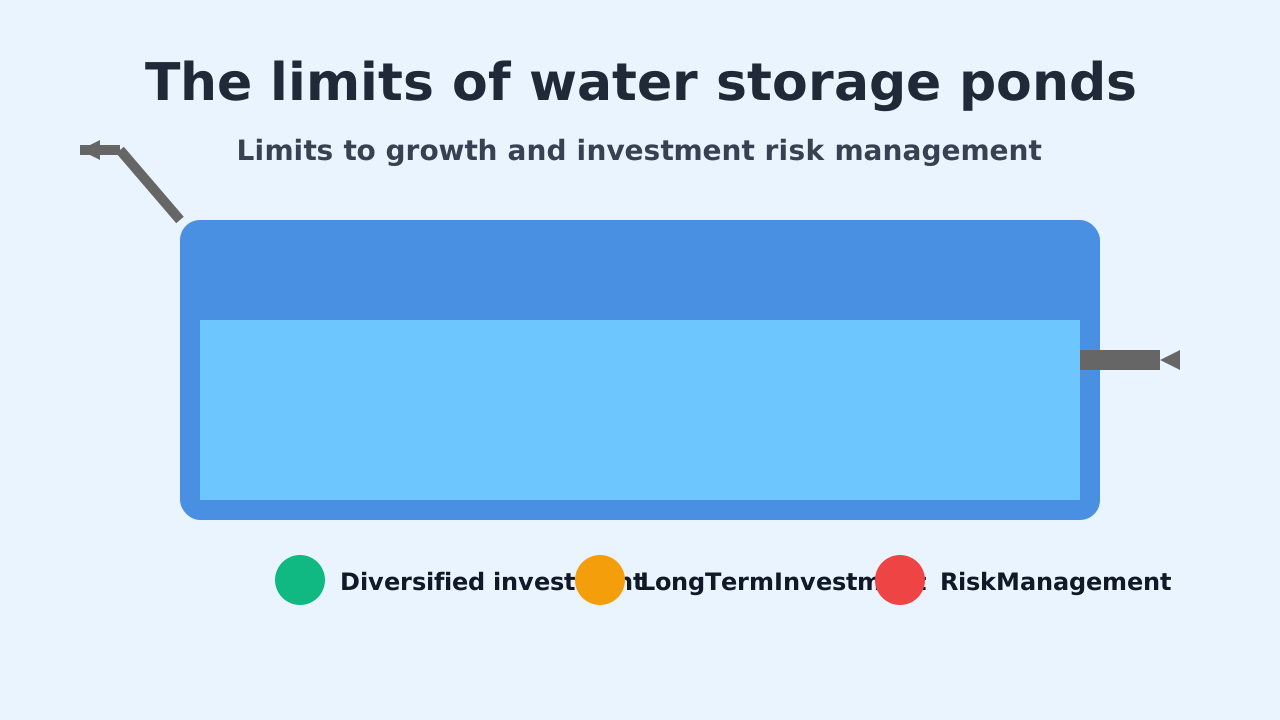
What is the limit of water storage ponds?
A water storage pond is a facility for storing rain and river water.
It's a convenient mechanism, but it's not universally accepted.
Water storage ponds have the following restrictions:
- There is a limit to capacity
- Balance between inflow and outflow is required
- It becomes dangerous if the water level rises too high
- Failure to manage will increase the risk of collapse.
Something quite similar happens in the investment world.
Even as funds continue to flow in,
- market size
- corporate profit growth
- consumer demand
- production capacity
- Investor's acceptable risk
has its limits.
In other words, there is no such thing as a "reservoir that continues to grow forever."
No matter how attractive an investment target may seem, there will always be capacity issues at some point. The more popular the theme, the more difficult it is to see this upper limit.
What happens if you replace it with an investment?
Using the metaphor of a water storage pond makes it easier to understand points that are often overlooked when investing.
There are three things I want to focus on first:
- Capital inflow alone will not grow
- Diversified investment is similar to having multiple water storage ponds.
- Long-term investing is like water level management.
Let's look at them in order.
1. Capital inflow alone will not grow
For beginners, when looking at popular investment targets,
If everyone is buying, won't it still go up?
I tend to think that.
In the short term, that view may be correct.
However, popularity is not the only thing that will support prices for a long time. Popularity is close to water inflow, profit is close to embankments and drains.
What really matters are the following entities:
- sales
- profit
- production capacity
- Sustainability of demand
- cash flow
Even if a large amount of water flows into the reservoir, it can be dangerous if the drainage equipment and embankments are weak.
Even in investment, if only funds are collected and actual growth cannot keep up, it approaches a bubble. Although the water level is rising, the saucer is not expanding.
We not only look at whether funds are coming in, but also whether there is enough profit and market size to receive the funds. If you don't look at this, you'll confuse the reasons why things are going up and the reasons why they keep going up.
2. Diversified investment means having multiple water storage ponds
Relying on only one reservoir increases the impact when a problem occurs.
For example,
- drought
- flood
- Equipment failure
- management error
If this happens, the entire water supply in the area becomes unstable.
The same goes for investing.
If you focus too much on one asset, one country, or one theme, your entire household finances will be shaken when that market collapses.
The roles of typical assets can be organized as follows.
| assets | Main role |
|---|---|
| stocks | go for growth |
| bond | Compensate for the stability of price movements |
| cash | Ensure livelihood protection and liquidity |
| ETF | Easy to disperse even small amounts |
Diversification is not a way to give up on making money.
This is a system that prevents the entire water supply from being interrupted even if one water storage tank is malfunctioning. There are times when you can greatly increase your investment by concentrating your investments, but if you keep your living funds in the same place, there will be no way out if your finances collapse.
In actually continuing asset management, `a design that does not leave you midway'' is just as important as `the ability to increase significantly.''
3. Long-term investing is like managing water levels.
Good managers don't panic by watching the water level every minute.
Rather,
- See long-term rainfall
- View inflow and outflow trends
- Respond only when water levels are dangerous
- Regularly inspect equipment
Take that action.
The same goes for investors.
Continuing to react to daily price movements can lead to short-term decisions. It's like seeing only the shaking of the water surface and not seeing the strength of the embankment.
For long-term investments, the following management is more realistic.
- Continue to invest
- hold for long term
- Review your asset allocation only a few times a year
- Separate living funds and investment funds
Rather than looking at the water level every day and worrying about it, create a design that prevents it from overflowing in the first place.
In investment terms, this is asset allocation and risk management.
When the reservoir bursts
Even in the market, there are situations where the water reservoir is close to bursting.
The following situations are likely to be red flags:
- excessive leverage
- extreme optimism
- Price increase that exceeds reality
- Concentration of funds in one direction
- An atmosphere of “this time is different”
A water reservoir will overflow if it exceeds its capacity.
Even in investments, concentrating funds without considering risks can lead to large losses.
What you want to be especially careful about is when you can't explain why the price is going up.
If you buy something just because it's popular, or because it's a hot topic, or because you saw it on social media, you can't judge whether the water level is really safe. The more you can't explain the reason for the rise, the less likely you are to have any basis for holding on when it goes down.
Points that beginners tend to misunderstand
The following is a summary of the misconceptions that beginner investors often run into using the metaphor of a water storage pond.
| misunderstanding | actually |
|---|---|
| Popular assets will rise forever | There is a limit to growth |
| It is safe if there is a large inflow of funds. | Easy to overheat without physical growth |
| You can't make money if you diversify | This will be a defense against leaving midway through the game. |
| Short-term trading is more advantageous | Long-term investments are often easier to reproduce. |
| cash is a waste | Protect your life and provide extra power in the event of a market crash. |
The important thing here is not to view cash and diversification only as "protection."
Because you have extra power, you don't have to panic when the market goes down.
Since the water level is stable, operation can continue for a long time.
behavioral framework
If you are having trouble making an investment decision, it will be easier to sort it out if you think about it in the following order.
- Where does water come from? What are the sources of profit?
- Is there enough capacity? What is the market size?
- Is there a risk of collapse? Are debt and leverage excessive?
- Are there other water storage ponds? Is there a destination for distribution?
- Can it be maintained over the long term: Is it a design that you can continue with?
Just by checking these five points, you can reduce the number of times you jump into overheated investment targets.
Especially for beginners, it is easier to stick with "management that is difficult to break" first, rather than trying to select perfect stocks from the beginning.
Summary
The “reservoir limit” is a simple metaphor for understanding the essence of investing.
The points are as follows.
- There are limits to growth
- Capital inflow alone does not create value.
- Diversified investment is similar to having multiple water storage ponds.
- Risk management is to prevent collapse.
- Long-term investment is more like water level management than daily price movements.
When investing, consider not only `how much water can get in'' but also `how safely it can be maintained.''
The power to increase and the mechanism to protect.
Combining both of these will result in long-term asset management. The difference in design will be more noticeable in situations where there is a risk of overflowing, rather than situations in which there will be an increase.