
What is the Taiyo Line?
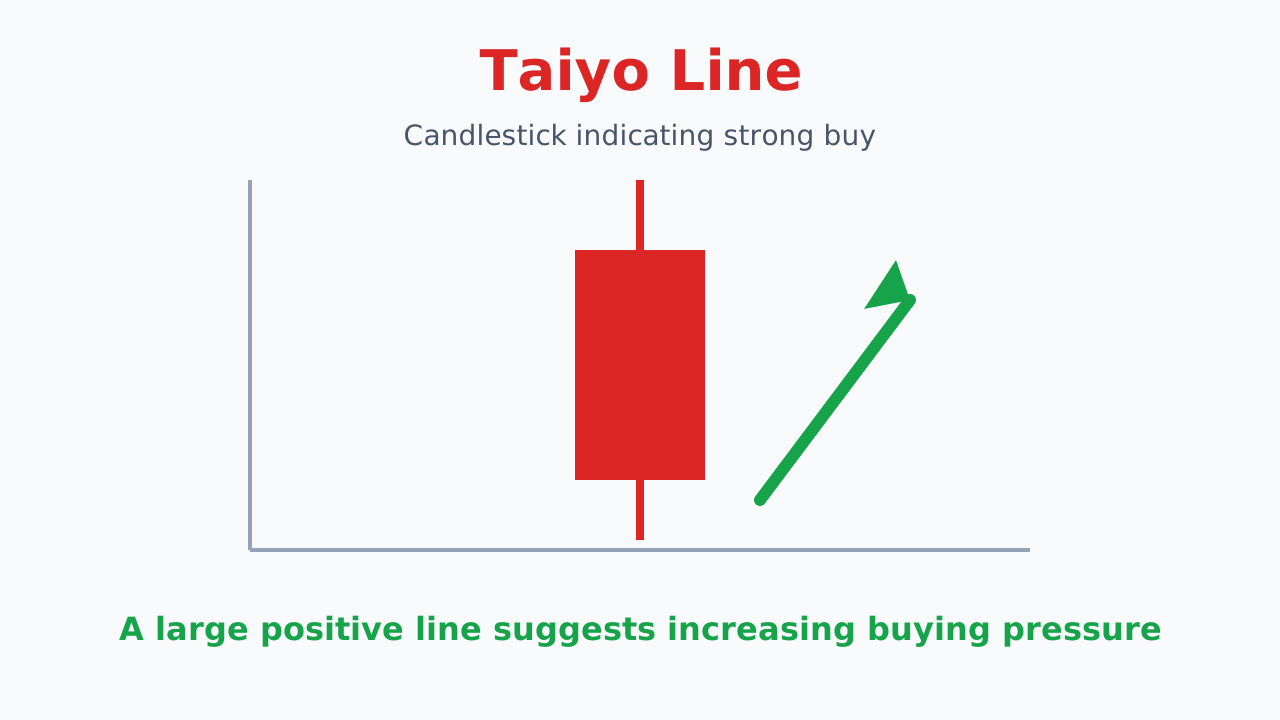
The Taiyo line is a positive line with a large candlestick body.
A positive line is a candlestick whose closing price is higher than its opening price.
Among them, the one that rises significantly from the opening price to the closing price is called the Taiyo line.
High price │
      █
      █
      █
      █
Low price │
This indicates that there were strong buyers and the stock price rose significantly during the trading session. The closer the closing price is to the high price, the more likely you are to buy until the close.
Features of Taiyo Line
| Points to see | meaning |
|---|---|
| body is large | strong buying pressure |
| closing price close to high | Buying continued until the close |
| high trading volume | The number of participants is increasing |
| come out after the fall | Possibility of reversal |
The Taiyo line is a candlestick that visually shows buying momentum.
However, there is no clear unified standard as to how large it must be to qualify as the Taiyo line. It is practical to check whether the price is large compared to the past price range or the stock's usual volatility.
Main scenes where the Taiyo line appears
The Taiyo line is more likely to appear in the following situations.
- Good financial results were announced
- There was an upward revision
- Stock buyback announced
- I ran out of bad material
- There was a short sale buyback.
- The entire market rebounded sharply
Even the same Taiyo Line has different meanings depending on the background.
Taiyo Line, which is accompanied by improved financial results and performance, may be likely to continue to be bought. Taiyo Line, where the material is not clear, may end up with only short-term buybacks. Even if the positive line is the same, you will make a mistake in judgment unless you look at the reason why the funds were received.
How to use the Taiyo Line
1. See it as a reversal sign
If the Taiyo line appears after a continued decline, the selling may have come to an end.
In particular, if the stock breaks out of a downtrend with high trading volume, there may be a combination of buybacks from sellers and new purchases. This is the scene where I want to see if the tide has changed.
2. Check for breakouts
If the Taiyo line breaks above the resistance line or recent high, it may be determined that the buying momentum is strong.
However, there are also "deceptions" that stall immediately the next day.
What we want to see is whether the stock price can be maintained after breaking out. If it gets pushed right back the next day, it might not be as strong as it looks.
3. Use it as a guideline for taking profits
If the Taiyo line appears in the stocks you own, a strong rise is a good sign.
However, it can overheat in the short term.
If the upper beard becomes longer after the Taiyo Line, or if the trading volume stagnates after a sudden increase, there may be an increase in profit-taking selling.
Mistakes that beginners often make
I jumped when I saw the Taiyo Line.
The Taiyo Line stands out, so beginners will want to buy it. This is because it looks the strongest on the chart screen.
However, if you buy after the stock has risen significantly, you may end up grabbing a high price.
Before you buy, check why the price has gone up. The next day's outlook will change depending on whether it's a good financial result, a buyback from short sellers, or just a rise in the index.
don't look at volume
Taiyo Line, which has low trading volume, may have low confidence in buying.
Volume is important to see whether it is a full-fledged capital inflow or a temporary price movement.
ignore the upper beard
Even on the Taiyo Line, you need to be careful if your upper beard is long.
This is because a high price means a sell-off, and a close price means a pullback.
practice framework
Once you find the Taiyo Line, check it in the following order.
- Where did you come out?
- Is trading volume increasing?
- Do you have materials and financial statements?
- Isn't your upper beard long?
- Is it breaking above the resistance line?
- Can the value be maintained even after the next day?
Summary
The Taiyo line is a candlestick that indicates strong buying.
- The closing price is much higher than the opening price
- Indicates increasing buying pressure
- After a fall, it may become a reversal sign.
- If the resistance line is broken, it can be used to confirm a breakout.
- Be sure to check the yield and materials
Taiyo line is a strong sign. However, this is not a reason to buy on the fly.
Check the background and use it in conjunction with risk management. On the day when the price goes up, you should first set out the reason for buying and the conditions for withdrawal.