
What is a crosshair?
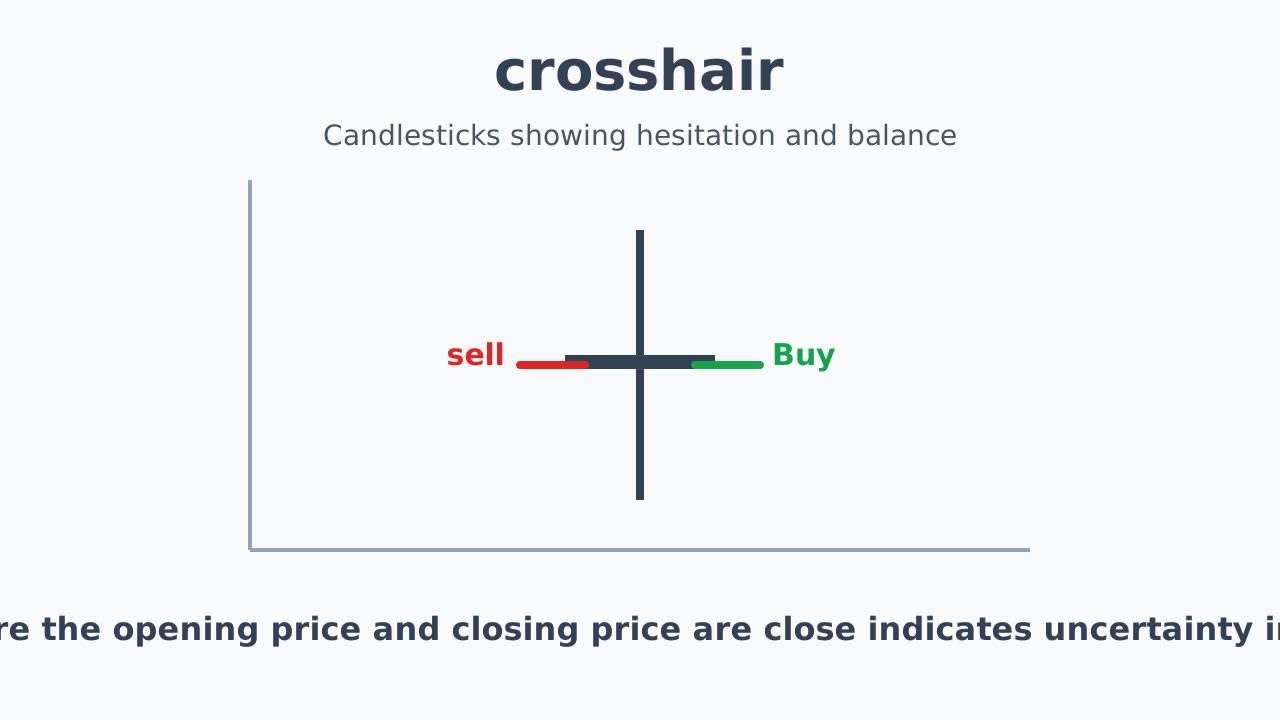
A crosshair is a shape in which the opening and closing prices of a candlestick are almost the same, and the substance is very small.
  │
──┼──
  │
This indicates that the price moved up and down during the trading period, but eventually returned to around the opening price and closed.
In other words, there is no clear winner for either the buyer or the seller.
Characteristics of crosshairs
| Points to see | meaning |
|---|---|
| substance is small | Opening and closing prices are close |
| have upper and lower beards | It swayed up and down in the middle |
| exit in the high price range | Beware of slowing upward momentum |
| exit in the low price range | Beware of slowing down momentum |
The crosshairs are candlesticks that indicate market uncertainty.
However, you can't tell whether it's going up or down just by looking at the crosshairs. Even though the shape of the crosshair is the same, the way it is perceived differs between the crosshair at a high price and the crosshair after a fall.
Why the crosshair is attracting attention
The crosshairs attract attention because they indicate that the momentum of the trend may have stopped.
In a market that continues to rise, buyers have the upper hand.
When a crosshair appears there, you will see something like this:
Buying momentum may have weakened.
Profit-taking selling may be increasing
I may be waiting for the next material.
On the other hand, if the crosshairs appear in a market that continues to decline, it may mean that the selling has come to an end. However, the buyer has not yet won. The sense of distance is just right, just that I was confused.
Types of crosshairs
Crosshairs come in several shapes.
| type | Features | way of seeing |
|---|---|---|
| standard crosshair | Relatively equal upper and lower whiskers | Hesitation/Equilibrium |
| dragonfly | long lower beard | Possibility of buying at a low price |
| Toba | long upper beard | Possibility of selling at a high price |
| long leg crosshairs | long upper and lower beard | I'm very confused |
Don't judge by the shape alone; check where it appears. The crosshairs are more about context than form.
How to use the crosshairs
1. See it as a pause in the trend
The crosshairs can be used as a sign that the market momentum has stopped.
If the stock is in an uptrend, the buying momentum may have slowed. If the stock is in a downtrend, the selling momentum may have weakened.
2. Check the next candlestick
It is difficult to tell the direction with just the crosshairs. Rather, it is more natural to think of it as a foot that has not been able to decide on its direction.
Therefore, the next candlestick is important.
- A positive line appears after the crosshairs
- A hidden line appears after the crosshairs
- break through highs and lows
- Volume increases
These next moves confirm the direction of the market.
3. Differentiating the meaning of high price range and low price range
If the crosshairs appear in the high price range, the upward momentum may be slowing down.
If the crosshairs appear in the low price range, the selling may have run its course.
Even the same crosshair has a different meaning depending on where it appears.
Mistakes that beginners often make
Think of the crosshairs as an immediate turn signal.
Crosshairs are a sign of hesitation, but they do not necessarily mean a trend change.
Sometimes it ends with a pause during the ascent. Sometimes it ends with a short break during the decline.
don't wait for the next leg
The crosshair is a candlestick with a weak sense of direction.
Therefore, it is more realistic to check the next candlestick than to buy or sell the moment it appears. There are many situations where it is not too late to wait until you see whether the price will break above the high price or break below the low price.
don't look at volume
Crosshairs with high trading volume may indicate that market participants are highly uncertain.
A crosshair with low volume may simply mean low trading.
practice framework
Once you find the crosshairs, check them in the following order:
- High price range or low price range?
- After a rise or a fall?
- What is the length of the upper and lower beard?
- Is trading volume increasing?
- Which way did the next candlestick move?
- Is it near important support/resistance levels?
Summary
Crosshairs are candlesticks that indicate confusion between buyers and sellers.
- Opening and closing prices are almost the same
- Indicates market uncertainty/balance
- Beware of slowing down in high price ranges
- Beware of a round of decline in low price areas
- Check the direction on the next candlestick
The crosshairs are not used to make buying or selling decisions on their own.
View it as a sign that the market is looking for its next direction. If you can just take a breather there, you can significantly reduce unnecessary buying and selling.