
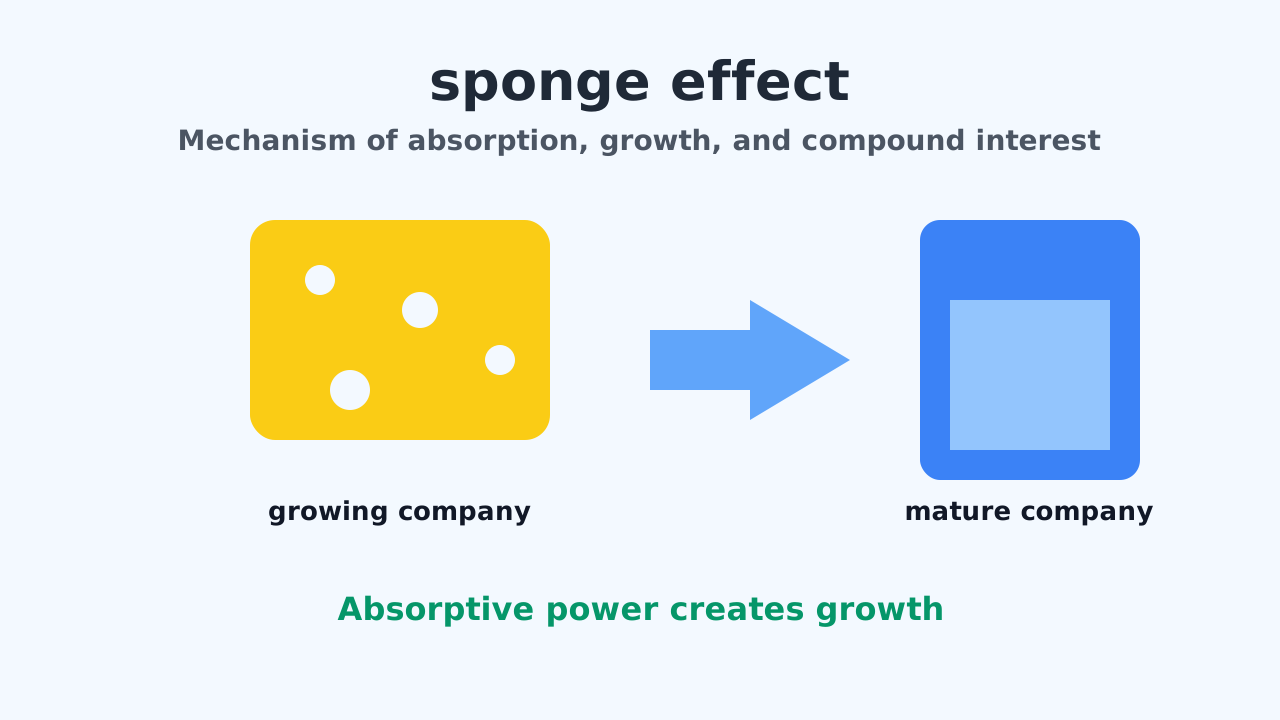
What is the sponge effect?
Sponges absorb water.
In dry conditions, they can take in a lot of water, but they cannot do so indefinitely.
The sponge has the following characteristics:
- There is an upper limit to the amount of absorption
- When it gets saturated, you can't breathe anymore
- If you squeeze it hard, water will come out.
- As it gets older, its absorption capacity decreases.
A similar phenomenon exists in the investment world.
Companies and markets grow by absorbing the following:
- funds
- human resources
- technology
- information
- customer demand
If you look at this as an investment metaphor, you can call it the "sponge effect."
In short, growth is the process of taking in resources from outside and converting them into profits and value. Just smoking is not enough. Let's take a look at how the water is used.
Sponge effect in investment
The sponge effect is an easy-to-use concept when looking at the growth stages of a company.
Here, we will look at three categories: growing companies, mature companies, and sharp market declines.
1. Growing companies are dry sponges
Early growth companies are like dry sponges.
There is still room in the market, it is easy to increase the number of customers, and the invested funds are easily linked to sales and profits.
For example, companies such as:
- can acquire new customers
- Can expand market share
- Incorporate technological innovation
- Use investment funds for growth
- There is room to improve profit margins
At this stage, sales and profits can increase significantly.
One of the reasons investors look at growth companies is this "absorption room."
However, even if it looks like a dry sponge, whether it can actually absorb water is another matter. Even if you raise funds, if your product capabilities, sales capabilities, recruiting capabilities, and fund management are weak, you will not grow as much as expected. The scary thing about growth stocks is that instead of having room for absorption, the expectation that ``they should be able to absorb'' is what drives them forward.
2. Mature companies are saturated sponges
As a company grows, its absorption capacity changes little by little.
For companies that already have a high market share and a wide customer base, growth rates may not be as high as they used to be.
Mature companies are more likely to experience the following changes:
- market matures
- growth rate decreases
- It becomes difficult to acquire new customers
- competition becomes fiercer
- Growth is limited even with large investments
This is similar to a sponge that has absorbed all the water.
Of course, this does not mean that mature companies are bad.
Mature companies may have stable profits, dividends, brand power, and strong financial foundations.
However, it is dangerous to think that it will continue to grow at the same speed as it did in the early stages of growth. If stock prices are priced in with high expectations, even a slight slowdown in the growth rate may result in a large sell-off. This is where things get sold even though the numbers aren't bad.
3. A sudden drop in market prices is a movement to squeeze the sponge.
When the market becomes unstable, funds can go out all at once.
Specifically, the movements are as follows.
- Profit selling
- outflow of funds
- risk avoidance
- Deleveraging
- Withdrawal of funds from investment themes
This is similar to squeezing a sponge.
Prices may drop significantly because the funds that were previously absorbed are released in a short period of time. The less liquid a stock is when it rises, the more likely its price will jump the moment more people want to sell.
The important thing here is that a collapse does not necessarily mean a complete negation of corporate value.
If the market as a whole becomes risk averse, even good companies will be sold. On the other hand, the more a company has been bought than it actually is, the more likely it is that the price will fall more significantly if funds are withdrawn.
Relationship with diversified investment
Relying on only one sponge increases the impact when a problem occurs.
If the sponge becomes damaged, becomes too dry, or loses its absorbent capacity, the overall water management becomes unstable.
The same goes for investing.
If you focus on only one stock, one country, or one theme, you will be susceptible to large losses if the absorption capacity of that investment target declines.
The roles of typical investment targets can be organized as follows.
| Investment target | Expected role |
|---|---|
| stocks | capture growth |
| ETF | widely dispersed |
| bond | Mitigating price fluctuations |
| cash | Be prepared for emergencies |
Diversified investing is not about throwing away profits.
This is a system that combines assets with different absorption capacities to prevent the whole from collapsing even if one part stops functioning. This is the meaning of mixing assets that capture growth with assets that suppress price movements.
Sponge effect and compound interest
Compound interest is important in investing.
Compound interest is a system in which profits generate further profits.
Expressed as a formula, it looks like this:
A = P × (1 + r)^nHere, P is the principal, r is the yield, n is the operation period, and A is the future amount.
Combining the sponge effect and compound interest creates the following flow.
- absorb new funds and demand
- reinvest the profits earned
- grow further
- The increased profits will become your next investment surplus.
Companies that do this well can grow significantly over the long term.
However, compound interest is not magic. The premise is that the yield will continue to be stable, that it will not deteriorate significantly along the way, and that the yield will not be grabbed at a high price due to excessive expectations. If it decreases significantly, it takes time just to restore it.
Misconceptions that beginners often fall into
Considering the sponge effect makes it easier to sort out the misconceptions that beginner investors tend to fall into.
| misunderstanding | actually |
|---|---|
| Growing companies grow forever | Growth rates often decline gradually |
| The absorption capacity of popular brands is limitless. | There is a limit to market size |
| A crash is proof of failure | Sometimes it's a normal market correction. |
| Diversification only reduces profits | Useful for risk management |
| Compound interest always increases | Yield, period, and loss management are necessary |
What you need to be especially careful about is confusing `the amount you are absorbing'' with `room that can be absorbed in the future.''
The more money that has already been invested in an investment, the greater the performance required for its next growth.
How to use it in practice
When looking at investment targets, it will be easier to organize by checking the following five things.
- Is there still room for growth?
- Can we absorb new markets?
- Can profits be reinvested?
- Is the financial base sound?
- Are you able to diversify your investments?
Just like how much water a sponge can absorb, we look at how much capital, demand, human resources, and technology a company can absorb.
Just by having this perspective, it will be easier to reduce the decision to "buy it because it's popular." Does it have enough absorption capacity or has it already been absorbed? Let's consider that separately.
Summary
The sponge effect is an easy-to-understand concept when it comes to understanding investing.
The points are as follows.
- Growing companies are like dry sponges
- Mature companies tend to have lower absorption capacity
- A market decline is like squeezing a sponge.
- Increases growth potential when combined with compound interest
- Diversified investment can reduce imbalances in absorption capacity.
When investing, think not only about "how much you are absorbing now," but also "how much you can absorb in the future."
Look at both the room for growth and the limits.
Just having that perspective will make it easier to avoid excessive expectations and over-concentration. While room for growth is attractive, signs of saturation also appear on the same screen.