
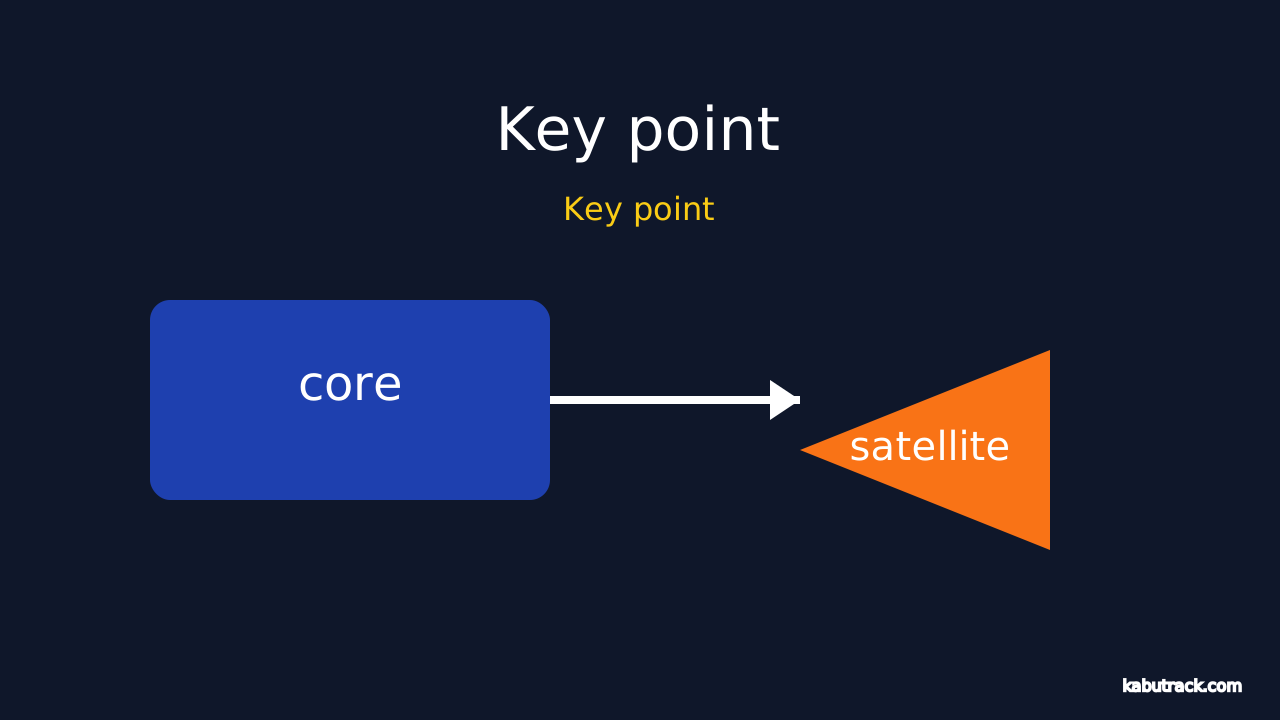
What is satellite investment?
Satellite investments are
This is a strategy part to increase returns.
Roles need to be clearly separated.
- Core: Stable/take market average
- Satellite: Attack and aim for excess return
If this becomes ambiguous, the entire portfolio becomes unstable.
Basic rule: ratio is everything
The conclusion is simple.
Satellite up to 10-30%.
Beyond this range,
- Price movements become rough
- Reproducibility of investment decisions decreases
- become easily influenced by emotions
As a result, it becomes harder to win in the long run.
Three types of satellites (sources of return)
The important thing is to keep them separate.
Income type (high dividend)
- Dividend income is the main focus
- Easy to provide a cushion during a downturn
Suitable situations:
- high interest rate environment
- When the market is flat
Value type (cheap stocks)
- Stock price rise due to undervaluation correction
- Strategies to address market distortions
Suitable situations:
- Early economic recovery
- Growth stocks are adjusting
Growth type (growth stocks)
- Driven by sales and profit expansion
- Aim for a big price increase
Suitable situations:
- Interest rate decline phase
- A period of accelerating technological innovation
By combining these three,
The structure is adaptable to any market environment.
Market environment as of 2026
Here are some highlights from the last few months:
- Interest rates remain high
- Increased volatility in tech stocks
- Widening performance gap between sectors
In this environment,
- Growth concentration is high risk
- Incorporating dividends and value is effective
In other words,
This is a situation where balanced satellites tend to function.
Practical portfolio example
If satellite is 20%:
- High dividend: 8%
- Value: 6%
- Growth: 6%
The point is clear.
Don't be biased towards one or the other.
This alone can greatly reduce the amount of risk.
Trading rules (most important)
The difference in satellite investment is the buying and selling rules.
Profit rules
- Partial profit taken at +20~30%
- Reduce position when overheating
stop loss rules
- -15~20% review
- Withdraw if the premise collapses
The important thing is that
Must be decided in advance.
Without rules, all decisions are driven by emotion.
common mistakes
Satellites take center stage
→ Entire portfolio becomes high risk
Concentration on theme stocks
→ Even if you win in the short term, you will collapse in the long term.
Buying and selling without rules
→ Loss of reproducibility
The essence of satellite investment
Satellite investment is
It's not something you can rely on.
It is designed to accumulate probabilities.
rather than individual successes,
It is important to create a winning structure.
Summary
- Keep satellites to 10-30%
- Diversify the sources of returns
- Adjust the balance according to the environment
- Set trading rules in advance
And most importantly,
Do not destroy core assets.