
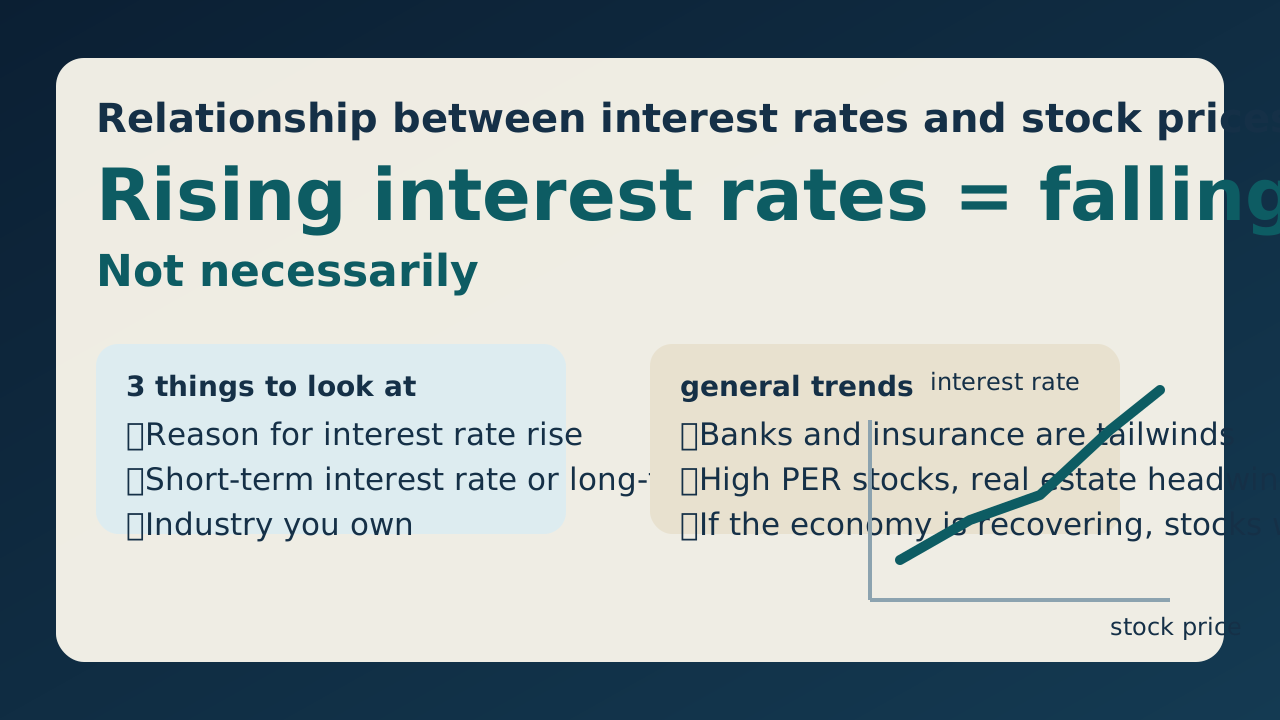
Why are interest rates and stock prices related?
In conclusion, the ``discount rate'' used to calculate corporate value changes the company's financing costs.
When interest rates rise, the discount rate at which future profits are revalued to present value tends to rise. As a result, stocks that have high expectations for future profits are more likely to be undervalued.
At the same time, companies' borrowing costs and investors' expected returns are likely to rise. Interest rates are therefore a variable that drives the assumptions underlying stock prices.
basic pattern
First, let's organize the general outline.
| interest rate movements | General impact on stock prices | reason |
|---|---|---|
| interest rate rise | easy to fall | Increase in discount rate, increase in borrowing burden |
| interest rate decline | easy to rise | Lower discount rate, improved financing environment |
| Rapid interest rate rise | Large fluctuation | Valuation adjustment is likely to occur |
| Economic recovery and interest rate rise | It may go up | Expectations for profit growth outweigh interest rate increases |
What is important is to look not only at interest rates but also at ``why interest rates are moving.''
Why stock prices tend to fall when interest rates rise
1. Discount rate increases
Stock prices are often explained in terms of the present value of future profits.
interest rate rise → Discount rate increase → The present value of future profits decreases
This trend tends to make growth stocks with particularly high P/E ratios fall.
2. Increased financing costs for companies
Companies that are highly dependent on borrowing are likely to pay more interest due to rising interest rates. Companies with heavy real estate and capital investment burdens, and companies with high financial leverage are likely to experience headwinds.
3. Stocks become less attractive compared to bonds
When interest rates are low, bond yields are low, making it easier for investors to invest in dividend stocks and growth stocks. Conversely, when interest rates rise, bond yields improve, making stocks less attractive.
Why stock prices can still rise as interest rates rise
This is important in practice.
If a rise in interest rates is accompanied by an "economic recovery" or "improvement in corporate profits," stock prices may rise.
For example,
- economy is strong
- Corporate sales increase
- Wage increases and capital investment progress
In such a situation, expectations for profit growth may outweigh a slight rise in interest rates.
In other words, it is necessary to separate bad interest rate increases from good interest rate increases.
| Types of interest rate increases | How to view stock prices |
|---|---|
| economic recovery type | neutral to bullish |
| worsening inflation type | easy to become timid |
| Fiscal instability/government bond selling pattern | easily destabilized |
Impact by industry
The impact of interest rate changes is not uniform.
Areas prone to tailwinds
- Banks: Interest margins are likely to improve
- Insurance: Improvement in investment yield is likely to be a tailwind
- Some trading companies and resource stocks: Can be strong when coinciding with an inflationary phase
Areas prone to headwinds
- High P/E growth stocks: susceptible to higher discount rates
- Real estate: Rising borrowing costs tend to be a burden
- Retail/restaurant: Difficult if economic slowdown and cost increases overlap
Three points investors should look at
In conclusion, we look not only at the level of interest rates, but also at the background, speed, and industry.
1. Short-term interest rate or long-term interest rate?
In addition to policy interest rates, long-term interest rates such as the 10-year government bond yield are also important. There are situations in which long-term interest rates are more effective for stock price valuation.
2. What is the reason for the rise in interest rates?
The meaning changes depending on whether it is an improvement in the economy, worsening of inflation, or a decline in policy confidence. The same rise in interest rates can be good or bad for stock prices.
3. What type of stocks do you own?
The impact will differ depending on whether there are many high-growth stocks, many dividend stocks, or many financial stocks. When looking at interest rate news, it is more practical to first check the impact on your portfolio rather than the overall index.
Points that beginners tend to misunderstand
- If interest rates rise, stocks do not necessarily fall.
- If interest rates fall, stocks will not necessarily rise.
- Interest rates alone cannot explain market conditions.
Stock prices are influenced by interest rates, the economy, corporate performance, supply and demand, and exchange rates. Although interest rates are a very important factor, it is dangerous to make buying and selling decisions solely on their own.
Summary
- Interest rates affect stock price discount rates and financing costs
- In general, rising interest rates are a burden on stock prices, while falling interest rates tend to be a tailwind.
- However, if interest rates rise due to economic recovery, stocks may rise.
- Banking and insurance are relatively tailwinds, while high PER stocks and real estate tend to be headwinds.
- It is important to check not only the interest rate level but also the background, speed, and industry.
When you see interest rate news, first think about why interest rates have gone up and how they will affect the stocks you own.