
First, the conclusion
Operating cash flow is one of the most important indicators of a company's ``cash generation ability''.
Profit on the income statement is an accounting number, but operating cash flow can be read as if it were actually cash coming in or going out.
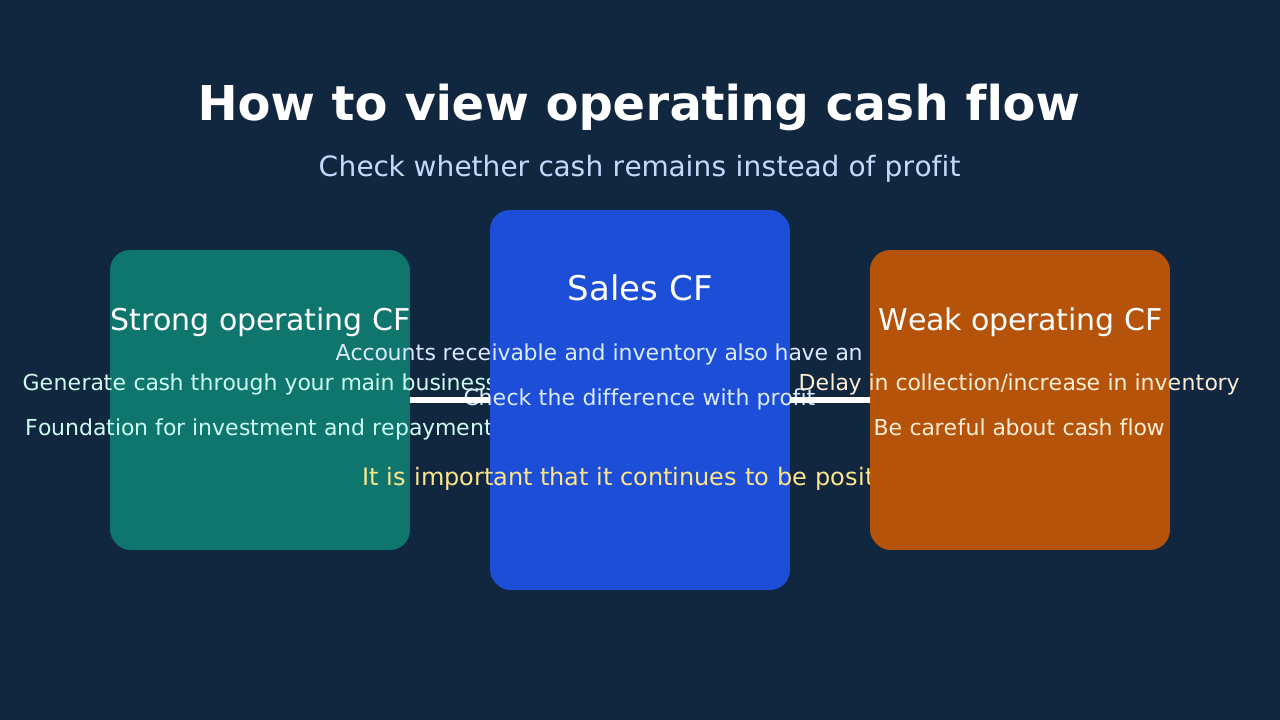
Therefore, even if profits are increasing, you should be careful if operating cash flow is weak. On the other hand, if operating cash flow is stable and positive, it is easier to think that there is a foundation to support capital investment, loan repayments, and shareholder returns.
How it works
The cash flow statement mainly consists of the following three parts:
| classification | what to show | Typical example |
|---|---|---|
| Operating cash flow | Ability to earn cash from your main job | Product sales, service provision, purchasing and expense payments |
| investment cash flow | movement to use cash for the future | Capital investment, M&A, securities acquisition, asset sales |
| financial cash flow | Trends in financing, repayments, and shareholder returns | Borrowing, repayment, dividends, share buybacks, capital increase |
Of these, operating cash flow represents the cash balance generated from the main business, such as selling products and providing services.
| Item | Impact on operating cash flow | How to read |
|---|---|---|
| Collected payment for goods and services | Plus | I have cash from my day job |
| Paid the purchase price and labor costs | Minus | Cash is available as working capital for the main business. |
| Accounts receivable increased | Negative factor | Even though sales are up, cash collection is delayed. |
| Inventory has increased | Negative factor | Cash is turned into inventory |
| Accounts payable increased | positive factors | I moved the payment later and still have cash left over. |
Specific example
Even if a business is in the black, it looks different depending on the strength of its operating cash flow.
| case | profit | Operating cash flow | how to see it |
|---|---|---|---|
| cash generating type | surplus | big plus | I am able to collect cash from my main business. |
| profit-driven type | surplus | weak or negative | Cash collection may be delayed compared to sales recording |
Cases with strong operating cash flow
Companies whose main business is stable and sales proceeds are well collected are likely to have consistently positive operating cash flow.
| Item | amount |
|---|---|
| Sales | 100 billion yen |
| Operating profit | 12 billion yen |
| Operating cash flow | +15 billion yen |
In this case, it is easy to think that not only profits but also cash remain, and the company is able to secure funds for investments, repayments, and shareholder returns from its main business.
Cases where profits are made but operating cash flow is weak
On the other hand, if accounts receivable increase or inventory accumulates significantly, operating cash flow may become weak even if profits are generated.
| Item | amount |
|---|---|
| Sales | 100 billion yen |
| Operating profit | 10 billion yen |
| Operating cash flow | +1 billion yen |
In this case, even though the company is in the black, it may not be able to collect enough cash. You need to pay more attention to your cash flow than the appearance of the numbers.
Points to see
Are profits and operating cash flow linked?
The first thing to check is whether there is a large discrepancy between operating income, net income, and operating cash flow. If the discrepancy is large, it is better to look at the effects of changes in accounts receivable, inventory, advances received, etc.
Are you able to continue to maintain positive results?
Even if there is a temporary positive result in a single year, that alone does not provide peace of mind. It is easier to evaluate the cash-generating ability of a company's core business if it maintains a stable positive return over several years.
Changes in accounts receivable and inventory
When operating cash flow is weak, check to see if an increase in accounts receivable or inventory is the cause. Even if sales are increasing, if collection is delayed or inventory accumulates, cash will not increase as much as expected.
Can you support investment and returns?
If operating cash flow is stable, it will be easier to see the sustainability of capital investment, loan repayments, and dividends. On the other hand, if this is weak, it is necessary to check whether investment and returns are dependent on borrowing.
Points to note
When looking at operating cash flow, be careful of the following misconceptions:
| common misconceptions | actual view |
|---|---|
| Don't worry if you're in the black | There may be no cash left due to increases in accounts receivable and inventory. |
| It is enough if operating cash flow is positive once. | Continuity is important, not a one-year temporary factor. |
| If it's negative, it's immediately bad. | It may worsen during the early stages of growth or when there is a temporary increase in working capital. |
| Just looking at profits is enough | It is difficult to grasp the actual situation unless you also look at whether there is cash left. |
action steps
If you are a beginner and want to check it out, the following order is easy to understand.
| order | Check items | Reason to watch |
|---|---|---|
| 1 | Compare operating income and operating cash flow | Understand the gap between profits and cash |
| 2 | View changes in accounts receivable and inventory | You can check the reason why there is no cash left |
| 3 | Check trends over the years | Easy to distinguish between temporary causes and continuing trends |
| 4 | Read together with investment CF and financial CF | Understand whether the cash you earn can support your investments and repayments. |
Summary
Operating cash flow is an important indicator of how much cash a company is generating from its core business. If you have no cash left even if you are making a profit, you need to pay attention to your cash flow and sustainability of growth. On the other hand, if operating cash flow is stable and positive, it is easy to see that the company's foundations are relatively solid.
What is important is to check not only profits, but also the movement of accounts receivable and inventory, continuity over several years, and the balance with investments and returns.