
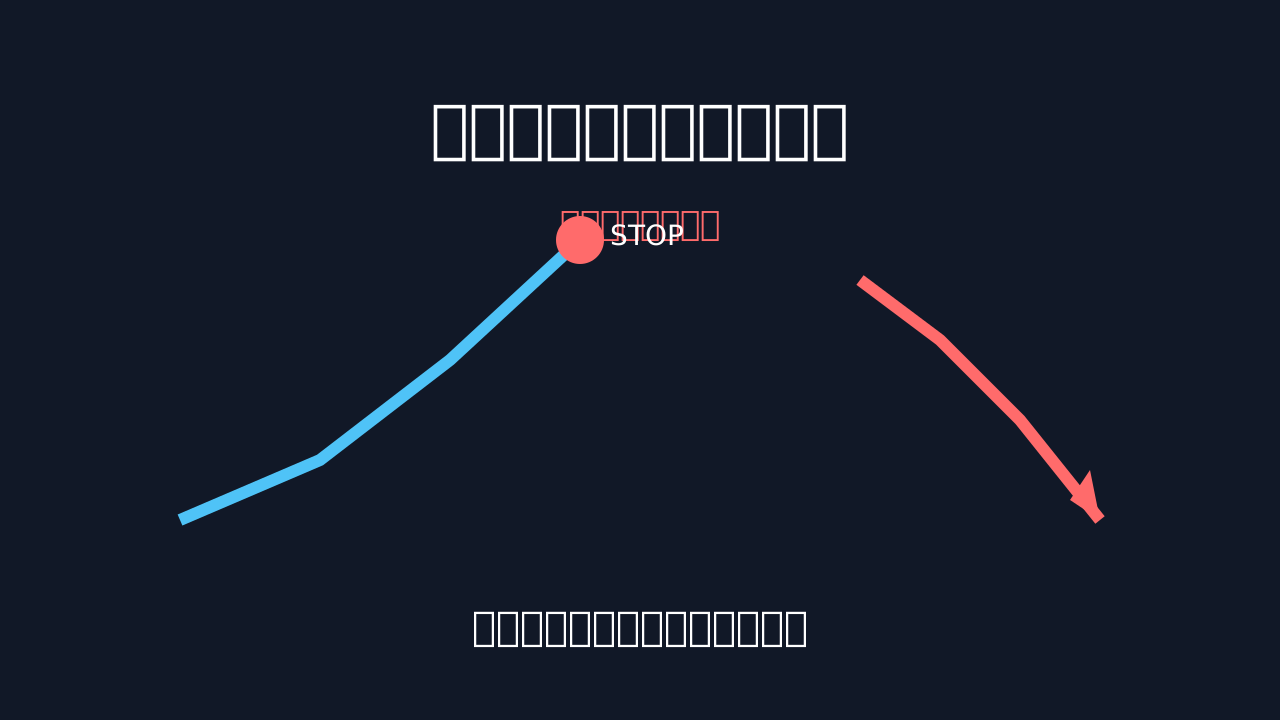
What is Terminal Rate?
The terminal rate is the policy interest rate that the market and the central bank thinks when the end of this interest is reached.
For example:
- Current policy interest rate: 3%
- Market Forecast Final Point:
The terminal rate is around.
う
The terminal rate is the expected goal of the interest.
Why is it important?
The market is not “now” but “future”.
For example, the central bank is 0. 25% interest
At this time, the market is really looking at it.
More importantly,
- Where to go
- How long does high interest rate last?
- When to turn to interest
Home
So the same 0. Even with 25% interest, market reactions vary greatly depending on the view of the terminal rate.
What happens when the terminal rate rises?
When the terminal rate is expected to rise, the market becomes easy to accept "longer financial金融".
Here is a typical impact.
| Property | Impact |
|---|---|
| Shares | Easy to drop |
| Bonds | Easy to drop |
| English | Stronger |
| Gloss Corporation | Reversed wind in valuation |
Especially high-tech and Gloss strains are easy to understand.
However, it is because the stock price is easily formed by the expectation of future profit.
Why is stock price lower?
As interest rate increases, the current value of future profit is lowered.
The stock price is evaluated by dividing future profit into current value.
The image expression is as follows:
PV = FV ÷ (1 + r)^n| Signs | 意味 |
|---|---|
| PV | Current Value |
| FV | Future Value |
| r | Discount rate, interest rate |
| n | Period |
The higher the interest rate, the larger the minus.
As a result, the current value of future profit becomes smaller.
Interest rate rise → current value drop → reverse wind to stock priceThis is the basic reason why the stock price is easy to down by increasing the terminal rate.
Difference between terminal and long-term interest rate
The terminal rate and long-term interest rate are easy for beginners.
| 項目 | 内容 |
|---|---|
| Terminal Rate | Expectation of the final point of policy interest rate |
| Long-term interest rate | Long-term income on the market |
| Main target | Central Bank Policy Interest |
| Example | U.S. FF interest rate forecast, 10-year bond yield |
The terminal rate is the goal of how the policy interest rate of the central bank rises.
On the other hand, the long-term interest rate動き in comparison with economics, inflation, national bond supply and demand, and market requirements.
Both people may interlock, but not the same.
Relationship with dot chart
U.S. FOMC announces a dot chart showing policy interest rates.
Dot chart indicates the level of policy interest for future FOMC participants.
Market is here
- 利上げ継続か
- 利下げ転換か
- The terminal rate is somewhere
- How long does high interest rate last?
read.
In addition to the policy interest rate itself, the future interest rate path is modified from dot charts and chairpersons.
Is the terminal rate degraded?
not necessarily.
If the terminal rate decreases, it is easy to catch up with the stock on the interest rate surface.
However, if the reason for degradation is worse, the story changes.
For example:
- End of interest after calming inflation
- Expectation to lower interest due to rapid de ration
The market is different.
While the former is likely to become a plus to the stock, the latter may become a strain from anxiety to corporate performance.
For beginners
It is enough to remember the following.
| Contact | Market view |
|---|---|
| Terminal rate rise | Long-term financial ing |
| Degraded Terminal Rate | In terms of interest rate, catch up with stock |
| Expand interest expectations | Growth strains are easy to catch up |
| Expectation of interest is由来 from exacerbation | Even in the case of reverse wind to the stock due to business performance anxiety |
In the news, it becomes easier to understand if you think that the financial締めing will be prolonged when the market raises the terminal rate.
Points for investors
Check the following three sets when viewing the terminal rate:
1. Inflation rate
When the inflation increases, the central bank becomes less likely to interest.
Therefore, terminal rate prediction becomes easier.
2. RECRUIT
If is strong, it is judged that it is withstanding the economy, and the expectation of interest may be re ed.
On the contrary, if the is suddenly weakened, the interest expectation will increase.
3. Central Bank
FRB Chairs and FOMC Participants speak a lot of interest in the market.
“higher for longer” means that the message of increasing interest rate is easy to be warned by the stock market.
Common misunderstandings
| misunderstanding | In fact |
|---|---|
| Share High at Stop of Interest | There is a strong concern about scenic deterioration |
| The terminal rate only refers to the actual interest rate | Includes market forecasts and central bank s |
| Stock price is determined only by interest rate | s, economics and supply and demand are also important |
| Terminal rate drop is always good | Please note if you are concerned about recession |
| Only high-tech stocks begin | Influence on real estate, bonds and exchanges |
- Terminal rate is expected to be the last point of interest
- The market focuses on “final point” and “interest time” from “current interest rate”
- Terminal rate rise is easy to reverse the stock
- High-tech and Grow strains are particularly easy to understand
- Even if the terminal rate drops, caution is necessary if the economy is worse
- FOMC, dot chart, 統計 statistics, inflation indicators
First of all, it is important to determine the habit of seeing the word "ter rate", "dot chart", and "expected interest" in the news after FOMC.