
Prerequisite: resource is
The starting point of economics is simple.
You can't get all.
There is a limit to money, time and physical strength.
For example, if you do a side job on a holiday, your income may be increased. However, the time spent with your family is reduced.
If you turn money into investment, future assets may be affected. However, the money you can use is reduced.
The concept of economics begins with the reality that "all can not be selected".
Basic Rules 1: Trade Off
Trade-off is a relationship that gives up something else.
| Select | What to give up |
|---|---|
| Contact Us | Money to use |
| Save | Current consumption |
| Overtime | Free time |
| Choose a cheap product | Quality & Warranty |
| High Return | Stability |
Trade-offs are always available for daily or investment.
It is not possible to get from "cheap". If you want to break it, you can buy it again.
Not limited to "high dividends" If the performance is poor, there is a risk of deduction or stock price drop.
If you think economically, you need to see not only what you chose but also what you throw away.
Basic Rules 2: Opportunities
Opportunities cost is the value of choices you have not selected.
I bought a game for 10,000 yen.
The 10,000 yen was used separately.
- Buy Books
- Buy Investment Trusts
- Make travel funds
- Use for food
- Save
The actual amount is 10,000 yen.
However, in economics, I think that "another thing made of 10,000 yen" is cost.
This is quite useful for investment.
If you put funds in A, you will lose the opportunity to choose B or cash holding. There is an opportunity cost for holding stocks.
If you look at the price, you will see this feeling.
Basic Rules 3: Incentives move people
Incentive is a、 to move people.
Act for reasons such as getting, avoiding loss, rated, and avoiding punishment.
| 仕組み | icult behavior |
|---|---|
| Point reduction | More shopping |
| Overtime | Long working |
| Fine | Avoid violations |
| Taxes | More investments and capital investments |
| Free Shipping Line | Additional purchases occur |
Point reduction, coupons and free shipping lines are all incentives.
However, incentives need to be careful when using them.
"Free shipping if you buy 500 yen" This is also incentive.
It’s normal to get more end res.
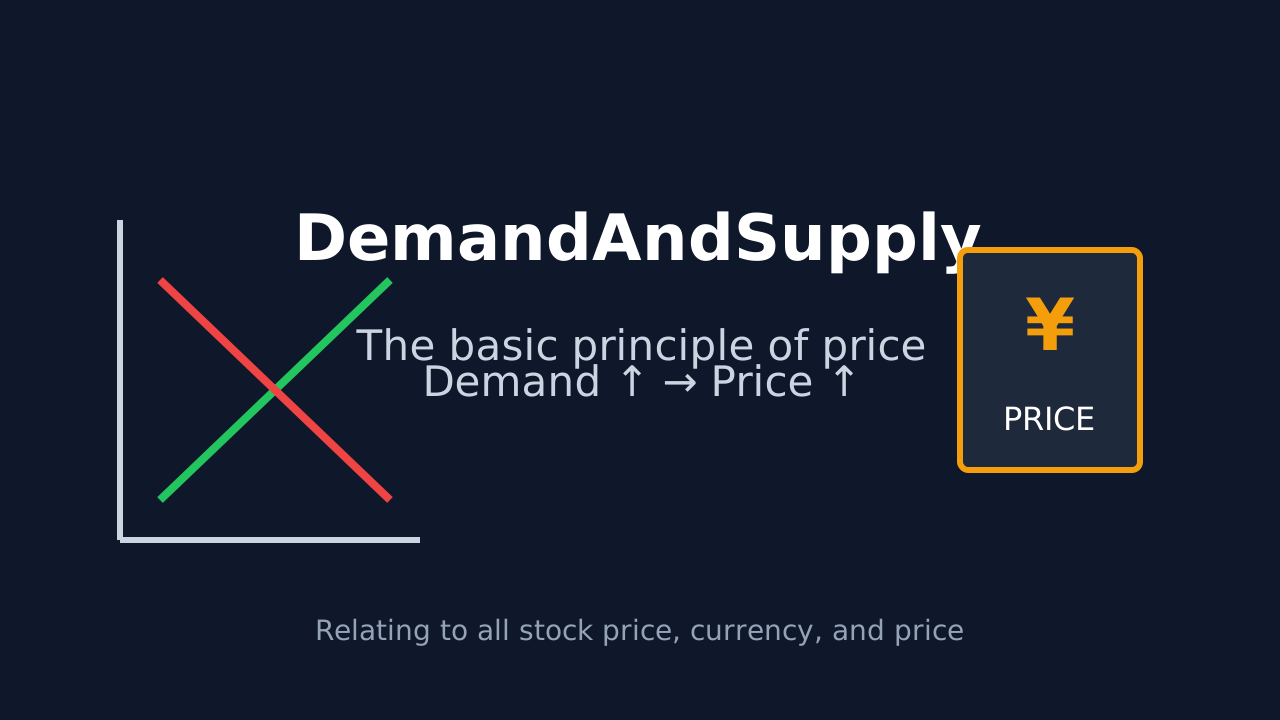
Basic 4: Prices move by demand and supply
The price is the balance of the volume and supply of the person who wants.
| Contact | Price Movement |
|---|---|
| More people want | Easy to climb |
| Insufficient products | Easy to climb |
| Inventory | Easy to down |
| Competitive | Easy to down |
This applies to stock price.
The stock price is not determined by the company value alone.
If the number of people you want to buy is increasing and the number of people you want to sell is increasing.
Of course, long-term performance and profit are important. However, in the short term, it may move greatly depending on supply and demand.
Sale is the same.
Popular products are not easy to understand, and the resold items are largely discounted. Even when you look at 80% OFF products, it will be difficult to fail if you think about "Why is this cheaper?"
Basic Rules 5: People are not always reasonable
In economics, there is a scene that thinks as a premise for people to act reasonably.
However, real people don’t move well.
感情s.
- I don't want to lose
- Shopping
- When you see the value rise, you will be burned
- I'll be scared if you fall out
- Free and limited
In particular, in investment.
Sold scaryly by rampage. It is not too late to ride on the rising market.だけidend yields only look at results.
This is not a rare failure.
It is rather calm to know from the beginning if it is not reasonable.
Basic Rules 6: Make Time Allies
仕組み Interest is a mechanism for profits.
The basic formula is as follows:
A = P(1 + r)^n| Signs | 意味 |
|---|---|
P | 元 |
r | Interest rate |
n | Year |
A | Future amount |
The power of compound interest is difficult to understand in short term.
However, the number of years increases.
For example, the assets starting at資産 every year are not changed in one year. However, after 10 years and 20 years, the profit will increase.
This is because it is said that the time spent on investment is high.
However, compound interest is not only positive.
The interest of the borrower is also heavy when left. The interest rate of revo payments and card loans is scary because the longer the payment is, the more the interest burden is swelling.
Basic 7: Risk and Return Set
High returns include high risk.
| Assets and Behaviors | General Features |
|---|---|
| 預金 | Low risk and low return |
| Bonds | Medium-term risk |
| Shares | High risk and high return |
| Leverage Trading | More Risks |
| Home | There is a single dream, although the expect value is low |
In most cases, it is better to see it.
Investment fraud and suspicious financial products show similar to this word.
Guarantee, High Yield, Short-Term, Easy for Anyone
When this combination comes out, it is better to check the distance first.
Easy to misunderstand for beginners
| misunderstanding | In fact |
|---|---|
| School of Mathematics | The basics of choice and distribution |
| If you buy cheap | Quality, time and opportunity cost |
| High income | Depends on s and habits |
| Points are always earned | Inc ing unnecessary end res |
| Choose high return products | Increase risk |
When you learn about economics, daily shopping and investment decisions will be a little calm.
“Is this really good?”
“What do you give up?”
“I’m running incentives?”
It is quite different even if you think about this three.
Economics is a question of how to use limited resources.
First of all, I want to hold one premise and seven basic rules.
- Resources
- There are tradeoffs on the map
- Considering the opportunity cost
- People move incentives
- Prices move in demand and supply
- People are not always reasonable
- Diligence Sides Time
- Risk and Return Set
The concept of economics can be used not only for investment, but also for shopping, working, savings, loans, and time usage.
This is the first thing to be aware of.
If you choose something, you can see what you want to lose.
When you learn this way of thinking, the judgment of household and investment will change considerably.