
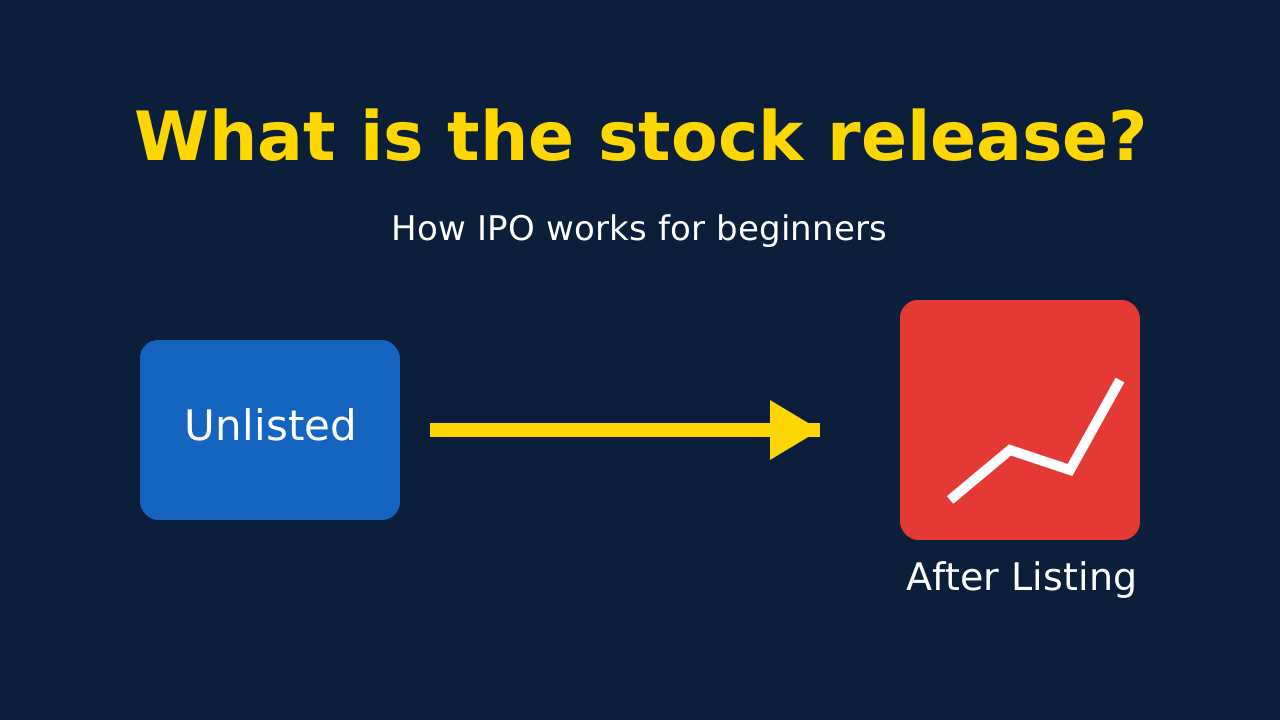
What is IPO investment?
IPO is an abbreviation for Initial Public Offering.
This is an event where unlisted companies will be listed on the stock exchange to allow general investors to buy and sell their shares.
In IPO investment, you can buy shares at the public price by signing up from a securities company before listing, drawing or allocation.
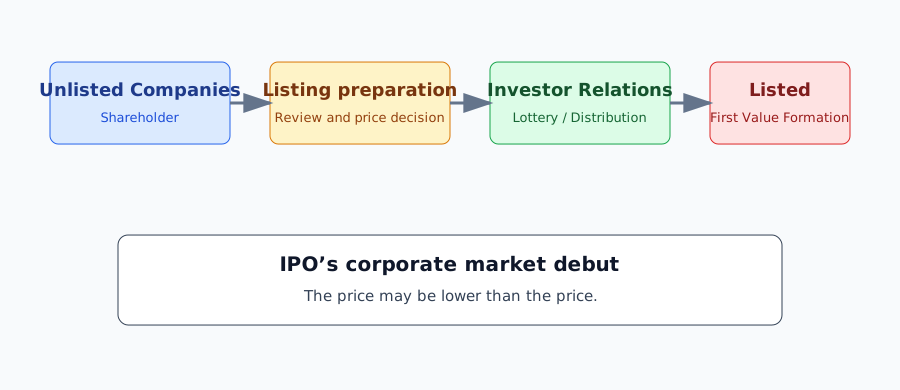
The basic flow is as follows:
| 手順 | 内容 |
|---|---|
| Contact | Apply from a securities company to IPO |
| Lottery / Distribution | Selected investors can purchase |
| 購入 | Acquisition of shares at public prices |
| Listed | Trading on the market begins |
| Sold | Sell at first and post-listed stock prices |
The first stock price on the first day of listing.
Profit if the price is higher than the public price. If the first value is lower than the public price, the first value is broken and the loss is.
Why is IPO a profit?
The biggest reason why IPO is said to be profitable is that it is easy to concentrate on buying demand immediately after listing.
In particular, popular IPOs attract a lot of investors from the listing.
- Growing market
- Themes such as AI, semiconductor, space, SaaS
- Low number of public shares
- Small absorption amount
- Inc ing performance
- Famous managers and brands
If such conditions are overlapping, the number of people who want to buy on the first day of the listing will be increased.
On the other hand, the number of shares on the market is limited.
Low stock. Many people want.
The dev。 of this supply and demand may push the first value.
Pricing
The stock price is simply calculated by supply and demand.
If you want to buy more than the person you want to sell, it is easier to get.
In IPO, this supply and demand is temporarily。.
For example, if the public price is 1,500 yen, and the first price is 2,300 yen, if you choose 100 shares and sell it with the first price, it will be a profit of 80,000 yen before tax and fee.
Price 1,500yen
First value 2,300 yen
Difference 800 yen
100 shares 80,000 yen
IPO investments are becoming more popular.
However, this is only the case when the first time goes up. In the same way, we may lower the initial public price.
Figure: Basic structure that makes profit with IPO
Benefits of IPO
Easy to participate in small amounts
IPO can apply for several million yen to ten million yen depending on the brand name.
For example, if the public price is 700 yen, it is 70,000 yen for 100 shares.
It is not just a case where you need a lot of money like a large stock, so even beginners can easily apply for investment opportunities.
Short-term results
IPO's first selling is a relatively short investment from application to listing and selling.
It is close to investments that read the supply and demand at the time of listing rather than reading 10 years after the company's long-term holding.
This shortness is also attractive, but it does not mean that it is good to make decisions.
Easy to narrow down points to compare
In IPO, it is different from the existing listing stock.
In particular, the following items will be useful if the first value is targeted.
| Search | 意味 |
|---|---|
| Ab ed amount | How much money can be absorbed from the market |
| Number of shares | Cal the lightness of initial supply and demand |
| Company Profile | View sales growth and profit levels |
| Theme | Defining investors' desire to buy |
| Sales Ratio | See if the exchange color of existing shareholders is strong |
| Lock-up | View sales pressure after listing |
It is necessary to read the supply and demand and expected value of the listed company rather than just PER or dividend yield.
IPO failure case
Bad market environment
IPO is the first time in popular companies.
U.S. shares have been rushed. Growth stocks are sold. Risk assets are avoided by increasing interest rates.
In this aspect, investors tend to prefer cash and large stocks from newly listed shares.
IPO evaluation is not determined by the company alone. It depends on the air of the day market.
too large to list
IPO has a large number of public shares, and IPO has a large amount of absorption.
Even if there are many people who want to buy, the supply and demand will not be locked if there are more stocks sold.
This is because IPO is strong and IPO is heavy.
Low performance and profit
Even if sales increase, companies with large deficits are wary.
In particular, if there is a fairly high value at the time of listing, the market immediately sees "Is it really recoverable in this growth?"
Even if the first IPO is high, it is easy to sell disappointment in subsequent financial results.
In IPO, the difference between the story before the listing and the number after the listing move the stock price.
Strong color
IPO has a public offering to issue and fund new shares, and sales of shares held by existing shareholders.
IPOs with high sales ratios may be seen as “existing shareholder cash exchange events” rather than “collecting growth funds”.
Of course, it is not bad just because there is a sale.
However, if the sales is large, the use of funds is weak, and the growth story is thin, it becomes difficult to grow first time.
Too weave the future with the first value
Even if the person who bought the prize at the public price is profitable, the person who jumped at the first price may be high.
IPO、 is a time to attract attention by news, social media, ranking, and率 rate.
If you buy in the hot air, you may already have a few years of expectations.
When buying after listing, it is not the first value, but the total market value, sales, profit, growth rate, and unlock.
Easy for beginners
Not winning
IPO is just a lottery.
However, it is not always possible to increase the winning symbol.
In particular, in popular large IPOs, deficit companies, geographical industries, and publicly priced brands, there is also a first-rate crack.
If you choose whether to buy after the selection, you want to judge by looking at the見us and the market environment.
Long-term ownership is not limited to correct
IPO companies are easily visible to growth companies, but there are some symbols that have a long stock price after listing.
Before listing, growth stories are highlighted. After listing, it will be evaluated by numbers every quarter.
This difference is large.
If you are a long-term business model, you need to look at your business model, profit rate, competitive advantage, money use, and management.
Don’t buy a popular theme
The theme of AI, space, semiconductor, bio and SaaS is easy to buy with IPO.
However, the more the theme is strong, the better the expectations of the public price and initial price.
Even with a good theme, if the price is too high, the investment subtle taste will be increased.
It is important to see not only what company is, but also what price is too high for that expectation.
Tips to Practice IPO
Use multiple securities companies
IPO differs from the number of shares per securities company and the lottery method.
The main stock is easy to allocation, and the net stock may have a complete lottery.
There is a way to apply from multiple securities companies to increase the winning probability.
However, there is no financing, application unit, and lottery rules for each securities company. Let’s check it before using it.
See absorption amount and theme
The combination of the absorption amount and the性 is important in the initial target.
IPO has a small, growing theme and business performance.
On the contrary, IPO is large, soldering, and IPO has a slow performance.
If it is quite simplicity, the first value target looks like this.
| 条件 | First Value |
|---|---|
| Small, popular theme, black | Stronger |
| Small, Red, Future Expectations | Value movement is easy to understand |
| Large and high profile | There is a demand, but there are many public shares |
| Large and Growing Dull | The first value is heavy |
Determine whether to sell first or long term
In IPO investment, it is difficult to determine the policy before joining.
The purpose is short-term supply and demand.
If you have a long-term holding, the purpose is to take the growth after listing.
Even with the same IPO, the point to see is different.
| Style | See Points |
|---|---|
| First price | Supply and demand, absorption amount, number of public shares, popularity, ge |
| Long-term ownership | Sales Growth, Profitability, Competitive Advantage, Funding, Management |
"If you sell up, switch to long-term holding" is a failure for beginners.
Let's decide whether it is a short term or long term from the beginning.
IPO investment is an investment that aims to profit by selling the shares purchased at the public price.
In the popular IPO, the number of public stocks is limited, while the purchase order is concentrated, and the first public price may be exceeded.
However, IPO is not a profitable investment. The market environment is poor, the listing scale is large, the business performance is weak, the sales color is strong, the first and the high. In these conditions, the first break or fall after listing occurs.
For beginners, it is enough to press the following three first.
- IPO benefits are born from supply and demand It is not necessary to buy even if you choose
- First and long-term investment
IPO is an attractive investment opportunity if you use it well.
However, it is not safe because it is popular. It is important to check the public price, absorption amount, performance, sales ratio, and lock-up, and participate only in matters that fit your own policy.
Reference
- Date: 2026-05-26