
First Con まず
If you trade domestic shares with SBI Securities, it is simple to do it first.
Set various reports and grant documents to electronically and check whether they are subject to zero revolution.
That's it.
If it is subject to the zero revolution, the transaction fee for the target transaction is 0 yen, including the actual stock transaction, credit transaction, and S stock of less than one unit.
However, there are points that are easy to understand here.
In credit transactions, even if the transaction fee is 0 yen, various expenses such as interest rate and loan fee will be charged separately.
In other words, 0 yen of actual transaction and 0 yen of credit transaction are different meaning.
It is safe for beginners to understand from real trading first.
Difference between real and credit transactions
、 shares include real and credible transactions.
| Trading Type | 内容 | For beginners |
|---|---|---|
| Real Trading | Buy shares in your own cash | As a general rule, loss is easily within the range of investment |
| Credit | Buy and sell funds and stocks | Leverage occurs, interest rates and loan fees |
If you buy a stock of 100,000 yen, you need 100,000 yen.
Credit transactions can be collateraled by the contract deposit and can be traded larger than their own funds. Profits may increase, but losses may increase.
The cost of credit transactions is not the only transaction fee.
If you buy it, interest rate, stock rental fee, reverse-day walking etc. are related. Even if the fee is free, the cost will be increased if the number of days of holding credit transactions increases.
Zero Revolution
The Zero Revolution of SBI Securities is a service to free trading fees such as domestic stocks.
The SBI Securities Official FAQ mainly shows the following two conditions as a free subject of domestic stock fees.
| 条件 | 内容 |
|---|---|
| コースments | Internet Course or Internet Course (Plan C) |
| Contact Us | All electronically issued methods of writing in electronic grant services |
The target is internet trading.
Direct, IFA and face-to-face courses are not eligible. In addition, some transactions such as phone orders are not eligible for free.
The Zero Revolution page of the SBI Securities explains that it includes S, real and credit transactions.
However, there is a separate interest rate and rental fee for credit transactions.
Make sure to understand this.
stock fees for zero revolution
If you meet the conditions of the zero revolution, you will see the trading fees for domestic shares as follows:
| Trading Type | Purchase fee |
|---|---|
| Real Trading | 0 |
| Shares less than one unit (S) | 0 |
| Legal Notice | 0 |
| General Credit | 0 |
Please check the electronic grant setting first before you worry about the transaction amount or number of times.
SBI Securities's domestic stock fees are the best.
If you do not set an electronic grant
If you do not meet the conditions of the zero revolution, the regular fee plan is applied to domestic stocks.
SBI Securities's domestic share fee plan is two major.
| Plan | How to determine fees | 向いている人 |
|---|---|---|
| Standard Plan | 1 Settlement fee per order | Low number of transactions |
| Active Plan | Determines the total price of the day | Tする who trade multiple times per day |
However, because there is a zero revolution, it is quite a bit less for people who can meet the conditions.
It’s not a plan, but it’s free.
Standard Plan Fee
Standard plan is a plan that has a fixed fee for each order.
If you do not meet the conditions of the zero revolution, the SBI Securities Official FAQ shows the standard plan fee for real trading as follows:
| 1Order の | Current transaction fee (tax included) |
|---|---|
| Up to 50,000 yen | 55 YEN(JP) |
| Up to 100,000 yen | 99m2 |
| Up to 200,000 yen | 115YEN(JP) |
| Up to 500,000 yen | JPY275 |
| 100 million yen | 535YEN(JP) |
| Up to 150 million yen | JPY640 |
| 30 million yen | JPN |
| Over 30 million yen | JPN |
The standard plan of credit transactions is divided by regular fees and incentives.
| 1Order の | Credit transaction fee (tax included) |
|---|---|
| Up to 100,000 yen | 99m2 |
| Up to 200,000 yen | JPY148 |
| Up to 500,000 yen | JPY198 |
| Over 50,000 yen | JPY385 |
In credit transactions, interest rates and loan fees are charged separately from the transaction fee.
Active Plan Fees
The active plan is a plan that has a fixed fee of 1 day.
If you do not meet the conditions of the zero revolution, the SBI Securities Official FAQ shows the active plan fee for the actual transaction as follows:
| Total daily contract fee | Current transaction fee (tax included) |
|---|---|
| 100 million yen | 0 |
| Up to 2 million yen | 1,238YEN(JP) |
| Up to 3 million yen | 1,691YEN(JP) |
| 1 million yen increase | 295 yen increase |
The active plan for credit transactions is as follows:
| Total daily contract fee | Credit transaction fee (tax included) |
|---|---|
| 100 million yen | 0 |
| Up to 2 million yen | 880YEN(JP) |
| 1 million yen increase | 440 yen increase |
If you look at this table only, you can see the active plan even if it is a small deal.
However, if you meet the conditions of the zero revolution, you will have to consider this comparison itself almost.
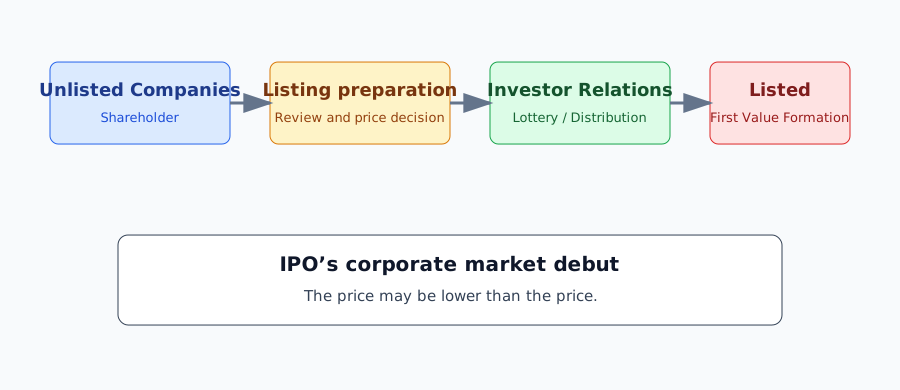
Figure: First look at SBI securities fees
Easy for beginners
No investment risk disappears even with a fee of 0 yen
If the transaction fee is 0 yen, it will be easier to trade.
However, it is different that the commission is cheap and the profit is easy.
Loss occurs if stock price falls.
Fee 0 yen is the advantage of cost, and it is not easy to make investment decisions.
Credit transactions are not for beginners
Credentials are trades that can increase the efficiency of money, while the loss is also prone to greater.
There are also interest rates and rental fees.
It is dangerous to enter a credit transaction by looking at only a fee of 0 yen when you are not familiar with the actual transaction.
Electronic grant setting leakage
In the zero revolution, electronic grant settings are important.
Even if you use a general account and do not issue an annual trading report, you need to change the method of 報告書ing an annual trading report to an electronic grant. It is described in the SBI Securities FAQ.
Let's check the status of application without thinking that "Automatically free after making an account".
SBI Securities’ domestic stock fees vary depending on whether or not the conditions of the zero revolution.
If the condition is met, the transaction fee of the target transaction including the actual stock transaction, credit transaction, and S stock is 0 yen.
Therefore, the first thing that beginners should do is not compare the damage of the active and standard plans in detail.
First of all, it is to set an electronic grant and check whether it is subject to a zero revolution.
However, in credit transactions, there is a separate fee such as interest rate and loan fee.
For beginners who want to reduce the fees of domestic stocks, start with real trading and check the latest free and non-target trading on the official page of SBI Securities.
出典
- Date: 2026-05-26