
First Con まず
"The data of the past is害ous, and it is not profitable" is a pretty strong word.
If you read it as it is, you may hear the data-free theory. However, considering the management of Seven-Eleven, you can see that.
Seven-Eleven is known for single product management and POS data utilization. In other words, it is not a company that has a light view of data.
So why did you warn the past data?
Simple.
For the same reason as yesterday, it is not possible to buy the same product today.
The past data is the result until yesterday. The weather, temperature, local events, paid days, social media topics, health-consciousness, savings, and more.
The essence of this word is the negligence of thinking stops, not past negligence.
Why is it dangerous for past data alone?
Past data is convenient.
Sales of the previous year, previous week, past hit products, average customer unit price, inventory turnover rate. Numbers help you make decisions.
However, there is a weakness in numbers.
The past numbers are based on the past conditions.
| What you can see in past data | I don't know |
|---|---|
| What did you sell? | Can you sell for the same reason today? |
| What time did you sell? | が the customer has changed |
| Average demand | an exceptional change |
| Strength of existing products | New dissatisfaction or desire is not born |
For example, the cold oodles sold last summer.
It’s hot this year. So you can make a lot of cold。oodles.
This is normal.
However, this year’s customer may be a bit expensive. You may want to add a salad chicken with your favorite protein. Hot oodles may be popular on SNS. The company rate may change.
If you see only the past data, you will lose these changes.
Sorry, this entry is only available in 日本語. The problem is to follow the past.
Toshifumi Suzuki emphasized hypo and verification
It is a hypo and verification that Mr. Suzuki often speaks in his work.
The hypo is to think that it is not like this when the answer has not yet been answered.
Validation is to confirm the idea by actual sales area, product, customer response, and number.
This is the current.
| Stage | Contact Us |
|---|---|
| 観察 | What’s happening to our customers |
| 仮説 | So what you want |
| Run | How to change the product, place, price and quantity |
| 検証 | What was the result? |
| 修正 | How to change |
The important thing here is that even if the hypo、 is removed, it can not end with failure.
If you are out, see why you have removed it. Temperature reading, price, taste, place, POP, customer layer?
This repetition increases the resolution of the site.
More than those who have memorized the past data, those who are disappointing and fixing the hypotheses will become stronger.
This is a pretty practical part of Mr. Suzuki’s management philosophy.
What is "Customer's Position"?
It is a posture to throw away the seller's convenience.
It’s easy to say “Stand in your position”
However, many companies think about the seller's situation.
- I want to sell from stock
- I want to raise the value because the cost is high
- I want to put because it is sold from the past
- I want to continue because I decided by the headquarters
- I want to order from previous years
There is no relationship with customers.
Do you want to come? What is the price? How do you feel right now? Is there more appeal than other options nearby?
When it comes to the customer’s position, it is to remove the value of the seller and enter the buyer’s nickname.
In this case, past data may be subject to change.
"This was sold last year"
"This shelf is always like this."
"This product is strong in this area"
The more you experience, the more you see, the more you know.
How to use for investors
This word can be used as a corporate analysis.
It is easy for investors to understand past data.
- Strong because it is the highest profit in the past
- Less in previous PER range
- High dividend
- It is okay because it is a good company from the past
- Return to stock price
Of course, past data is important.
However, it is dangerous to judge it alone.
The company value is determined by the ability to earn in the future, not past実績s.
For example, even if you’ve been a company with a high revenue for the past 10 years, you’re changing how to buy your customers, increasing your, increasing your raw material costs and leaving your talent, you’re not able to use your past profits.
On the other hand, even if the previous number is weak, structural reform progresses, the price revision is effective, and if the customer layer is changed, it will be mistaken only in the past.
The most important thing in the stock market is to look at the past numbers and ask the following questions:
| Past Data | A hypo to stand up |
|---|---|
| Increased sales | Increased quantity, increased value, or temporary demand |
| High profit | Strengths that can be maintained, or the current windbreak |
| Low PER | Are you interwoven with allocation or growth dullation? |
| High dividend yield | Re power, result of stock fall |
| Top Page | Is it a peak profit? |
Make a hypo from a number, not the end of looking at numbers.
This is how to use it for investors.
What do you think if you use it for work?
You don’t have to discard past data if you drop this word into work.
It is better to look at it first.
However, the following order is important.
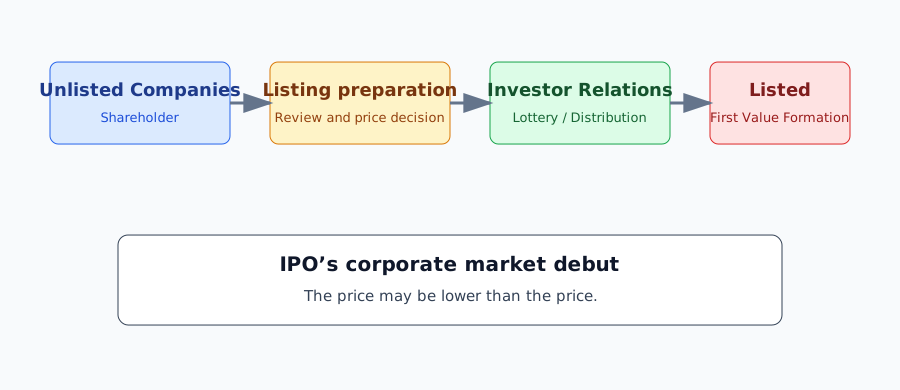
Figure: Flow of changing past data to hypotheses
Practical checklists
When you look at past data, you can use the following question as a set.
| Contact | 意味 |
|---|---|
| When was the data subject? | See if the environment has changed |
| Is the same customer now? | See why demand has changed |
| Is there any exception hidden in the average value? | Never overlook new signs |
| Is it not interpreted for the convenience of the seller? | Remove inventory, budget and internal circumstances |
| What to do when you leave | Transform hypo into learning |
Even with this five, the way you look at work is quite different.
It is weak to say that last year was this.
Last year was this. But this is different. That’s why we’re doing this.
This is the first hypo。.
It is important for the data era
It is a time that is much more data than the Suzuki era.
POS, EC, App, Search, SNS, Location, Review, Member Data If you look at it, there are numbers.
That’s why the risk of being dom by past data is increasing.
AI prediction is the same.
AI is good at finding patterns from past data. However, when the premise changes, human hypotheses are required to read the changes that have not yet been shown in the data.
The ability to view data and the ability to suspect data.
There are no changes in the market.
It is not a word that denys data.
It is a warning that the success of the past, the previous year's performance, and the rule of experience will be able to be.
Mr. Toshifumi Suzuki emphasized the customer's perspective, and made a hypo, and verified by sales and products.
Even for work or investment, past data is material.
Not an answer.
When I saw the numbers until yesterday, the next question is: What is the difference today?
A person who can make a hypothe from there will be strong in the changing times.