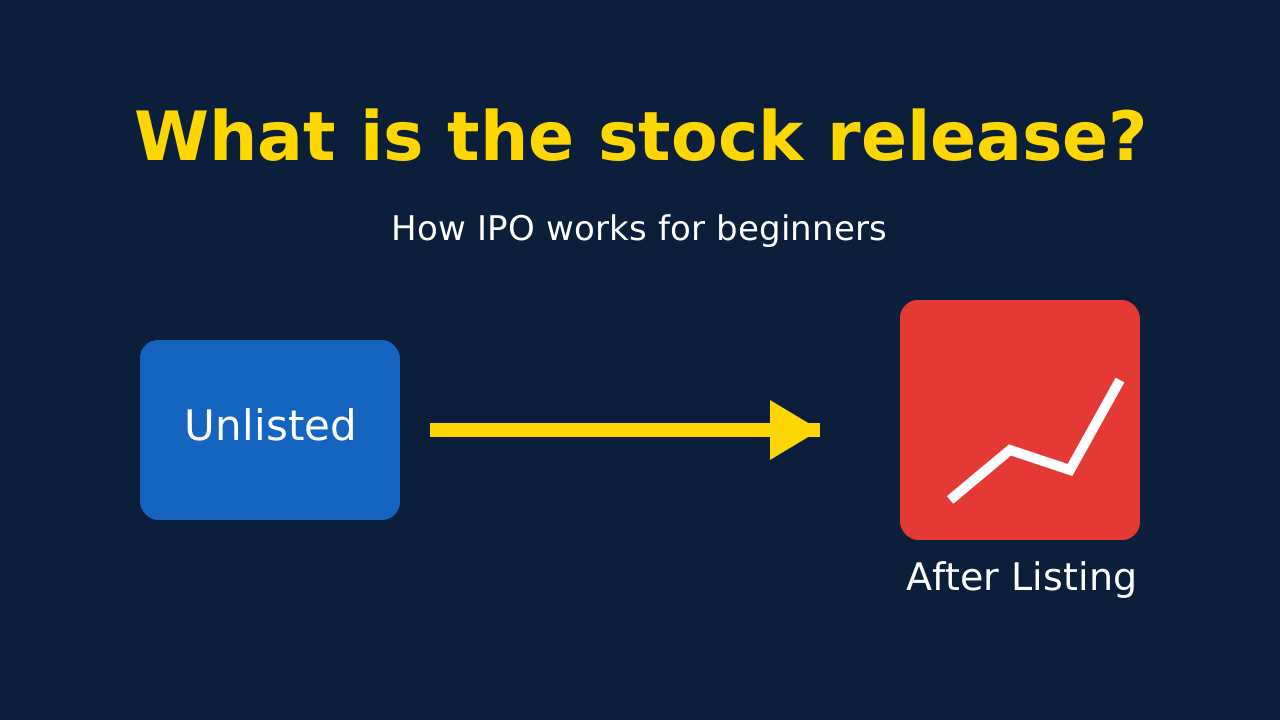
What is Public Offering?
Publication of shares is to publish corporate shares to general investors.
English is called IPO and Initial Public Offering.
In the unlisted stage, a person who has a corporate stock is limited to the founder, officer, employee, and venture capital.
However, when listed, individual investors and institutional investors can buy and sell their shares through the stock exchange.
Tokyo Stock Exchange The listed market includes Prime, Standard and Growth.
証券DAQ and New York Stock Exchange are well-known in the United States.
Why Companies Are Public
To raise growth funds for companies to share.
For example, you need the following funds:
- New business
- Factory construction
- 研究開発
- Overseas
- Recruitment
- M&A
Even bank loans can be funded, but loans are required to be repayment. On the other hand, financing by issuance of shares is not repayment obligation.
Of course, the accountability for the shareholder is born instead.
When listed, financial statements, investors, governance, and internal management systems are required. IPO is not just a financing, it is an event that companies will change to social public companies.
IPO Basic Flow
IPO does not start selling in the market.
In general, proceed with the following flow:
| Flow | 内容 |
|---|---|
| 準備 | Preparing for audits, internal management systems and listed audits |
| Listing approval | Stock Exchange Approves Listing |
| T conditions | The price range for investor demand is determined |
| Book Building | Investors want to purchase |
| Public price decision | Actual price and open price are determined |
| Lottery / Distribution | Decide which investors can buy |
| Listed | Trading on the market begins |
| First Value Formation | First stock price is determined after listing |
The price is the first day of the listing.
If the price is higher than the public price, the investor who won the IPO will be more profitable. On the other hand, if the first price is lower, the first value will be broken and the loss will be.
Why IPO Is Popular
If IPO is popular, there are cases where the first value is higher than the public price.
In particular, companies such as:
- About AI
- Semiconductor
- Space and Defense
- SaaS
- Bio-Medical
- A company led by famous managers
- Small and demand-light enterprises
However, the popularity and power do not necessarily match.
IPOs that were bought only by topic can be greatly lowered if they do not have business results after listing.
IPO considers the difference between the expectations before listing and the results after listing.
Benefits of IPO
Small amount
Depending on the brand, IPO may be able to apply from a few million yen.
If the public price is 700 yen, the necessary funds is 70,000 yen.
Therefore, it becomes an investment opportunity that is easy for individual investors to participate.
Easy to profit in a short time
In IPO investment, there is a short-term strategy to win the lottery, buy at the public price, and sell at the first price on the listing date.
If you exceed the initial public price, you can determine the profit in relatively short time.
However, this is a story when the first time goes up. If the first value is broken, it will be lost in a short time.
Early participation in growth companies
IPO can invest in listed companies.
If a company grows bigger then, it may be possible to get a large return on a long-term basis.
On the other hand, companies that are listed on the market are often not stable and are not easy to see.
IPOメリットs
It is difficult to draw
Popular IPOs have high competition rates and are not easy.
You may not be able to apply for more than ten times.
In particular, IPO, a small and popular theme, is easy to apply for individual investors.
First-rate cracking risk
IPO is not always up.
The following case is easy to break.
- Bad market environment
- Low performance
- Strong alertness to deficit companies
- too large to list
- High sales ratio
- Strong selling pressure of existing shareholders
The idea of "safety because IPO" is dangerous.
There is a possibility that it will be greatly lowered after listing
Even if the first value is high, it may fall after that.
IPO投資家 is because it is easy to sell short-term funds, the profit of the winner, the supply and demand of institutional investors, and unlock.
If you buy after listing, you need to see the company's performance, growth, profitability, and shareholder composition, not the first value.
Points that beginners should be aware of
Don’t buy only with topical
IPO may not match the popularity and power.
While the theme of AI, space, and bio is easy to focus, deficit companies and companies with future expectations are more prone to price movement.
It is not the theme.
Is sales growing? Is the profit coming out of the structure? Is it reasonable to use funds? Is it easy to sell after listing?
I want to check here.
Decide whether short-term investment or long-term investment
IPO investment has two major styles:
| Style | Features |
|---|---|
| First price | Short-term strategy to buy at public prices and sell at the first day of listing |
| Long-term ownership | Strategies to expect growth after listing |
If you sell first price, supply and demand, listing scale, public price, and popularity are important.
Long-term ownership is crucial for emerging, growth, profit, management, and capital policies.
If you participate without deciding the purpose, it will be easier to judge when the first step is down.
Figure: Flow of IPO
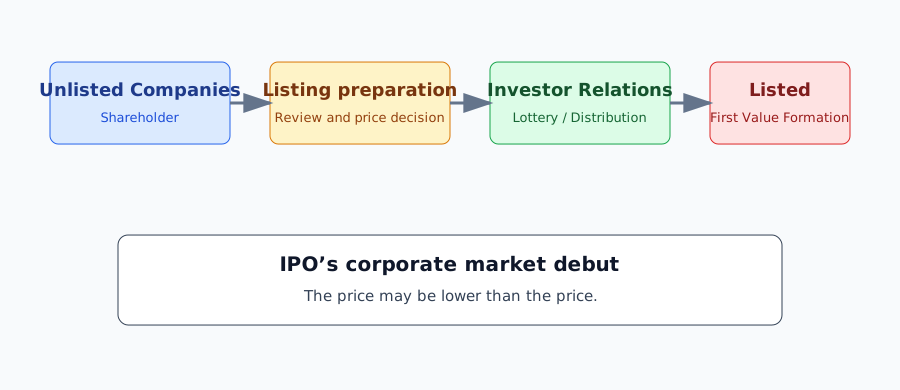
IPO is a non-listed company that can be listed on the stock exchange and the general investor can buy and sell shares.
It is an opportunity for companies to gather growth funds and increase their reputation and credibility.
It’s a chance for investors to join a growing company early. On the other hand, it is difficult to draw, and there is a risk of initial cracking and dropping after listing.
It is important to judge only by popularity.
Check the public price, listing size, performance, growth, lock-up, sales ratio, and shareholder composition, and decide whether you want to participate in short-term or long-term.
Reference
- Date: 2026-05-26