
What Is New NISA?
New NISA is Japan's revised small investment tax-exemption system that started in 2024.
Normally, when investors earn gains from stocks, investment trusts, dividends, or distributions, tax is charged on those profits.
When eligible products are held inside a NISA account, those investment gains can be tax-exempt.
Buy an investment product
->
Hold it in a NISA account
->
Capital gains, dividends, and distributions can be tax-exempt
The two main quotas are:
| Quota | Annual investment limit | Main use |
|---|---|---|
| Tsumitate investment quota | 1.2 million yen | Investment trusts suited to long-term, regular, diversified investing |
| Growth investment quota | 2.4 million yen | Listed stocks, ETFs, investment trusts, and similar products |
Used together, the annual investment limit is 3.6 million yen.
The lifetime tax-exempt holding limit is 18 million yen. Within that, the growth investment quota can use up to 12 million yen.
So far, this is a powerful framework.
But the important point is:
NISA itself does not generate profit.
Whether you make money depends on what you buy inside the NISA account and how that product performs.
The Biggest Pitfall Is Confusing the System With the Product
The first thing beginners should separate is the system and the product.
NISA is a system.
Investment trusts, individual stocks, ETFs, and REITs are products.
Those are not the same thing.
NISA = tax-exempt account system
Investment trusts and stocks = products with price risk
Even inside the same NISA account, the risk changes dramatically depending on what you buy.
| Product | Price movement image |
|---|---|
| Global equity index fund | Broadly diversified, but still exposed to global stock market declines |
| U.S. equity index fund | Concentrated exposure to the U.S. market |
| One individual stock | Large company-specific risk |
| Theme fund | Sensitive to boom-and-bust cycles in a single theme |
| High-dividend stock | Exposed to dividend cuts and earnings deterioration |
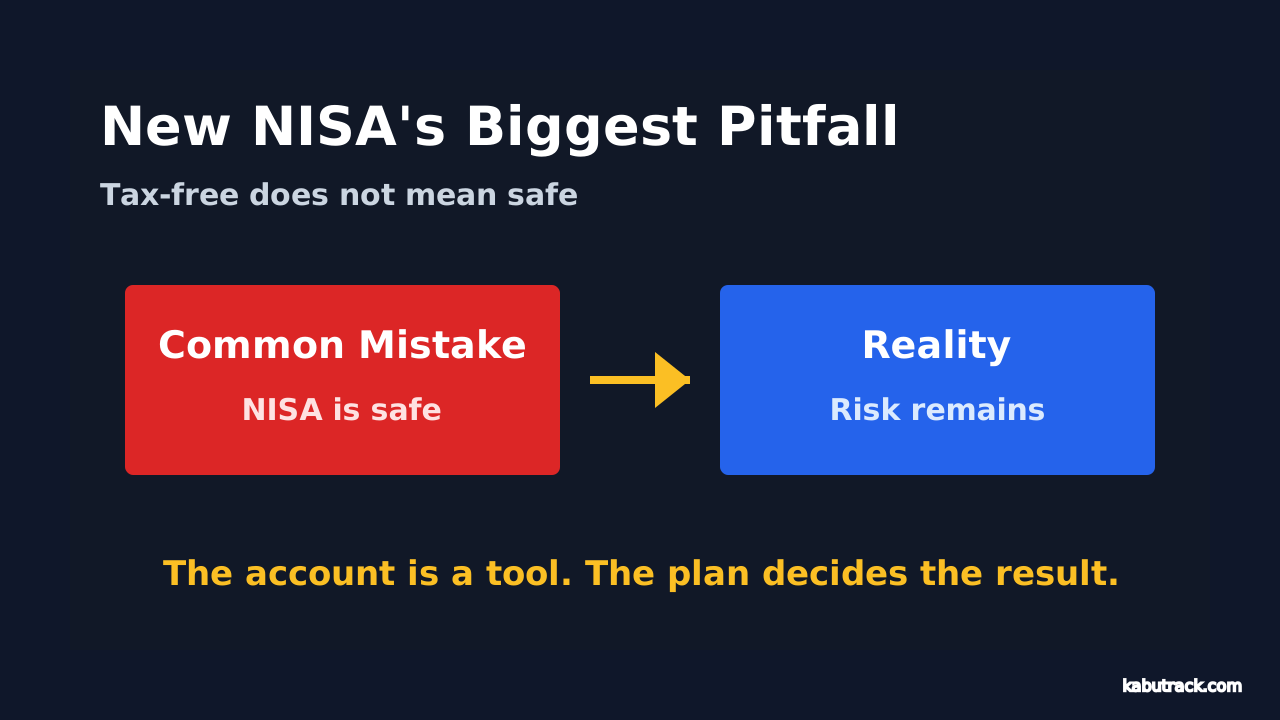
NISA is not safe simply because it is NISA.
What matters is what you hold inside it.
Pitfall 1: Thinking NISA Means Safety
Prices can fall even when the product is bought through New NISA.
For example:
Buy an investment trust in NISA
->
Global stocks fall
->
Portfolio value drops 30%
Or:
Buy an individual stock in NISA
->
Earnings deteriorate or a scandal occurs
->
Share price drops 50%
NISA is a tax-preferred system.
It is not principal protection.
It is not a bank deposit system with deposit insurance.
If this point is misunderstood, investors can end up with a vague belief that "because the government created it, it must be safe." That is not how investment risk works.
Pitfall 2: Concentrating in Individual Stocks Through the Growth Investment Quota
New NISA has a tsumitate investment quota and a growth investment quota.
One beginner mistake is filling the growth investment quota with only popular stocks.
There is a growth investment quota
->
AI-related stocks are trending
->
Buy only popular names
->
Losses become large when the theme falls
Individual stock investing is not bad in itself.
But individual stocks carry company-specific risk.
- Disappointing earnings
- Downward earnings revisions
- Scandals
- Dividend cuts
- Industry headwinds
- Currency and interest-rate effects
The growth investment quota is flexible. That flexibility also means the risk changes heavily depending on how it is used.
If a beginner fills the quota with only individual stocks from the start, the downside risk may stand out more than the NISA tax benefit.
Pitfall 3: Investing Because of FOMO
FOMO stands for Fear Of Missing Out.
In investing, it often looks like this:
A product becomes popular on social media
->
Everyone seems to be making money
->
You feel anxious because you do not own it
->
You buy near the high
FOMO investing can lose money inside NISA too.
In fact, because New NISA has a large tax-exempt investment capacity, some investors rush in with more money than they planned.
Be especially careful with:
- Theme stocks that have already surged
- Popular AI-related stocks
- Individual stocks heavily promoted on social media
- Investment trusts that gathered money very quickly
- Products noticed only because their distributions look high
Before buying, check at least three things:
- Why am I buying this?
- How long do I plan to hold it?
- What will I do if it falls?
If you cannot answer those questions, you may not be making an investment decision. You may simply be reacting to pressure.
Pitfall 4: Caring Only About Tax Exemption
NISA is a tax-exempt system.
That does not mean tax exemption should be the only reason to choose a product.
The first question in investing is whether there is a reasonable chance of profit.
Profit is generated
->
Tax on that profit becomes exempt
That is the order.
Compare these two cases:
| Case | Profit | Tax | After-tax amount |
|---|---|---|---|
| 1 million yen profit in a taxable account | 1,000,000 yen | About 200,000 yen | About 800,000 yen |
| 200,000 yen profit in NISA | 200,000 yen | 0 yen | 200,000 yen |
Tax exemption is a major benefit.
But it is not a reason to buy a low-return product or a product you do not understand.
NISA is not magic that increases returns. It reduces the tax burden after a return has been earned.
Pitfall 5: NISA Losses Cannot Be Offset Against Other Gains
This is easy to overlook.
If a loss occurs in a NISA account, that loss is treated as if it does not exist for tax purposes.
It cannot be offset against gains in a taxable account.
It also cannot be carried forward as a loss deduction.
For example:
NISA account: 300,000 yen loss
Taxable specific account: 300,000 yen profit
In this case, the NISA loss cannot be used to offset the taxable-account profit.
NISA is strong when there is a profit.
It does not provide a tax advantage when there is a loss. If you remember only "NISA is tax-free and therefore advantageous," you may miss this difference from taxable accounts.
This is another place where "NISA is better" is too simple.
Pitfall 6: Not Checking the Dividend Receiving Method
To receive listed-stock dividends tax-free in NISA, the dividend must generally be received through the securities company.
In Japanese, this method is commonly called kabushiki-su-hirei-haibun-hoshiki, or the stock-number proportional allocation method.
If you choose a method where dividends are paid directly into a bank account, dividends may still be taxed even if the shares are held in a NISA account.
People who invest only through investment trusts may not think about this. But anyone using NISA for individual stocks or ETFs should check it.
If your purpose is dividend investing through NISA, confirm the dividend receiving method with your broker before buying.
Pitfall 7: Misunderstanding the Selling Rule
New NISA is not a system where you can never sell.
You can sell when needed.
Under the NISA system from 2024 onward, if you sell a product, part of the lifetime tax-exempt holding limit becomes reusable from the following year onward.
But the amount that comes back is based on the book value, meaning the original acquisition cost, not the market value at the time of sale.
Buy a product for 1,000,000 yen
->
Sell it for 1,500,000 yen
->
The reusable limit from the following year onward is 1,000,000 yen
If this rule is misunderstood, investors may assume that the quota returns immediately or that the profit portion increases the available limit. It does not work that way.
NISA is useful for long-term investing, but real life can still require selling.
Home purchases, education costs, retirement funding, job changes, and self-employment can all change the plan.
Instead of saying "I will never sell," it is more realistic to plan with the possibility of selling included.
A Better Way for Beginners to Think About New NISA
Beginners are less likely to make a major mistake if they first build a core portfolio.
One practical framework is:
Core assets: 90%
-> Broadly diversified products such as global equities or balanced funds

Satellite assets: 10%
-> Favorite themes, individual stocks, high-dividend stocks, and similar ideas
This exact ratio is not mandatory.
The point is to take risk within a range that does not damage your daily life.
Use the tsumitate investment quota mainly for investment trusts suited to long-term, regular, diversified investing.
Use the growth investment quota, if needed, for a smaller allocation to individual stocks or ETFs you understand.
Separating those roles reduces the chance of putting the full amount into a product just because it is popular.
The Real Long-Term Trap Is Quitting Midway
Confusing the system with the product is a major New NISA pitfall.
But in long-term investing, the scariest mistake is often quitting midway.
During a market crash, the emotional pattern can look like this:
Portfolio value falls sharply
->
Fear rises
->
You stop regular investing
->
Anxiety grows
->
You sell near the low
Long-term investing does not mean participating only when markets rise.
It means continuing through weaker periods too, so purchase prices are averaged over time and the investor can use time as an ally.
Of course, you do not have to keep investing no matter what.
If you do not have enough living expenses, have debt, or are taking more risk than you can mentally tolerate, the investment amount should be reviewed first.
The important thing is not to start thinking after a crash has already happened. Decide before buying how much decline you can realistically withstand.
What to Decide Before Starting New NISA
Before starting New NISA, decide these five things:
| Decision | Example |
|---|---|
| Investment purpose | Retirement funds, education funds, housing funds, surplus asset building |
| Investment period | 10 years or longer, 20 years or longer |
| Monthly investment amount | An amount that does not strain household finances |
| Core product | Global equities, U.S. equities, balanced funds, and similar options |
| Selling rule | When emergency cash is insufficient, when a target amount is reached, and so on |
With this foundation, it becomes easier to avoid being pushed around by news and social media.
Without it, every popular product can start to look tempting.
New NISA is flexible.
That flexibility is exactly why investors need their own rules.
Conclusion
The biggest pitfall of New NISA is thinking:
NISA is safe, or using NISA means I will make money.
NISA is a tax-exempt system, not an investment product.
The key points are:
- NISA is a tax-exempt box
- Investment-product price risk does not disappear
- Risk changes greatly depending on how the growth investment quota is used
- Do not buy near the high because of FOMO
- NISA losses cannot be offset against taxable-account gains
- Check the dividend receiving method
- Reusable tax-exempt capacity comes back from the following year onward and is based on book value
- Build around core assets and continue for the long term
The people who succeed with New NISA are not necessarily the people who fill the tax-exempt limit the fastest.
They are the people who create an investment plan that fits their household finances, purpose, and risk tolerance, and then keep going.
The system is a tool.
To use it well, investors still need to decide what to buy, how much to buy, and how long to hold it.
Sources And References
- Financial Services Agency of Japan, NISA special website
- National Tax Agency of Japan, No.1535 NISA System
- Financial Services Agency of Japan, Eligible products for the tsumitate investment quota
- Checked on: 2026-05-30