
This article is general investment educational content and does not recommend the purchase or sale of specific financial products. Stock investments are subject to price fluctuation risk, credit risk, and liquidity risk, which may result in loss of principal.
Meaning of proverb
If you actually try to catch a falling knife with your hand, you will get hurt.
The same goes for investing; if you reflexively jump on a stock that is plummeting, you are likely to incur large losses.
For example, it is used in the following situations:
| Scene | What's at stake |
|---|---|
| Sharp decline after financial results | The deterioration in business performance may not have been factored in yet |
| Sudden decline due to scandal | Investigations, dispositions, lawsuits, and loss of trust may be prolonged |
| Sharp decline due to capital increase | Concerns about dilution and cash flow may remain |
| Entire market crash | Fire sales continue, and individual stocks may also be affected |
| Popular on SNS | Price movements tend to become wild when short-term funds are withdrawn |
What this saying says is, don't try to hit the bottom perfectly.
Even if you think "it's cheap because it's down 20%," that doesn't necessarily mean it's the bottom. A stock that has fallen from 1,000 yen to 800 yen may drop to 600 yen or even 400 yen.
Why is it dangerous to jump buy on rapidly declining stocks?
The reason that rapidly falling stocks are dangerous is not that the stock prices themselves have fallen.
The real danger is buying when the reason for the decline is not yet understood or resolved.
The main risks are as follows.
| Risk | Contents |
|---|---|
| Continuing negative news | The effects of deteriorating business performance and scandals do not end at once |
| Further decline | The price has fallen further from what you thought was "cheap" |
| Decrease in liquidity | You may not be able to sell at the desired price when you want to sell |
| Psychological burden | Unrealized losses increase, making it difficult to make calm decisions |
| Nanpin failure | Continuing to buy more without checking the reason for the decline |
The Japan Securities Dealers Association's investment education website also explains that stock investments are subject to price fluctuation risk and fluctuation risk due to the political and economic environment. During a sharp decline, these risks become more visible in the short term.
Especially for beginners, it is easy to confuse a drop in price with a "cheap price." Whether a stock is cheap or not is not determined by the stock price alone. You can only judge by looking at profits, cash flow, finances, growth potential, competitiveness, shareholder returns, and valuation.
Distinguish between during and after a decline
``Don't grab a falling knife'' doesn't mean you shouldn't buy any stocks that are on the decline.
The important thing is to differentiate between the period of a decline and the state of calm after a decline.
| Status | View |
|---|---|
| Falling | Unable to see the overall picture of negative factors, it is easy for fire sales to continue |
| Leveling off after a decline | Selling pressure weakens, making it easier to confirm the material |
| Early stage of reversal | Review may begin due to trading volume, financial results, and guidance |
For example, if a company's business performance has only temporarily deteriorated, but the company's finances are sound and demand is expected to return, it may become an investment opportunity after a sharp decline.
On the other hand, for companies that have structurally stopped making profits, companies with tight cash flow, and companies that have been affected by scandals for a long time, their stock prices may still be high even if they fall.
This is the difficult part.
There is a difference between stocks that look cheap and stocks that are truly cheap.
Bad buying practices that beginners tend to make
The buying methods that tend to fail in rapidly declining stocks are generally similar.
| Bad example | Problem |
|---|---|
| Buying because of a big crash | I don't see the reason for the decline |
| I bought it because I was told on social media that "now is the bottom" | I have no basis for it |
| Buy only by looking at the PER | If the profit forecast is revised downward, the PER will also change |
| Buying the entire amount at once | I don't have enough left in case the price drops further |
| Continuing to lower the average unit price with Nanpin | Easy to justify increasing losses |
Nanpin itself is not bad. However, it is dangerous to think that ``lowering the average unit price will help'' without investigating the reasons for the decline.
Stocks that have fallen sharply have volatile price movements and may rebound in the short term. Even if you feel relieved after seeing a rebound, it may drop again a few days later. We need to be careful about temporary rebounds such as so-called dead cat bounces.
Checklist to check before purchasing
If you want to buy a stock that has fallen sharply, check this item first.
- Can you explain in one sentence why it went down?
- Is the reason for the decline temporary or structural?
- How have sales, profits, and cash flow changed in the latest financial results?
- Are there any concerns about the equity ratio, borrowings, and financing?
- Have you confirmed the company's explanations and forecasts?
- Is there continued selling with high trading volume?
- Have you decided on the loss cut criteria when buying?
- Can you spread it out without putting in the entire amount at once?
If you cannot answer this check, deciding not to buy is also a good investment decision.
There is a saying, "It's worth taking a break." Waiting until the situation becomes clear is not a lost opportunity, but also risk management.
Illustration: Don't jump during a steep decline
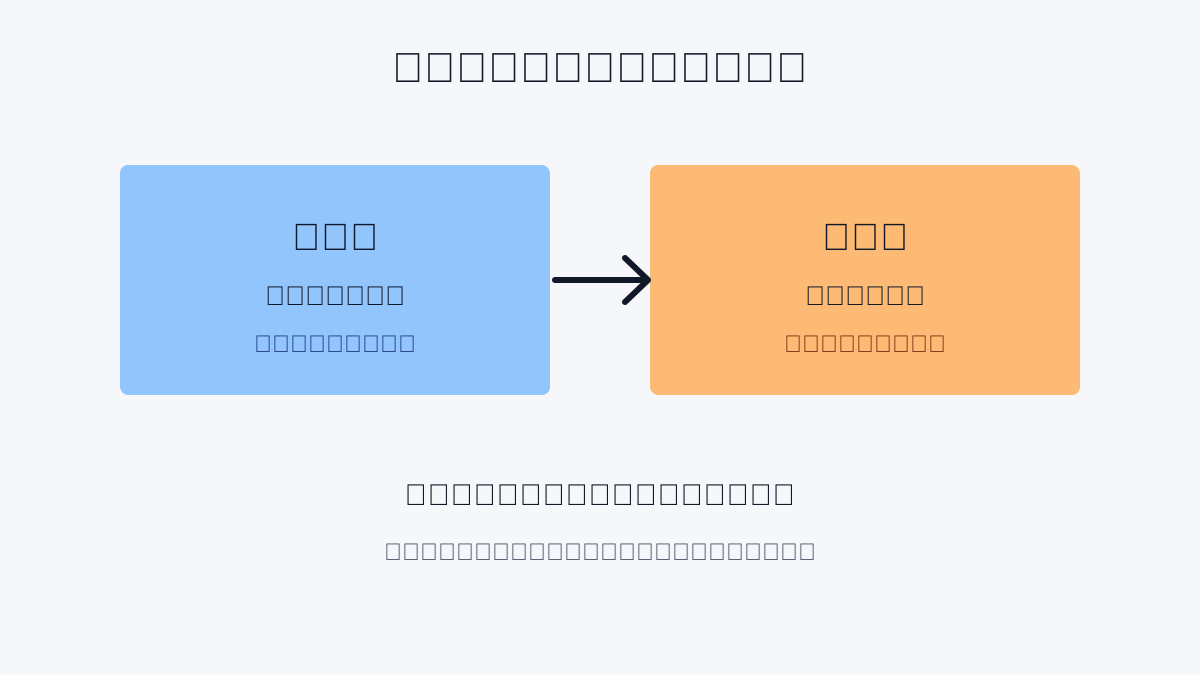
What do you think if you buy it?
If you're looking for investment opportunities after a sudden decline, it's better to think about it in stages, rather than investing the entire amount all at once.
In reality, the following steps are easy to use:
| Procedure | Contents |
|---|---|
| 1 | Check the reason for the decline |
| 2 | Read financial statements, financial statements, and company announcements |
| 3 | Wait until stock prices stabilize |
| 4 | Try with a small amount or diversify your investment |
| 5 | Deciding on withdrawal conditions in case expectations go wrong |
If you try to guess the bottom price, your judgment will be rough.
There is a saying that goes, "Give me your head and your tail." It is better for beginners to enter after the decline has stopped and business performance and supply and demand have been confirmed, rather than trying to take the first few percent of the bottom price.
Related sayings
When looking at plummeting stocks, it's a good idea to keep the following adage in mind:
| Proverb | Meaning |
|---|---|
| Give me head and tail | Don't try to hit the bottom or the top perfectly |
| Rest market prices | Don't force yourself to buy or sell, decide whether to wait |
| There is a path behind people's paths, a mountain of flowers | Contrarianism has value, but you need a basis |
| It's too late, it's still too late | Be careful of excessive market prices and premature judgment |
It is dangerous to use only one market maxim. During a sharp decline, it is necessary to simultaneously consider the appeal of contrarianism and the risk of a continued decline.
summary
``Don't grab a falling knife'' is a market adage that warns against jumping in and buying stocks that are plummeting.
The points to keep in mind are as follows.
- There is a reason for the sudden drop, and it may fall even further.
- “It became cheaper” and “it became cheaper” are different. *No one knows the bottom price
- Check the reason for the decline, performance, financials, and volume before buying
- Consider diversification and step-by-step purchasing methods rather than lump-sum investment
- When you cannot make a decision, waiting is also an investment decision.
Rather than looking at the fact that stock prices have fallen, look at why they have fallen.
Just by having this habit, you can significantly reduce the chances of jumping into stocks that are on the decline. The important thing for beginners is not to hit the bottom, but to stay in the market while avoiding catastrophic losses.