
New NISA system starts in 2024
New NISA is a NISA system that started in January 2024.
The main points advised by the Financial Services Agency as of June 18, 2026 are as follows.
| Item | Contents |
|---|---|
| Tax-free holding period | Unlimited |
| Account opening period | Permanence |
| Fresh investment limit | 1.2 million yen per year |
| Growth investment limit | 2.4 million yen per year |
| Annual investment limit | Total 3.6 million yen |
| Tax-free holding limit | 18 million yen |
| Upper limit of growth investment limit | 12 million yen |
| Reuse of quota | Book value of sold products can be reused from next year onward |
Compared to the old NISA, it is a system designed for long-term operation.
The important thing here is that just because the tax-free allowance is large, there is no need to use it up in a hurry. Some people can spend up to 3.6 million yen a year, while others start with 10,000 yen a month. It is better to consider the size of the system and the size of your household budget separately.
From the 2nd year onwards, look at the ``continuation mechanism''
Immediately after starting a new NISA, you will inevitably be concerned about your investment results.
Every time you open a securities account, you see unrealized gains and losses. If it goes up, I'm happy; if it goes down, I feel anxious. It's easy to stumble here.
However, what you should be looking at from the second year onward is not just short-term profits and losses.
1st year
  Account opening, product selection, savings settings

From 2nd year onwards
  Check whether the amount is sustainable, whether it fits the household budget, and whether the asset allocation is out of order.
The new NISA is a system that is easy to use for long-term asset formation, rather than a system that allows you to make quick profits through short-term trading.
Therefore, from the second year onward, rather than worrying about "I have to increase the number even more," I would like to check whether I can continue with this setting for 10 years.
Problems that tend to occur after the second year
I want to sell because I'm making a profit
If the market price is good from the first year onward, there may be a valuation gain.
At this point, it's easy to wonder if it's better to sell it now.
Selling itself is not a bad thing. Selling is an option if you have a purpose, such as purchasing a home, paying for education, or wanting to reduce risk.
However, if you sell just because you have made a small profit, you will shorten your long-term investment time. The new NISA has an unlimited tax-free holding period, so in many cases it makes more sense to continue holding it than to take short-term profits.
I want to decide whether to sell or not based on the purpose, not the amount of profit.
I get anxious because I have an unrealized loss.
On the other hand, there may be unrealized losses in the second year.
The prices of stocks and investment trusts go up and down. Even widely diversified products such as global stocks and US stocks typically fall in the short term.
There are two things I want to check here:
| Things to check | Points to see |
|---|---|
| Is it a product issue? | Is it high cost, concentrated investment, or overemphasis on the theme? |
| Is it a question of the amount? | Isn't the investment amount so large that you can't sleep when the market declines? |
If the product fits your long-term, diversified policy and your household finances are reasonable, there is no need to stop saving just because of short-term unrealized losses.
However, if you are investing money that covers your living expenses and will be used in the near future, it's a different story. Reduce reserve amount, increase cash, reduce risk asset ratio. Such adjustments are good risk management.
I am unsure whether to increase the investment amount or not.
Some people may be able to increase their savings through wage increases, bonuses, or a review of their expenses.
When considering an increase, it is better to check the following order rather than suddenly increasing it significantly.
- Do you have funds to protect your life?
- Are you investing money that you plan to use within six months to a year?
- Are your monthly balances in the red?
- Is the amount sustainable even during a downturn?
- Have you decided what purpose the increased amount will be used for?
Increasing the investment amount itself is not the correct answer.
It's more realistic to continue for a long time, even if it's a small amount, than to cancel your contract midway due to financial difficulties.
Checklist for the new NISA from 2nd year onwards
Are you able to continue saving?
The first thing to look at is not the investment performance, but whether the savings are continuing.
Monthly savings are automatic. There is no purchase error due to insufficient account balance. We also know the limits for credit card savings and bank withdrawals.
It's simple, but this is the foundation.
Are you cutting back on your livelihood defense funds?
The new NISA is suitable for long-term funds.
On the other hand, if you invest money that you can use right away, you will be forced to sell when the market price drops.
The standard of living defense funds differs from person to person. The amount required will vary depending on whether you are a company employee, a freelancer, a household with children, or whether you have a mortgage. It is easier and easier to continue investing if you first have a few months' worth of living expenses in cash and then decide on the amount to invest.
Is the asset allocation biased?
From the second year onwards, your asset allocation will change just by continuing to save money.
For example, when the stock market rises significantly, the stock ratio becomes higher than it was initially.
| Assets | Initial ratio | Ratio example after increase |
|---|---|---|
| Stock investment trust | 70% | 82% |
| Cash | 30% | 18% |
If a decline occurs in this state, the amount of assets will move more than expected.
It's a good idea to review the ratio of stocks, bonds, cash, and foreign currency assets even once a year. There is no need to make detailed adjustments every month, but if you leave it unattended for too long, the amount of risk may change.
Have you forgotten your investment purpose?
The new NISA is convenient, but it's easy to get lost if the purpose is vague.
The risks you can take will vary depending on your purpose.
| Purpose | Things to see |
|---|---|
| Retirement funds | Is it suitable for long-term investment of 20 years or more |
| Educational funds | Should you lower the risk when the time to use them approaches |
| Home purchase funds | If you plan to use it within a few years, are you investing too much? |
| Management of surplus funds | Can you accept price fluctuations |
Even though NISA is the same, the management concept is different for retirement funds and the down payment for a house in three years.
Compound interest is difficult to see in 2 years
Compound interest is a major weapon in long-term investing.
Compound interest is the idea that profits are added to the principal, and profits are added to the increased principal.
To simplify it, the future asset amount can be expressed by the following formula.
Future asset amount = principal × (1 + annual yield) ^ number of years of operationFor example, if you were able to invest at 5% per year for 20 years using simple calculations that do not take into account taxes, trust fees, exchange rates, and prices, this is what would happen.
1.05^20 = approximately 2.65The principal amount will increase approximately 2.65 times.
Of course, it does not necessarily increase at a rate of 5% every year. In reality, the market goes up in some years and down in other years. That's why it's too early to judge success or failure based solely on the results in the first or second year.
The important thing with the new NISA is to arrange the amount and product to be sustainable, rather than relying on high yields.
Mistakes that beginners often make
View asset amount every day
If you look at it every day, short-term price movements appear to be large.
Even if it's a few thousand yen or tens of thousands of yen, it moves your heart when you see it on the screen. This can lead to suspension of reserves and unnecessary buying and selling.
One idea is to reduce the frequency of confirmation from the second year onwards. For many people, reviewing once a month, once a quarter, or once a year is sufficient.
Switch to popular products one after another
When I look at rankings, social media, videos, and special features from securities companies, I see products that look good one after another.
However, if you switch repeatedly, your policy tends to change. Before purchasing a new product, I would like to explain why the current product is not suitable.
Change due to high fees
change to correct asset allocation
Change because the purpose has changed
If there is a reason for this, it will be reviewed.
If it's just because it's been going up recently, it's easy to just follow.
Stop saving when the market crashes
It's natural to feel scared when stocks go down.
However, with accumulated investment, you can buy more units when the price goes down. If you plan to continue investing over the long term, downturns are part of your savings.
Of course, if your household finances are tight, stopping your savings or reducing your amount is an option. The problem is the pattern of stopping just because of fear of the market price and then buying again when it goes up. If you repeat this, you will likely end up buying high and selling low.
forcefully increase the amount of investment
Because the new NISA allowance is large, some people feel like they are losing out if they cannot use the 3.6 million yen per year.
However, it is more important not to destroy the household budget than to use up the tax-free allowance.
Investing is done with surplus funds. There is no need to increase your credit card payments, mortgage, educational expenses, taxes, and social insurance premiums.
Themes I want to be aware of after 2026
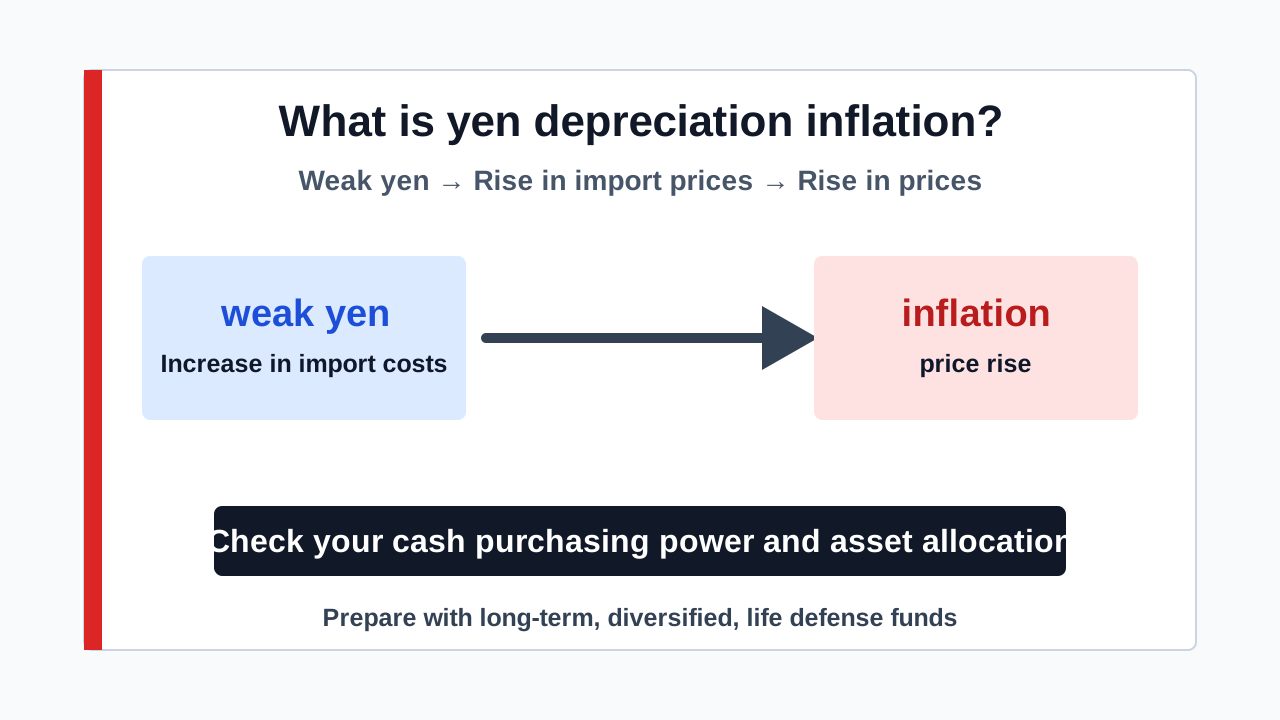
There are many topics of concern for the market after 2026, such as AI-related investment, semiconductors demand, weak yen inflation, wage pressure, rising interest rates, and geopolitical risks.
It's not bad to know about these topics.
However, in the savings part of the new NISA, the overall design of assets is more important than focusing on short-term themes.
Especially for beginners, consider the following steps.
- Decide on a reserve amount that makes sense for your household budget.
- Decide the investment purpose and investment period
- Focus on widely distributed products
- Limit thematic investings and individual stocks to a portion of your spare funds
- Review the policy only once a year
If you repeatedly change your savings policy in response to short-term news, the benefits of long-term investing will diminish.
Ideal behavior after 2nd year
The new NISA's actions from the second year onwards do not have to be flashy.
Rather, it is better to continue with simple inspections.
STEP1
Check your savings settings

STEP2
Check whether the household budget is reasonable

STEP3
Check asset allocation once a year

STEP4
Consider increasing the amount only when your income increases.

STEP5
Continue for 10 or 20 years
If you want to increase your investment amount, small adjustments such as increasing your investment by 10,000 yen each month, adding only a bonus month, or using only a portion of your wage increase are sufficient.
Conversely, in years when expenses increase, you can reduce the amount saved. Taking a pay cut in order to continue is not a failure.
summary
The new NISA will begin in 2024 and enter its second year in 2025. As of 2026, users will not only be at the stage of `getting started'' but also `checking how to continue''.
The points to keep in mind are as follows.
- The new NISA has an unlimited tax-free holding period and is easy to use for long-term investment.
- From the second year onward, confirm a system that can be continued rather than short-term profits or losses.
- Decide on increasing the amount of investment after looking at your daily life defense fund and household income and expenditure.
- The compound interest effect is difficult to see in 1 or 2 years, but becomes effective in 10 or 20 years.
- Even with NISA, there are still risks of loss of principal, exchange rate fluctuations, concentrated investment, and inability to calculate profits and losses.
The new NISA is not a shortcut to get results quickly.
Rather, it is important to set an amount that allows you to continue investing even if you become anxious along the way, check your asset allocation only once a year, and maintain a long-term, savings, and diversification strategy. The difference from the second year onward is more likely to be found in the ability to continue shopping that suits the household budget, rather than the flashiness of product selection.
reference
- Financial Services Agency "Know NISA", confirmed June 18, 2026. https://www.fsa.go.jp/policy/nisa2/know/
- Financial Services Agency "Frequently Asked Questions: NISA Special Website", confirmed on June 18, 2026. https://www.fsa.go.jp/policy/nisa2/question/
- Government Information Online "What is 'NISA'? Easy-to-understand explanation", confirmed June 18, 2026. https://www.gov-online.go.jp/article/202401/entry-5555.html
- Financial Services Agency, “Regarding publication of survey results regarding NISA account usage status (preliminary figures as of the end of December 2027)”, confirmed on June 18, 2026. https://www.fsa.go.jp/policy/nisa/20260218.html
- J-FLEC, Organization for the Promotion of Financial and Economic Education, “Reduce risk and grow wisely! Three points: long-term, savings, and diversification”, confirmed on June 18, 2026. https://www.j-flec.go.jp/public/learn/columns/%E3%83%AA%E3%82%B9%E3%82%AF%E3%82%92%E6%8A%91%E3%81%88%E3%81%A6%E8%B3%A2%E3%8 1%8F%E3%81%B5%E3%82%84%E3%81%99%EF%BC%813%E3%81%A4%E3%81%AE%E 3%83%9D%E3%82%A4%E3%83%B3%E3%83%88%E3%80%8C%E9%95%B7%E6%9C%9F/