
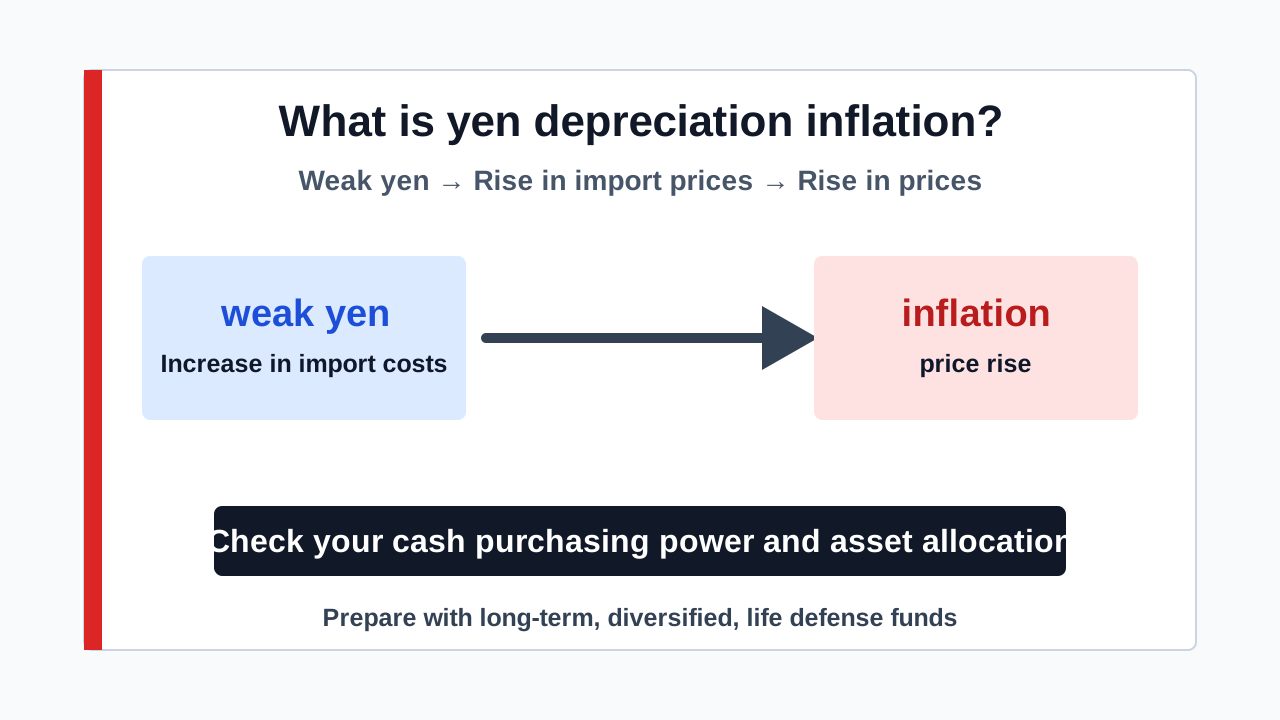
What is yen-depreciation inflation?
Inflation due to a weak yen refers to a rise in import prices due to a weak yen, which spreads its impact to domestic prices.
The flow is quite simple.
weak yen
  ↓
The yen-denominated prices of imported goods and raw materials will rise.
  ↓
Purchasing costs for companies increase
  ↓
Passed on to sales prices and service prices
  ↓
Household living costs rise
The Bank of Japan's materials also point out that the main channels when the yen weakens include positive effects on exports and inbound tourism, as well as downward pressure on corporate profits due to rising import costs and a decline in consumer purchasing power.
The depreciation of the yen and inflation is not determined solely by exchange rates. Factors such as crude oil, natural gas, wheat, soybeans, transportation costs, companies' stance on raising prices, wages, and government subsidies are also involved.
Still, in a country like Japan that relies on imports for many items, a weaker yen is an unavoidable factor when considering prices.
What is a weak yen?
A weak yen is a situation in which the amount of yen required to buy the same foreign currency increases.
| Exchange rate | View |
|---|---|
| 1 dollar = 100 yen | Yen is appreciating |
| 1 dollar = 150 yen | Yen weakening |
For example, let's say you import a $100 product from overseas.
| Exchange rate | Amount to pay in yen |
|---|---|
| 1 dollar = 100 yen | 10,000 yen |
| 1 dollar = 150 yen | 15,000 yen |
Even if the dollar price of the product itself remains unchanged at $100, if the yen depreciates, the price in Japanese yen will rise.
The actual import price also includes transportation costs, insurance premiums, customs duties, company profits, inventory, and price negotiations. Therefore, the amount of exchange rate movements does not necessarily show up in the store price. However, if the yen continues to be weak for a long time, companies will be forced to reflect this in their prices at some point.
This is where household finances come into play.
Things that are likely to rise in price due to the weak yen
The things that are most likely to be affected by yen depreciation and inflation are imported goods themselves and products and services that use imported raw materials.
| Field | Example | How to pay for household finances |
|---|---|---|
| Energy | Crude oil, LNG, coal | Gasoline charges, electricity charges, gas charges |
| Food | Wheat, soybeans, edible oil, imported meat, feed | Bread, noodles, sweets, eating out, livestock products |
| Daily necessities | Clothing, home appliances, miscellaneous goods | Store prices, shipping, repair costs |
| Corporate Activities | Raw Materials, Parts, and Transportation Costs | Price Increases in Final Products, Decrease in Profit Margins |
Data from the Agency for Natural Resources and Energy states that Japan's energy self-sufficiency rate in 2024 will be 16.4%, and explains that Japan is heavily dependent on foreign imports for fossil fuels such as oil, coal, and natural gas.
The Ministry of Agriculture, Forestry and Fisheries has also announced the food self-sufficiency rate for FY2020 as 38% on a calorie basis and 64% on a production value basis.
In other words, the impact of the weaker yen is not limited to just imported food becoming more expensive. This may include electricity costs, logistics costs, packaging materials, feed, and eating out costs.
Is a weaker yen good for companies?
A weak yen is not all bad.
Exporting companies and companies with large overseas sales tend to increase when sales and profits earned overseas are converted into yen. Dividends and profits from overseas subsidiaries may also appear large when converted to yen.
This is likely to be a tailwind for inbound tourism as well. From the perspective of overseas tourists, Japan's weak yen makes shopping and travel easier to see.
| Areas likely to receive a tailwind from the weak yen | Reasons |
|---|---|
| Exporting companies | Easily increases when foreign currency-denominated sales are converted to yen |
| Companies with large overseas sales | The yen equivalent of overseas profits tends to increase |
| Inbound related | Japan is easy to see as cheap for visitors to Japan |
| Foreign currency-denominated assets | The yen conversion value may increase |
However, it is not simple here either.
Even for exporting companies, costs will rise if raw materials are imported. Companies with a high proportion of overseas production may not be able to increase export volume as much as they used to because the yen is weaker. Even if a stock appears to have the advantage of a weaker yen, profits may not actually increase due to increased costs or the deterioration of overseas economies.
When looking at investments, it is necessary to check the sales currency, cost currency, production area, and price pass-through ability, rather than the label of ``company that benefits from a weak yen.''
Impact on household finances
For household finances, the weaker yen has a fairly modest effect on inflation.
Even if your salary remains the same, if the cost of food, electricity, gas, and eating out increases, you will have less money to spend. Even if your account balance does not decrease, the amount you can buy with the same amount of money will decrease.
This is a decline in purchasing power.
For example, suppose prices rise by 3% per year. To simplify things, what you can buy with 1 million yen today will be worth about 970,000 yen in one year.
1 million yen ÷ 1.03 = approximately 971,000 yenEven if the face value remains 1 million yen, the amount you can buy will change.
The important thing here is that we are not talking about cash being unnecessary. Cash is needed for sudden illness, unemployment, moving, broken home appliances, educational expenses, etc.
The problem is that you hold all your assets in cash and have no protection against long-term inflation.
What investors should think about
In the case of yen depreciation and inflation, it is easy to think of separating the roles of assets.
| Assets | Role | Notes |
|---|---|---|
| Cash/Deposits | Lifestyle defense funds, money to use soon | Difficulty keeping up with price increases |
| Japanese stocks | Look at companies' ability to pass on prices and the benefits of a weaker yen | Some companies are declining due to increased costs and worsening domestic demand |
| Foreign stocks/world stocks | As foreign currency-denominated assets, the yen equivalent value may increase when the yen is weak | When the yen returns to a strong yen, the yen equivalent value may decrease |
| Bonds | The role of stable income and suppressing price fluctuations | Prices may fall due to rising interest rates |
| Gold/Commodities | Candidates for diversification against currency depreciation | No interest or dividends |
If you hold foreign stocks in investment trusts or ETFs, the yen-equivalent value may rise when the yen depreciates. However, this is a tailwind from foreign exchange rates, and must be viewed separately from the rise in stock prices themselves.
Conversely, if the yen returns to appreciation, the yen-equivalent value of overseas assets may fall. Foreign currency assets can be a candidate for measures against inflation, but they also carry foreign exchange risks.
Yen depreciation inflation and long-term investment
Considering the weak yen and inflation, the topic of long-term investment and compound interest comes up.
Compound interest is the idea that profits are reinvested and incorporated into the principal, making it easier to generate future profits.
The basic formula is as follows.
A = P x (1 + r)^n

A: Future asset amount
P: Principal
r: Annual yield
n: Years of operation
For example, if the inflation rate is 3% per year and the investment yield on assets is 5% per year, the simple nominal yield will exceed inflation. However, this is just an assumption, and investment yields are not constant every year.
Stocks and investment trusts can go down significantly in the short term. Exchange rates also move. There are also fees and taxes.
Therefore, the countermeasure against yen depreciation and inflation is not just ``just invest immediately.'' It is important to first check your lifestyle funds, investment period, risk tolerance, and understanding of the product, and then choose assets that you can hold for a long time.
Points that beginners tend to misunderstand
A weak yen is always bad
Although this can easily be a burden on household budgets, it can be a tailwind for some companies.
It may work positively for exporting companies, companies with large overseas sales, inbound-related companies, and foreign currency-denominated assets. However, it is also necessary to take into account increased costs and the deterioration of overseas economies.
Your deposits are safe even with inflation
Deposits have a highly stable face value.
However, when prices rise, purchasing power falls. There is a difference between not losing the principal and being able to buy the same amount in the future.
If you invest, you can definitely protect it.
Investing involves risks of price fluctuations, loss of principal, exchange rates, fees, and taxes.
Even when investing as a countermeasure against inflation, it is dangerous to invest money that will be used in the short term. First, divide your life defense funds and then think about how to allocate long-term funds.
Checklist for investors
If you want to think about yen depreciation and inflation in terms of asset management, you should check the following in order.
- How much of your living expenses have increased in food, utilities, and fuel costs?
- Do you have cash for your daily life defense funds?
- Are you too biased towards deposits?
- Have you looked at the currency/region ratio of the investment trusts and ETFs you own?
- If you own Japanese stocks, have you checked their price pass-through power and exchange rate sensitivity?
- If you have foreign currency assets, can you withstand valuation losses if the yen returns to appreciation?
- Are you changing your asset allocation significantly just because of short-term news?
Although the checklist is simple, it will help you avoid buying and selling in a hurry due to news of a weak yen.
Currency exchange rates are difficult to read. Therefore, rather than trying to guess whether the yen will weaken or appreciate, it is more realistic to make sure that your household finances and assets will not suffer a major decline regardless of whether the yen moves in either direction.
Summary
Inflation due to a weak yen is a phenomenon in which a weak yen causes the yen-denominated prices of imported goods and raw materials to rise, pushing up domestic prices.
The points to keep in mind are as follows.
- When the yen weakens, the amount you pay in yen increases for the same foreign currency-denominated product.
- Japan relies heavily on imports for energy, food, and resources.
- Easily affected by food, utility bills, gasoline costs, and daily necessities
- It may be a tailwind for export companies and inbound-related companies
- There is a risk of decreasing purchasing power with cash alone
- Foreign currency assets and stocks are candidates, but there are risks of loss of principal and exchange rate risks.
In an era of weak yen and inflation, what is needed is not to throw away cash. Divide cash, investments, foreign currency assets, and living expenses by role.
By separating `money to protect'' and `money to grow over the long term,'' it will be easier to calmly face rising prices and exchange rate fluctuations.
Reference
- Bank of Japan "Outlook for Economic and Price Situations (January 2022) Box 1 Impact of Exchange Rate Fluctuations on Japan's Real Economy", confirmed on June 18, 2026. https://www.boj.or.jp/mopo/outlook/box/2201box1a.pdf
- Agency for Natural Resources and Energy, "Japan's Energy 2025 Edition 2. Stable Supply", confirmed on June 18, 2026. https://www.enecho.meti.go.jp/about/pamphlet/energy2025/02.html
- Ministry of Agriculture, Forestry and Fisheries, "Japan's Food Self-Sufficiency Rate", confirmed on June 18, 2026. https://www.maff.go.jp/j/zyukyu/zikyu_ritu/012.html
- Ministry of Internal Affairs and Communications Statistics Bureau "Consumer Price Index", confirmed June 18, 2026. https://www.stat.go.jp/data/cpi/