

First, the conclusion
Dainko's stop high on May 26th is difficult to explain based on fundamentals alone.
The company's main focus is EMS, or electronic equipment manufacturing contract services. The company handles substrate mounting, product assembly, optical equipment, automotive, medical, industrial equipment, and semiconductor manufacturing equipment. Not bad for a business theme. Rather, it is a stock that is easily associated with short-term funds when electronic components and semiconductors are being looked for.
However, looking at the latest financial results, organic profit is quite weak.
| Item | 1Q of the fiscal year ending December 2026 | Year-on-year comparison | Full-year plan | Progress rate |
|---|---|---|---|---|
| Sales | 9.557 billion yen | +7.6% | 41.000 billion yen | 23.3% |
| Operating income | 5.8 billion yen | -68.7% | 1.080 billion yen | 5.4% |
| Ordinary profit | 80 million yen | -62.0% | 980 million yen | 8.2% |
| Net profit | 262 million yen | +34.4% | 710 million yen | 36.9% |
Sales are increasing. However, operating profit is thin.
This is important.
This time's market price is more like a supply-demand situation where short-term funds were put into small-sized EMS stocks with low PBRs, and the market wouldn't hold up, rather than people simply buying on improving numbers.
Why did the stop rise?
Collapse of supply and demand due to ultra-small stocks
Dainikko has a small market capitalization. As of 862 yen on the morning of May 26th, the market capitalization is approximately 5.8 billion yen. As of the closing price of 619 yen on May 22nd, the value was approximately 4.2 billion yen.
Stocks of this size usually have low trading volume.
When short-term funds flood in, sell orders quickly dry up. It's not that the number of people who want to buy has increased, but that there are no people who want to sell. When this happens, stock prices tend to jump even with a small amount of capital.
It is more practical to view the high limit for micro-capital stocks as a phenomenon in which illiquidity is reflected in prices, rather than a large change in corporate value in one day.
Low PBR became an excuse to buy
Dainikko is also easily seen as a low PBR stock.
According to Yahoo! Finance, PBR as of 9:36 am on May 26, 2026 is 0.79 times. IRBANK's PBR as of May 22nd is 0.57x.
In other words, before the sudden rise, PBR was in the 0.5x range, and even after the sudden rise, it was below 1x.
It is sometimes talked about as being in the 0.4x PBR range, but based on the latest available market data, it is more accurate to see it as being in the 0.5x to 0.7x range.
After the TSE's request to improve PBR below 1x, small-cap stocks with low PBR have become more sought after. However, just because the PBR is low does not mean that the stock price will continue to rise.
What the market will ultimately look at is whether the company has the ROE, profit margin, and capital policy to overcome the low PBR.
Associative buying of semiconductor-related and electronic component stocks
Dainho is not a core company that manufactures semiconductor manufacturing equipment itself.
However, the company's business areas include electronic substrates, industrial equipment, semiconductor manufacturing equipment, automotive equipment, medical equipment, and optical equipment. When the market is looking for stocks related to semiconductors and electronic components, their names tend to come up as peripheral stocks.
This positioning of ``I'm not right in the middle, but I can relate'' is effective for small-cap stocks.
When thematic funds become sluggish in the favorite large-cap stocks, they sometimes flow into surrounding small-cap stocks. The rapid rise in prices of Dainikko is partly due to this trend.
Business model: What is EMS?
Dainikko's mainstay is EMS and Electronics Manufacturing Service.
Rather than selling final products under its own brand, it is a model in which it manufactures products and parts for customer companies on contract.
The company's business areas include board mounting, assembly of optical equipment and medical equipment, power supply development, unit assembly, and product manufacturing. The target fields are wide-ranging, including automotive, medical, OA equipment, social infrastructure, aerospace, and industrial equipment.
| Area | Contents |
|---|---|
| Board mounting | Electronic component mounting on printed circuit board |
| Optical equipment assembly | Optical/medical equipment assembly in a clean room environment |
| Automotive related | Demand for electronic components due to electrification and autonomous driving |
| Power supply development | Custom power supplies, BMS, charging circuits, etc. |
| ODM/prototyping | Design, prototyping, mass production support |
On the surface, it's quite thematic.
Automotive, semiconductor peripherals, medical, aerospace, power supplies, and board mounting. If you just look at this, it looks like a company that cuts across growth markets.
However, EMS has structural difficulties that investors tend to overlook.
Structural risks of EMS
Sales expansion is difficult to directly link to profit growth
EMS is not a business type that will immediately become highly profitable if sales increase.
As long as the manufacturing is contracted out to the client company, price negotiation power tends to lean more towards the ordering company. If the customer is a major manufacturer or Tier 1, the quality requirements are high and delivery times are also strict. On the other hand, it is not always possible to immediately pass on increased costs to prices.
In fact, in the first quarter of the fiscal year ending December 2026, although sales increased by 7.6% year-on-year, operating profit decreased by 68.7%.
This truly shows the difficulty of EMS.
There are sales. I also have a job. However, it is difficult to make a profit.
Automotive is growing, but it is not a market where you can easily make money.
Demand for automotive electronic components is likely to grow due to the trend toward EVs, ADAS, autonomous driving, and electrification.
Therefore, there is room for growth for EMS companies like Dainho.
However, quality requirements for in-vehicle products are extremely high. Certification, inspection, traceability, defect rate management, long-term supply, customer audits, etc. are more burdensome than for ordinary electronic devices.
Moreover, price negotiations are tough in the automobile industry.
Just because it's used in cars doesn't mean it's highly profitable. In fact, it is possible that the volume will increase but the profit margin will be thin.
Financial weight cannot be ignored either
Dainikko's equity ratio is 24.1% as of May 26, 2026 according to Yahoo! Finance, and 23.5% at the end of 1Q 2026 based on financial results.
As a manufacturing company, it is hard to say that the company has a lot of financial leeway.
In an EMS that requires overseas bases, capital investment, working capital, and parts procurement, the demand for funds tends to increase as sales increase. When interest rates rise, interest payments will also increase.
In the 1Q results, interest expense increased from 38.15 million yen in the same period last year to 59.76 million yen. For a small company, this difference is not trivial.
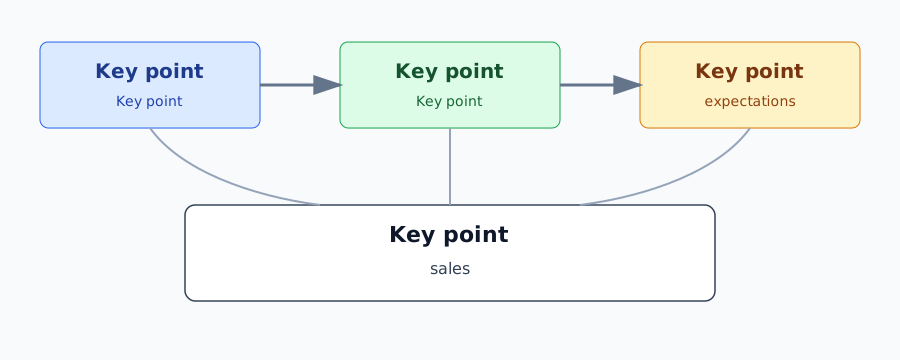
Diagram: The structure that caused this sharp rise
Future trends
Short term is prone to fluctuations
Micro-cap stocks, which have soared due to supply and demand, move rapidly both upward and downward.
There may be further purchases the day after the stop high, but the moment short-term funds are withdrawn, the stock becomes thinner and there may be a sharp fall.
In a market like this one, it's dangerous to just think that the stock is strong because it's going up.
It is necessary to distinguish whether the reason for the increase is business results or supply and demand.
View it as a peripheral stock rather than a favorite in the AI market
Dainikko is not an AI semiconductor design company, GPU manufacturer, or advanced exposure equipment manufacturer.
It is a peripheral brand responsible for EMS, electronic boards, product assembly, and power supply development.
That's why it's easy to buy lightly in the theme market. On the other hand, when theme funds leave, they return quickly.
Rather than being a favorite in the AI market, I would like to see it as a stock that is likely to move when the search for electronic components and semiconductors spreads to the surrounding area.
Progress towards full-year plan will be questioned
According to company plans, operating profit for the fiscal year ending December 2026 is 1.080 billion yen.
However, 1Q operating income was 58 million yen. The simple progress rate remains at 5.4%.
Of course, there are seasonality and project biases. There is no need to conclude that full-year results will not be achieved based solely on 1Q.
Still, the market will look to see improved progress in the next earnings report.
It is not enough to increase sales for automotive, industrial equipment, and semiconductor manufacturing equipment. Will the operating profit margin return, will price pass-through progress, and will interest expenses be absorbed? This will be our next focus.
Investment risk
1. Dependence on specific customers/fields
EMS companies are easily influenced by customers' production plans.
If customer companies adjust their inventories, orders will decrease. If model changes are delayed, production will be delayed. If procurement policies change, profitable projects may disappear.
In the case of Dainikko, the field is wide, including optical equipment, automotive equipment, industrial equipment, medical equipment, and semiconductor manufacturing equipment, but as it is contract manufacturing, it is impossible to avoid the investment and production plans of the customer.
2. Difficulty passing on costs
The biggest difficulty with EMS is passing on costs.
Even if parts, labor costs, logistics costs, electricity, or interest rates rise, it is not always possible to immediately pass the price on to customers.
Even if the operating rate increases, if the gross profit is reduced, there will be no profit left.
Profit over sales, cash over profit.
When viewing Great Nikko, you should check them out in this order.
3. Low PBR alone is not enough
PBR below 1x is likely to be a good buy.
However, we also need to look at the reasons for the low PBR.
If low ROE, thin profit margins, heavy finances, and low capital efficiency remain, PBR will not easily return to 1x.
For the PBR correction market to continue, it is necessary to improve profit margins, ROE, shareholder returns, or asset efficiency.
In the case of Dainikko, we are currently in a phase where `the company was bought because of its low PBR'' and not a phase where `we have confirmed an improvement in profitability that is enough to eliminate the low PBR''.
Checkpoints when looking at stock prices
If you want to see the future of Great Nikko, you should follow the following items.
| Check items | How to view |
|---|---|
| Trading volume | Do you have short-term funds left? |
| PBR | How far has the low PBR correction progressed |
| Operating profit margin | Has EMS returned to profitability |
| Full-year progress rate | Are we approaching the 1.080 billion yen plan |
| Interest expense | Is interest expense cutting into profits |
| For automotive/industrial equipment | Does it contribute not only to sales but also to profit? |
| Credit supply and demand, not lock-up | Rotation of margin purchases is also important for small-cap stocks |
In the short term, volume and board.
In the medium term, operating profit margin and cash.
The numbers you should look at will change depending on the time axis you look at.
Summary
Dainikko Engineering's stop high on May 26, 2026 should be seen as a combination of supply and demand for ultra-small stocks, low PBR, and associations related to electronic components and semiconductors, rather than a sudden recovery in business performance.
Demand for EMS, Dainikko's business model, is solid. There are a wide range of markets involved, including automotive, medical, industrial equipment, semiconductor manufacturing equipment, and optical equipment.
However, EMS has weak price negotiation power, and sales expansion does not directly lead to profit growth. In the first quarter of the fiscal year ending December 2026, sales increased, but operating income decreased significantly.
The current sharp rise in stock prices is a result of market expectations and weak supply and demand.
What is needed for sustained re-evaluation is not thematic nature. These are price pass-through, improved operating profit margin, profit contribution from automotive and industrial equipment, and improved financial position.
The surge in small-cap stocks looks attractive.
However, stocks that rose due to supply and demand will fall due to supply and demand.
If you are looking at Dainikko, you should calmly check whether profits will actually return in the next financial results, rather than getting into the heat of a stop high.
Reference information
- Yahoo! Finance “Dainko Engineering (6635)” stock price/reference index
- Dainikko Engineering “Summary of first quarter financial results for the fiscal year ending December 2026”, disclosed on May 15, 2026
- Dainikko Engineering “EMS (electronic equipment manufacturing contract service)”
- Dainikko Engineering “Business area”