

What happened first?
On May 20, 2026, GitHub announced ``Unauthorized access to GitHub-owned repositories'' on its official blog.
The facts that can be confirmed from official announcements are quite limited.
| Item | Contents you can check |
|---|---|
| Detection date | May 18, 2026 |
| Entry Point | Infringement of employee terminals related to poisoned VS Code extension released by a third party |
| Scope of impact | Preliminary assessment that the leak is limited to internal GitHub repositories |
| Number of cases | The attacker's claim of approximately 3,800 repositories is consistent with the investigation and sense of direction |
| Customer Impact | No known impact to customer Enterprises, organizations, or repositories |
| Response | Deletion of malicious extensions, device isolation, rotation of important secrets, log analysis, additional monitoring |
What's important here is that we're not talking about "the entire GitHub was hijacked."
GitHub notes that the current impact is limited to access to internal GitHub repositories. There was no announcement that external user repositories or enterprise customers' GitHub Enterprise data was directly compromised.
However, this is not a reassuring story either. Internal repositories can contain production code, internal tools, configuration information, support snippets, and hints for future attacks. For an attacker, a "map" that can be used for the next infiltration may be more valuable than personal information that can be immediately turned into cash.
Why is it so shocking?
GitHub is developer infrastructure itself.
Companies around the world manage their code on GitHub, run CI/CD with GitHub Actions, and use GitHub Packages, Dependabot, and GitHub Advanced Security. GitHub was attacked not through a server zero-day, but through a developer terminal and VS Code extension.
It's heavy here.
Traditional security investments tend to focus on external perimeters, firewalls, EDR, SASE, identity management, and cloud configuration audits. Of course they are necessary. However, developer terminals are a little different. You have local code, you have tokens, you have SSH keys, you have cloud CLI, you have npm and PyPI credentials.
From the attacker's perspective, the developer PC is a "small production environment within the company."
What's more, VS Code extensions run in the developer's workspace. Can read files. Touch the terminal. It is similar to Git authentication information and environment variables. The more convenient the extension is, such as AI coding support, formatter, test support, and cloud integration, the more permissions it will have.
This incident made GitHub's own structural weaknesses visible.
Organize the attack flow
The current flow can be summarized as follows, combining the news reports and GitHub official announcement.
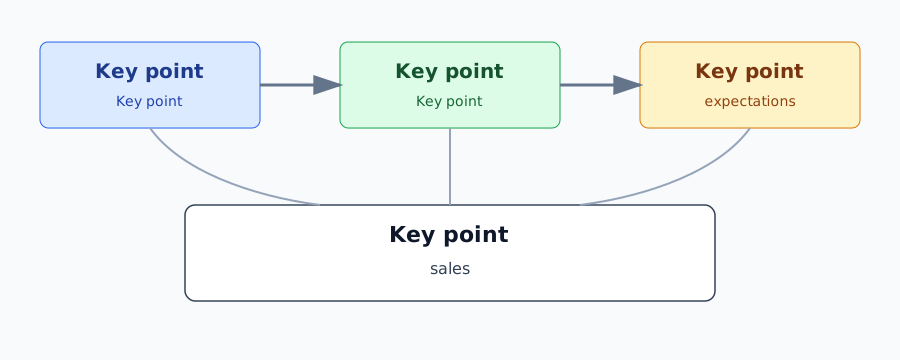
First, the attacker poisons a third-party VS Code extension. The extension then runs on the employee terminal. From there, credentials and permissions are used to access internal repositories.
This trend is not a frontal breakthrough.
Steal credentials. Enter with proper authority. From the inside, communications and operations look ``just like that''. Therefore, it is difficult to detect.
Herein lies the fear of supply chain attacks. Use trusted tools, trusted developers, and trusted credentials instead of directly attacking vulnerable servers.
What we know about TeamPCP
The latest breach is claimed by a threat group called TeamPCP.
The official GitHub announcement does not specify the name of the attacker. Meanwhile, multiple reports say TeamPCP claims access to approximately 4,000 internal repositories and is attempting to sell stolen data for as much as $50,000.
IT Pro describes TeamPCP as a supply chain attack group associated with the Mini Shai-Hulud worm that steals CI/CD credentials and uses them to release infected packages. VentureBeat reports that the Google Threat Intelligence Group is tracking TeamPCP as UNC6780.
This is where we need to separate officially confirmed facts from press-based attributions.
| Classification | Treatment |
|---|---|
| Officially confirmed by GitHub | Infringement of employee terminals, poisoned VS Code extension, internal repository leak, consistency with approximately 3,800 claims |
| Report-based | TeamPCP's involvement claims, sales claims for $50,000, and connections to other campaigns such as Mini Shai-Hulud |
| Undetermined | Complete details of leaked data, impact on customers, final purpose of attacker, scale of secondary damage |
The most dangerous thing about security articles is mixing them up.
You cannot write "GitHub named TeamPCP." At the moment, we are looking at a combination of the attack vector published by GitHub and the attacker's claims reported by external media.
Why VS Code extensions are dangerous
VS Code extensions are useful.
But convenience is two sides of the same coin.
Extensions access files in your workspace, execute commands, and operate close to the environment where Git, cloud CLIs, package management tools, and AI agent configuration files reside. It is easier to access the deeper aspects of the development device than just a browser extension.
Moreover, developers frequently replace extensions.
Code completion, linters, themes, testing support, DB connectivity, Docker, Kubernetes, AI coding assistance. All are directly related to daily work. Installation decisions are influenced by the speed of the site, and security reviews tend to be postponed.
Ideal for attackers.
No need to look for flashy vulnerabilities. They create tools that seem useful, hijack existing extensions, publish extensions with similar names, and mix malicious code into updates. The developer will bring it in themselves.
Risks have increased in the AI era
In 2026, the number of AI tools will rapidly increase at the development site.
AI coding agent, CLI, MCP server, IDE extension, in-house code search, test generation, vulnerability remediation support. Developers have more tools and more power.
AI agent-based tools are particularly difficult to use.
Read code, modify files, run tests, and interact with browsers and terminals. The core of convenience becomes the attack surface. Mixed with malicious configurations, prompt injections, bogus dependencies, and tainted extensions, AI tools can automate the attacker's work.
We are starting to see a market here. The focus of cybersecurity investment is expanding from the traditional "protecting networks" to "how to protect trust in development and AI operations."
Practical issues faced by companies
Looking at this incident, there are clear issues that companies should consider immediately.
| Area | Practical questions |
|---|---|
| IDE extension management | Who uses which extensions and in which versions |
| Update the extension | Allow automatic updates or lock to verified versions |
| Secret management | Are there any long-lived tokens or plaintext keys left on the development device? |
| Repository authority | How many repositories can be accessed from one developer terminal |
| CI/CD | Are the publishing permissions for Actions, npm, PyPI, and Docker Hub too strong? |
| AI Tools | How much does an AI agent touch files, shells, and external communications |
| Audit log | Is it possible to detect abnormal access using regular tokens |
Honestly, this must still be rough for many companies.
Contains EDR. There is also an MFA. SASE was also introduced. Even if they have progressed to that point, there are not many companies that have taken inventory of VS Code extensions, internal permission lists, minimum extension age policies, and restrictions on repository permissions from development terminals.
This incident pierces that gap.
Benefit areas that are easy to see in the market
If you look at it as an investment theme, the benefits are not simply "cyber security in general", but are quite developer-oriented.
| Area | Reasons for the direction of demand |
|---|---|
| Software Composition Analysis | Understanding npm, PyPI, OSS dependencies and vulnerability management |
| Secrets detection / rotation | Detect and update tokens remaining on Git, CI/CD, and devices |
| CI/CD security | Control GitHub Actions, package publishing, signing, and permissions |
| Developer endpoint security | Protect development devices as high-risk assets separate from regular devices |
| Code security / ASPM | See code, dependencies, settings, and cloud permissions all in one |
| Artifact signing / provenance | Verifying the provenance of packages and build artifacts |
| Browser/IDE governance | Manage the use of extensions, plugins, and AI tools |
Representative companies and product groups include GitHub Advanced Security, Snyk, JFrog, Sonatype, Socket, Endor Labs, Aikido Security, Chainguard, Aqua Security, Wiz, CrowdStrike, Palo Alto Networks, and Okta.
However, I would like to take a calm look at this as well.
Just because an incident has occurred, it does not necessarily mean that the related stocks will become profitable immediately. Even as security budgets increase, purchasing decisions are slow. There is also a lot of overlap with existing tools. Rather than adding new tools, CISOs may first rework their existing identity management, EDR, SCA, and CI/CD privilege designs.
Fear is what is easily bought in the market, but what reflects performance is introduction, renewal, contract unit price, and cancellation rate.
Views on GitHub and Microsoft
For Microsoft, this incident looks pretty bad.
GitHub is a developer platform under Microsoft, and VS Code is also at the center of Microsoft's developer ecosystem. This attack, at least visually, appears to be an attack on GitHub, a company owned by Microsoft, within a Microsoft development environment.
Of course, this isn't a story about Microsoft's entire cloud being broken. GitHub is also proceeding with containment, secret rotation, and log analysis.
Still, confidence in developer security has suffered. GitHub Advanced Security, Copilot, Actions, Codespaces, VS Code The more you expand your extension ecosystem, the greater the accountability for how you manage your extensions and AI tools.
In the long run, this also gives GitHub reason to strengthen its security products. In the short term, improvements to marketplace screening, extended privilege display, enterprise controls, device isolation, and AI tool management will be required.
Future changes
After this incident, some changes should proceed in the development organization.
First, let's allowlist the VS Code extension. From free installation to operation using only company-approved extensions.
Next, review automatic updates. Convenient automatic updates can cause more damage if a malicious version is distributed even for a short time. Operations such as updating after a certain period of time, passing it through a verification environment, and fixing the version are increasing.
The third is zero trust for development devices. It is no longer acceptable for all repositories to be accessed from the developer's PC. Repository permissions, token lifespan, terminal posture, network routes, and CI/CD issuing permissions need to be finely tuned.
The fourth is the management of AI agents. AI coding tools speed up development, but because they touch on local files, secrets, external communication, and shell execution, they are as much or more controlled than IDE extensions.
Things developers should check immediately
There are practical lessons not only for enterprises, but also for individual developers and small teams.
- Delete unused VS Code extensions
- Check the extension's publisher, number of installations, update history, and permissions
- Review the most recently installed or updated expansions
- Inventory tokens from GitHub, npm, PyPI, cloud, 1Password, Vault, etc.
- Move long-lived tokens to short-lived/least privilege
- Minimize repository privileges
- Regularly rotate CI/CD secrets
- Control automatic updates of extensions in critical projects
The important thing here is not to stop everything out of fear.
If you don't use developer tools, you won't be able to do your job. That's why we control it based on the premise of its use. We've reached the point where IDE extensions, CLIs, AI tools, packages, and CI/CD should be treated as "executable code" rather than "useful tools."
Summary
This GitHub internal repository breach is not just an isolated GitHub incident.
This incident shows that the developer's work environment itself has become the company's supply chain.
As far as we can confirm from GitHub's official announcement, the impact is limited to GitHub's internal repositories, and no impact on customer repositories or Enterprise data has been confirmed. Still, the scale of approximately 3,800 cases, the entry point of VS Code extension, and the need for secret rotation are quite heavy.
Software development in the AI era is faster, more automated, and runs more third-party code. Convenience will increase. This increases the amount of room an attacker can gain entry into.
The 2026 cybersecurity market will see more than just traditional perimeter defense. There is a demand for "developer security" that collectively protects developer terminals, IDEs, AI agents, OSS dependencies, CI/CD, and secret management.
This incident gave the market a much clearer picture of why the budget moves.
source
- GitHub Blog, Investigating unauthorized access to GitHub-owned repositories
- IT Pro, GitHub internal repositories exfiltrated via malicious VS Code extension
- Tom's Hardware, Hacker group hits 3,800 internal GitHub repositories via poisoned developer plugin
- VentureBeat, GitHub confirms 3,800 internal repos stolen through poisoned VS Code extension as supply chain worm hits Microsoft’s Python SDK