

First, the conclusion
Nokia's true nature is no longer that of a company that lost out on mobile phones.
The most important thing about Nokia today is that the company is not focused on the AI calculations themselves, but rather on the communications infrastructure needed to run the AI.
In the AI market, it will not scale if three things are missing: GPU, power, and communication network. If NVIDIA is a company that owns GPUs and AI computing infrastructure, Nokia is investing in peripheral data center connectivity, optical networks, IP routers, AI-RAN, and 6G.
In short,
NVIDIA = AIKey point
Nokia = AIKey point
That is the view.
This is also the reason why the market has begun to reconsider Nokia. Rather than being a memory of past mobile phone brands, it is being reevaluated as a physical infrastructure stock for AI data center investment.
However, I would like to take a calmer view here. Although AI & Cloud is growing rapidly, it will only account for 8% of group sales as of Q1 2026. For Nokia's stock to be evaluated as an AI stock all at once, it needs to confirm that orders will turn into sales and profits, and that AI-RAN will be a profitable investment for telecommunications carriers.
Company Overview
Nokia is a telecommunications infrastructure company headquartered in Finland.
The company used to have a strong impression of mobile phone terminals, but its current business is centered on BtoB. It provides fixed, mobile, optical, and IP network-related technologies for telecommunications carriers, cloud providers, hyperscalers, governments, and industrial companies.
The official outlook from 2026 is that the main forces will be organized into the following two segments.
| Segments | Main details | Key points for investors |
|---|---|---|
| Network Infrastructure | Optical Networks, IP Networks, Fixed Networks | AI data centers, optical communications, DCI, IP routers |
| Mobile Infrastructure | Core Software, Radio Networks, Technology Standards | 5G/6G, AI-RAN, Patent Licenses, Base Stations |
There are also Portfolio Businesses, but in the context of AI infrastructure investment, the focus is on Network Infrastructure and Mobile Infrastructure.
Of particular importance is that Nokia completed its acquisition of Infinera in February 2025. This acquisition, announced in 2024, was meant to strengthen its connection to optical networks and webscale customers. This is an opportunity for optical communications to expand its reach at a time when demand for communications for AI data centers is increasing.
Recent materials
There are mainly four recent materials that can be confirmed as of May 26, 2026.
| Materials | Content | Implications for the market |
|---|---|---|
| Q1 2026 financial results | Comparable operating profit increased 54% year-on-year | Profit improvement confirmed by numbers |
| AI & Cloud orders | 1 billion euro orders received in Q1 | Focused as a leading indicator of sales |
| Optical/IP Networks Outlook Revised Upward | Optical Networks and IP Networks Growth Expected to 18-20% | Demand for AI Data Centers Has Started to Enter the Earnings Outlook |
| Partnership with NVIDIA | NVIDIA invests $1 billion in Nokia to jointly promote AI-RAN and 6G | Raise expectations, but confirmation of profitability is yet to be seen |
Reuters reports that after the Q1 results on April 23, 2026, Nokia stock rose to its highest level in 16 years. This is more than just a reaction to the financial results, but rather the result of a growing belief that demand for AI data centers will come to Nokia as well.
The market is no longer looking at the AI market based solely on GPUs. Evaluations are expanding to include power, cooling, optical communications, networks, and data center connections. In this trend, Nokia was reconsidered.
How to view performance
The numbers for Q1 2026 show Nokia's changes quite honestly.
| Indicators | 2026 Q1 | Perspective |
|---|---|---|
| Comparable sales | 4.50 billion euros | +4% year-on-year after currency and portfolio adjustment |
| Comparable operating profit | 281 million euros | 54% increase compared to previous year |
| Comparable operating profit margin | 6.2% | 200bp improvement compared to the previous year |
| Sales for AI & Cloud customers | 49% increase year-on-year | Still 8% of company-wide sales, but growing quickly |
| AI & Cloud orders | 1 billion euros | Points to confirm future sales |
| Optical Networks sales | 20% increase year-on-year | Easy to see benefits of AI data center connectivity |
The important point here is that overall sales are not growing explosively. If you only look at the growth rate of the group as a whole, it still looks modest.
However, the stock market is looking at changes in the mix rather than company-wide sales.
If orders for optical networks, IP networks, and AI & Cloud grow, Nokia will change from being a mature communications equipment manufacturer to a growth stock in the AI infrastructure periphery. This is the focus of re-evaluation.
Conversely, if orders for AI & Cloud stall or the growth of optical networks is seen as temporary, the current evaluation is likely to erode.
Business structure
Nokia's revenue sources can be easily understood by dividing them into four main categories.
1. Optical network and data center connectivity
This is the area where the market is most responsive.
In generative AI, the bottleneck is not only the computational performance of the GPU, but also the speed of data movement. It is necessary to connect GPU clusters, data centers, and cloud locations with high speed and low latency.
Therefore, demand for optical networks and DCI, or Data Center Interconnect, will grow.
In this area, Nokia will combine optical transport, coherent optical technology, IP routing and network automation. The acquisition of Infinera also has great meaning in this context.
2. IP Network
AI data centers don't work on servers alone.
Processing large amounts of data requires IP routers, switches, gateways, and network management. Nokia explains that the number of design projects for AI & Cloud applications in IP Networks is increasing.
Competition is strong here as it overlaps with the areas of Cisco, Arista, and Juniper. Still, Nokia's ability to offer optical and IP together is a strength.
3. Mobile infrastructure and AI-RAN
AI-RAN is a concept that incorporates AI processing and GPU acceleration into radio access networks.
Traditionally, base stations were basically equipment that processed communications. AI-RAN runs communication processing and AI processing on the same infrastructure and extends it to network optimization, edge AI, and real-time processing for industrial applications.
Nokia and NVIDIA are partnering for AI-RAN and 6G. NVIDIA announced in October 2025 that it would invest $1 billion in Nokia.
Expectations are high. However, it is better to view this as a stage in which to move from demonstration to customer testing. As of Q1 2026, Nokia has explained that it is on track to begin customer testing of AI-RAN within the year.
4. Technology Standards and Patent Licenses
Although this is a modest area, it is an area that supports Nokia's profit quality.
Technology Standards is the former Nokia Technologies. It has intellectual property related to 5G, wireless communications, video, and communication standards, and earns patent license income.
This business is a little different from the capital investment cycle for communications equipment. Of course, it will be affected by contract renewals, lawsuits, and regulations, but if things go well, it will become a source of cash flow with high profit margins.
If you look at Nokia only as an AI infrastructure growth stock, it's easy to overlook the underpinnings of this patent license. In fact, the combination of growth and cash-generating areas is what makes Nokia's investment story.
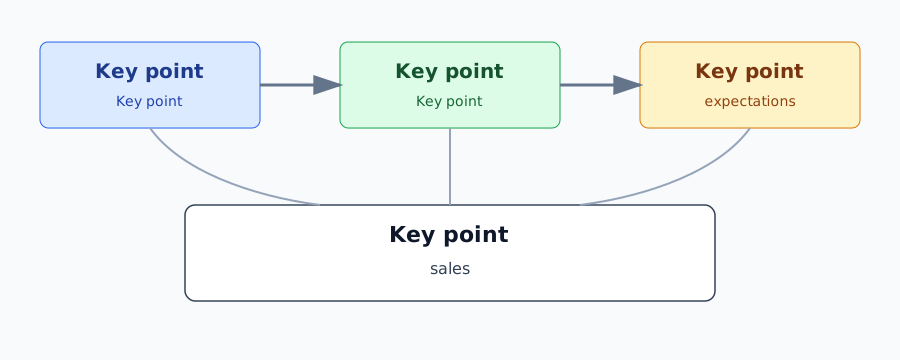
Diagram: Nokia's target AI infrastructure location
Interpretation in the stock market
Reevaluating Nokia is not a simple matter of ``buying anything related to AI.''
Rather, it reflects that the AI market has entered the second stage.
From 2024 to 2025, the main players in the market will be GPUs, semiconductor manufacturing equipment, HBM, and advanced packaging. As we enter 2026, we will begin to see the physical infrastructure needed to actually operate AI. They are power, cooling, optical communications, data center connectivity, and network automation.
Nokia will be responsible for communications and networks.
If this view expands, Nokia's valuation will be easier to see as a piece of AI infrastructure rather than as a traditional communications equipment maker. This is where there is room to reevaluate stock prices.
However, there is also a hint of anticipation.
Although AI & Cloud sales are growing, it is still too early to say that it will become a pillar of the entire company. AI-RAN also has great future potential, but the question remains how much telecommunication carriers will invest in it and how much they will be able to monetize it.
The numbers are good. However, I think the market is at a stage where it wants further confirmation.
Bullish scenario
In the bullish scenario, Nokia is valued as a communications infrastructure company in the era of AI data centers.
The conditions are as follows.
| Conditions | Meaning in the stock market |
|---|---|
| AI & Cloud orders continue to accumulate | Growth does not appear to be temporary |
| Growth rates of Optical Networks and IP Networks remain high | Recognized as an AI data center connection stock |
| Infinera integration leads to improved profit margin | Acquisition effects confirmed |
| AI-RAN customer test progressing smoothly | Becoming a new growth theme before 6G |
| Technology Standards generates stable cash | Becomes a profit source that supports growth investment |
In this case, Nokia's perspective will change from a `mature stock in communications equipment'' to a `regrowth stock in AI infrastructure.''
If Nokia increases its presence in optical communications and IP networks for hyperscalers, investors will no longer evaluate Nokia based solely on traditional carrier capital investment cycles.
Bearish scenario
The bearish scenario is also clear.
Although Nokia has acquired an AI theme, it is still a communications infrastructure company. Subject to investment restraints by telecommunications carriers, intensified competition, material restrictions, price competition, exchange rates, and geopolitical risks.
| Risks | Points to watch |
|---|---|
| Slowdown in communications carrier investment | Impact on Radio Networks and Core Software |
| Anticipating advance demand for AI & Cloud | Will orders turn into sales and profits |
| Delay in commercialization of AI-RAN | Will demonstrations come to an end |
| Intensifying competition | Competition with Ericsson, Huawei, Cisco, Arista, etc. |
| Infinera Integration Risks | Synergies, Costs, and Customer Retention |
| Uncertainty in Patent Licensing | Impact of Contract Renewals, Litigation, and Regulation |
What I would like to pay particular attention to is the monetization of AI-RAN.
AI-RAN is strong as a story. However, for carriers, there are issues of capital investment, power costs, operational complexity, and return on investment. There's a difference between being technically interesting and being bought by a carrier on a large scale.
If the market misunderstands this, it is likely that the market will buy in anticipation and then sell in disappointment.
Featured KPIs
When looking at Nokia's future, I want to follow the next KPI before looking at the stock price itself.
| KPI | Why is it important |
|---|---|
| AI & Cloud sales growth rate | Are AI themes turning into actual sales |
| AI & Cloud order amount | Important as a leading indicator |
| Optical Networks sales growth rate | Strength of data center connectivity demand |
| Design adoption and orders for IP Networks | Presence inside and outside of AI data centers |
| Network Infrastructure operating profit margin | Is growth accompanied by profit |
| Number of customer trials and commercial projects for AI-RAN | Transition from story to sales |
| Technology Standards Sales/Profit | High profit margin Stability of cash source |
| Infinera integration synergies | Will the acquisition be a profit contribution rather than a burden |
Personally, I think the first thing to look at is AI & Cloud orders and Optical Networks' profit margin, rather than the AI-RAN news.
AI-RAN tends to make headlines. However, optical and IP networks, for which demand is already visible, are most likely to have an impact on short- to medium-term performance.
Summary
Nokia hasn't come back as a smartphone company.
Rather than a revival, it would be more accurate to say that the company has begun to be reevaluated as a different company.
Nokia in 2026 is a B2B communications infrastructure company that combines optical communications, IP networks, AI-RAN, 6G, and patent licensing for AI data centers. If NVIDIA wants to take control of the computing infrastructure for AI, Nokia is going after the network infrastructure that connects AI.
On a bullish note, Nokia will be a beneficiary in the communications space as the AI market expands from GPUs to physical infrastructure.
However, the stock market is already starting to see the potential. From here on, we will confirm the profit contribution of AI & Cloud orders, optical network growth, IP network adoption, AI-RAN customer testing, and Infinera integration.
Nokia is interesting. However, it cannot be said that the company has been fully proven as an AI infrastructure company yet.
The numbers started coming in. Next is continuity.
source
- Nokia “Corporation Interim Report for Q1 2026”
- Nokia “Q1 2026 Financial Results presentation”, published in April 2026
- Nokia “New strategy, operating model and long-term financial target”
- Nokia “Infinera acquisition completion”
- Nokia “NVIDIA strategic partnership”
- NVIDIA “Nokia AI platform for 6G”
- NVIDIA “T-Mobile and partners AI-RAN-ready infrastructure”
- Reprint from Reuters "AI boom lifts Nokia sales, shares hit 16-year high after earnings beat"