

First, the conclusion
Rather than explaining TMH's sudden rise solely in terms of business results, it is more natural to look at it in terms of a combination of supply and demand and themes.
There are three main materials.
- Large holdings in Simplex Asset Management
- Semiconductor-related stocks based on AI and data center investment *Low supply and demand due to small growth stocks with a market capitalization of just under 10 billion yen
TMH's business is interesting.
It is a company that handles the semiconductor factory aftermarket, that is, equipment parts, repairs, used equipment, and procurement support, and has a cross-border e-commerce platform called ``LAYLA-EC.'' The story of digitalizing procurement for semiconductor factories is quite easy to understand.
However, stock prices are already far ahead of the curve.
As of May 25th's closing price of 2,320 yen, Yahoo! Finance's expected PER was 34.22 times, actual PBR was 6.31 times, and market capitalization was 8.678 billion yen. While it's not yet huge for a small-cap stock, its valuation clearly includes growth expectations.
From here on, the focus will be on whether the market can move from the supply and demand market to the performance confirmation market.
Why was the stop high recently?
Large holdings of Simplex became a catalyst
The large shareholding report received on May 19, 2026 confirms that the TMH shareholding ratio of Simplex Asset Management and joint holders is 16.01%.
The purpose of holding is pure investment.
What the market reacted to here was not so much the wording of the holding purpose itself, but rather ``who bought it and how much.''
Holding 16% of small-cap growth stocks is not a small amount. From a short-term perspective, this appears to be a sign that free float will further tighten and supply and demand will become stronger.
The large holdings report itself does not change performance.
However, in small-cap stocks, supply and demand changes. This is the primary cause of the recent surge.
Bought as a semiconductor-related laggard stock
TMH is not a manufacturer that mass-produces semiconductor manufacturing equipment itself.
The main battlefields are sales of semiconductor manufacturing equipment and parts, repair services, support for buying and selling used equipment, and procurement platforms.
Still, when AI, data centers, and semiconductor capital investment themes are strong, capital flows into these peripheral stocks.
Especially when large-sized semiconductor stocks are already being bought, the market tends to look for the next move in small-sized semiconductors. TMH got into it.
The supply and demand characteristic of small growth was effective.
As of May 25th, the number of outstanding shares is 3,746,000 shares, and the market capitalization is 8,678 million yen.
At this size, the price tends to jump when buying is concentrated.
Trading volume also increased to 385,300 shares on the same day. The price jumped from the previous day's closing price of 1,920 yen to 2,320 yen, setting a new year-to-date high.
This movement is more like a market where there were not enough selling items to meet buying orders, rather than a situation where good factors were carefully factored in.
This is common in small-cap stocks.
It's fast when it goes up. It also collapses quickly.
TMH business model
TMH is a company specializing in the aftermarket field of semiconductor manufacturing equipment.
According to the company, its main focus is the sale and repair services of semiconductor manufacturing equipment and parts, and it provides parts sales and repair services to semiconductor factories using cross-border e-commerce sites such as LAYLA-EC.
When you look at it as a simple wholesale company, it seems a little shallow.
TMH's distinctive feature is that it supports the procurement, repair, and distribution of used equipment for semiconductor factories with both digital and engineering support.
| Area | Contents |
|---|---|
| Parts sales | Procurement and sales of semiconductor manufacturing equipment parts from Japan and overseas |
| Repair service | Repair and maintenance support for equipment parts |
| Buying and selling used equipment | Support for buying and selling equipment, transporting and installing, etc. |
| LAYLA-EC | Cross-border EC platform specializing in semiconductor manufacturing equipment and parts |
| Engineering | Support for equipment relocation, installation, process adjustment, etc. |
Meaning of LAYLA-EC
In semiconductor factories, it is important not to stop equipment.
If equipment stops, it will affect yield rates, production planning, delivery dates, and customer support. Particularly for older equipment, genuine manufacturer parts may be difficult to obtain.
What is needed is parts procurement, search for substitutes, repair, remanufacturing, and utilization of used equipment.
TMH's ``LAYLA-EC'' is a platform that attempts to visualize this analog, closed procurement market. The official website explains that it has grown into a platform that handles information on over 300,000 parts.
Investors have high expectations here.
If you are just a parts trading company, profit margins tend to be thin.
However, if it can be turned into a platform, inventory information, supplier network, customer data, and repair know-how will be accumulated. If the number of continuous users increases, it will be more likely to be evaluated than regular wholesale.
The market is buying it.
However, it is necessary to check the financial results to see how profitable the platform type is at this point.
Latest financial results are still not strong
The first quarter results for the fiscal year ending November 2026 were sales of 814 million yen, operating loss of 44 million yen, ordinary loss of 44 million yen, and net loss of 31 million yen.
According to Yahoo! Finance's financial summary, sales are expected to be concentrated in the second half due to the bidding timing for used equipment projects. IRBANK also confirms the full-year forecast of sales of 6.112 billion yen and net income of 250 million yen.
| Item | 1Q of November 2026 |
|---|---|
| Sales | 814 million yen |
| Operating income/loss | -44 million yen |
| Ordinary profit/loss | -0.44 billion yen |
| Net profit or loss | -31 million yen |
| Total assets | 2.657 billion yen |
| Net assets | 1.346 billion yen |
I want to look at this calmly.
Despite the skyrocketing stock price, the company was in the red in 1Q.
Of course, this is a business where quarterly results can fluctuate due to project delays or the timing of used equipment sales. There is no need to judge a company as weak just because it posted a 1Q deficit.
However, since the stock price rose significantly first, it is necessary to explain the ``overweighting in the second half'' with numbers in the next financial results.
The market is waiting there.
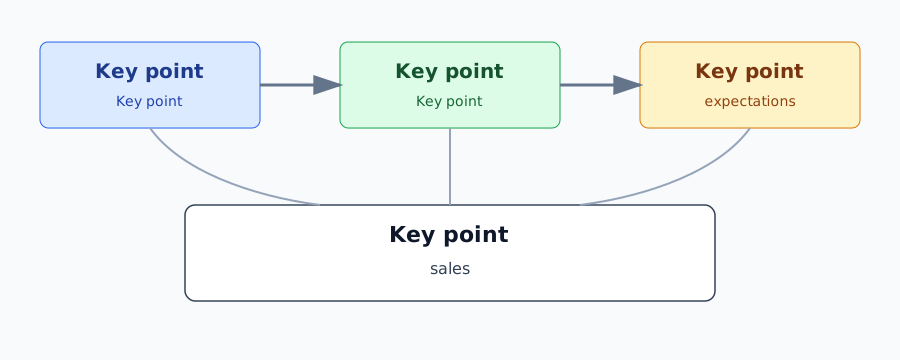
Diagram: The structure that caused this sharp rise
Investment risk
1. Expectations and valuation
As of the closing price of 2,320 yen on May 25th, the company's expected PER was 34.22 times and PBR was 6.31 times.
Because the original market capitalization is small, stock price increases tend to look flashy. However, the PER and PBR are already high for an "ordinary wholesale business."
The market is beginning to see TMH as a semiconductor aftermarket platform company, rather than just a wholesale company.
To meet this evaluation, a company needs not only sales but also operating profit margin, recurring transactions, platform revenue, overseas expansion, and M&A results.
2. Discrepancies in quarterly results
TMH's sales tend to be uneven due to used equipment sales and large-scale projects.
This type of company looks quite different from quarter to quarter.
Even if the company is in the red in the first quarter, it is possible that it will be in the black for the full year. On the other hand, if the forecast continues to be delayed, there will be concerns about the full-year forecast.
For small-cap growth stocks, supply and demand can reverse with a single settlement of accounts.
It's scary here.
3. Semiconductor cycle
The semiconductor industry is a growth industry in the long term, but the capital investment cycle is large in the short to medium term.
When demand for AI is strong, expectations for equipment, parts, and maintenance will increase.
However, demand suddenly slows down as memory market conditions, logic investments, capital investment plans, regulations for China, and inventory adjustments change.
Although TMH is an aftermarket company that supports factory operations, it is not unrelated to semiconductor capital investment.
4. China/Geopolitical Risk
Based on securities reports, overseas sales, especially those in Asia, account for a high proportion, and major customers include Chinese and overseas affiliates.
The US-China conflict, export restrictions, and stricter controls related to semiconductor manufacturing equipment are likely to have an impact on parts distribution and used equipment transactions.
In fact, the more stringent regulations become in the semiconductor aftermarket, the more needs there will emerge.
However, if regulations become too strict, transactions themselves will become difficult. We need to look at this from both sides.
5. Reaction of major shareholder material
Holding a large amount is a strong factor, but it is not a permanent buying factor.
Once it becomes clear that the stock is held, short-term investors may view it as having already been bought. In the future, if additional purchases appear in the revised report, this will be a factor again, but if the holding ratio declines or the supply and demand worsens, it will become a factor for selling.
Supply and demand factors for small-cap stocks can work both upward and downward.
Points to watch in the future
If you are looking at TMH, you will need to confirm the following:
| Check items | How to view |
|---|---|
| Change report | Whether there will be additional purchases or sales of Simplex products |
| Trading volume | Do you have short-term funds left? |
| 2Q financial results | Will sales really be concentrated in the second half |
| Operating profit margin | Will platformization increase profitability |
| LAYLA-EC KPIs | Number of registered parts, factories used, number of trading companies, etc. |
| Overseas sales | Changes in dependence on China and Asia |
| M&A/Agency development | Is the growth plan being implemented |
In the short term, there will be follow-up reports on trading volume and large holdings.
In the medium term, we will record sales from 2Q onwards and the operating profit margin.
In the long term, can LAYLA-EC become more than just a procurement site, but a platform for the semiconductor aftermarket?
It is best to look at these three stages.
Summary
The recent sharp rise in TMH is due to the combination of large holdings by Simplex Asset Management, semiconductor-related themes, and supply and demand for small-sized growth.
The business model is interesting. The question is whether stock prices will grow at the speed expected.
"LAYLA-EC" is a cross-border e-commerce platform that sells and repairs semiconductor manufacturing equipment and parts, supports the purchase and sale of used equipment. The aftermarket aspect that supports the operation of semiconductor factories is easy to explain even in the age of AI and data centers.
However, the stock price moved first.
The company had an operating loss in 1Q, and its valuation has risen to 30x PER and 6x PBR. From here on, it will be a matter of proving things with numbers rather than expectations.
For short-term trading, look at supply and demand.
For medium- to long-term investment, I would like to look at LAYLA-EC's profitability, operating profit margin, overseas risks, and semiconductor cycle.
TMH is a "small-cap stock with a good theme."
However, the better the theme, the more expectations will move into the stock price first. It's better not to forget that.
Reference information
- Yahoo! Finance “TMH (280A)” stock price/reference index https://finance.yahoo.co.jp/quote/280A.T
- Yahoo! Finance “TMH (280A)” financial information https://finance.yahoo.co.jp/quote/280A.F/financials
- M&A Online “Simplex Asset Management Co., Ltd. submits report on large holdings of TMH Co., Ltd. <280A> shares” https://maonline.jp/kabuhoyu/sh-s100y2yb
- TMH official website https://www.tmh-inc.co.jp/