

First, the conclusion
Unitree's IPO is a symbolic deal for the Chinese robot market.
This is because, up until now, humanoid robots have often been talked about as ``technological demonstrations that look good on video.'' Walk, run, dance, and overcome obstacles. It's a strong video. But if you look at it as an investment, the question is even colder.
Can it really be mass produced?
Will sales continue?
Will there be any profit?
Unitree is beginning to answer this question with numbers, at least for now. Sales in 2025 will be 1.708 billion yuan. We are making progress in turning a profit, and have established a track record of selling humanoid robots for research, education, and corporate demonstration purposes.
However, here's where it gets difficult. The market will not be able to continue buying products for a long time just because of the label "the first humanoid robot." After listing, it is necessary to confirm actual demand, gross profit, cost management, and mass production quality.
Listing scale and schedule
Unitree aims to be listed on the Science and Innovation Board of the Shanghai Stock Exchange. According to a document published by the Shanghai Stock Exchange in March 2026, the company's IPO application has been accepted and the expected amount to be raised is 4.202 billion yuan.
What I want to pay attention to here is the unit. "4.202 billion yuan" in Japanese means approximately 4.2 billion yuan in renminbi, and approximately 600 million dollars in dollar terms. It has the same meaning as "RMB 4.202 billion" seen in the English article.
The number of shares scheduled to be issued is over 40.4464 million shares based on the invitation letter. The funds raised will be used for intelligent robot model development, robot body development, new product development, manufacturing base construction, etc.
According to Chinese media reports on May 25, 2026, the Shanghai Stock Exchange's Launch Review Committee is scheduled to deliberate Unitree's IPO on June 1, 2026. If it passes the examination, it will be one step closer to registration, issuance, and the start of trading.
Listing has not yet been completed. At the moment, it is accurate to view it as the `first candidate for humanoid robots on the Shanghai Science and Technology Board'' and as a `China physical AI stock candidate'' as an investment theme.
It would be better to use a few words here. A-shares are a listed market classification. Whether it is an AI stock or not depends on the classification of the business theme. In Unitree's case, the business stated in the invitation letter is research and development, production, and sales of high-performance universal humanoid robots, quadrupedal robots, robot parts, and concrete intelligent models, and is not a pure software AI company. However, the company is easily seen in the market as a representative candidate for ``physical AI/tangible intelligence,'' where AI moves real-world aircraft.
Performance is quite strong, but expenses are becoming heavier.
Unitree's 2025 results look pretty good for an IPO story.
| Indicators | Contents |
|---|---|
| Sales in 2025 | 1.708 billion yuan |
| Sales growth rate | 335.36% increase compared to previous year |
| 2025 Net Profit | 600 million yuan |
| Operating CF in 2025 | 672 million yuan |
| Appraisal value at the time of latest funding | Reported to be 12.7 billion yuan |
Many humanoid robot companies are still running in the red while investing R&D costs upfront. Among them, Unitree is showing sales growth and profitability at the same time. This is changing the way the company is viewed.
However, as we enter 2026, the landscape will change slightly.
According to reports, sales for January-March 2026 were 423 million yuan, an increase of 68.49% compared to the same period last year. On the other hand, periodic expenses such as research and development expenses and selling expenses increased, and the net profit after sales decreased by 52.55% year-on-year to 40.2536 million yuan.
Sales are increasing. But profits are being cut.
This is a natural phase for a growing company, but the stock market will take a hard look at it after going public. Robots in particular tend to have high costs, not only for research and development, but also for parts procurement, quality assurance, maintenance, sales networks, and support for on-site implementation. Unitree's numbers reflect both the strength of "companies that have entered mass production" and the "costs that arise because they have entered mass production."
Business model
The essence of Unitree is that we are not just a manufacturer of finished robot products.
It's more like a robot platform company that combines low prices, mass production, and in-house production of core parts.
Manufacture core parts in-house
The heaviest parts of a robot's cost include actuators, motors, reducers, and control systems. If we rely too much on external procurement, it will be difficult to lower prices and we will be susceptible to supply constraints.
Unitree has created price competitiveness by developing and in-house manufacturing in this area. This vertical integration is the reason why humanoid and quadruped robots can be brought to market at relatively low prices.
According to reports, the company's main sales ratio in 2025 will reach around 60%. This is a fairly high standard for a robot company. Of course, if the product mix changes after going public, the gross profit margin will also change. If we are to further expand our low-priced model, maintaining gross profit margins will be a major confirmation point in the market.
Two pillars: humanoid robots and quadruped robots
Unitree is a company that originally became famous for its four-legged robots. This is the domain of so-called robot dogs.
However, if you look at the reports based on the letter of invitation, the profit structure has already begun to change. As of January-September 2025, humanoid robot sales amounted to 595 million yuan, accounting for 51.53% of robot product revenue, exceeding sales of four-legged robots.
| Area | Current role |
|---|---|
| Quadruped robot | The product group that became the starting point. Created sales results through research, inspection, exhibition, education, etc. |
| Humanoid robot | Growth driver. Research and development platform, demonstration experiments, and expectations for future work replacement |
This shift is huge. The way the market views Unitree is changing from `a company that makes cheap robot dogs'' to `a company that can mass-produce humanoid robots.''
First, go to the research, education, and demonstration markets.
Unitree's humanoid robots are not already being used in large quantities in homes or factories as complete labor replacement robots.
At present, the main battlefields are universities, research institutes, educational applications, corporate demonstration experiments, exhibitions, demonstrations, and development platforms.
This may seem unassuming, but it's not a bad strategy. Rather than suddenly saying ``replace human work,'' we will widely distribute the aircraft to researchers and developers and develop software, controls, data, and applications. In terms of AI, this is similar to a move to expand SDKs and open platforms for developers first.
In the humanoid robot market, success is not necessarily determined by finished products alone. How many actual machines do developers have on hand? This is where the future ecosystem will depend.
Strengths of Unitree
Our biggest strength is that we have a sales track record, not just a technology demo.
There are many companies that are attracting attention for their humanoid robots, such as Tesla, Figure AI, Agility Robotics, and Boston Dynamics. However, what the investment market ultimately looks at is the number of units shipped and profits, not the power of the images.
Reuters Breakingviews reports that Unitree sold 5,500 humanoid robots in 2025. This scale of shipments is quite large considering that the humanoid robot market is still in its early stages. However, since estimates of global market share tend to fluctuate depending on the market definition, it is more practical to give more weight to the fact that a product is "mass-produced and generates sales" than the ratio itself.
This number does not mean that we have reached full adoption. In fact, because the market is still small, it is easy for a small number of mass-producing companies to establish a presence.
Still, what is important is that Unitree has created a ``sellable price range''. Humanoid robots have long been expensive research equipment. Unitree is a low-cost model that fits into the budgets of labs, schools, exhibitions, and demonstration experiments. This is where the company's practical strength lies.
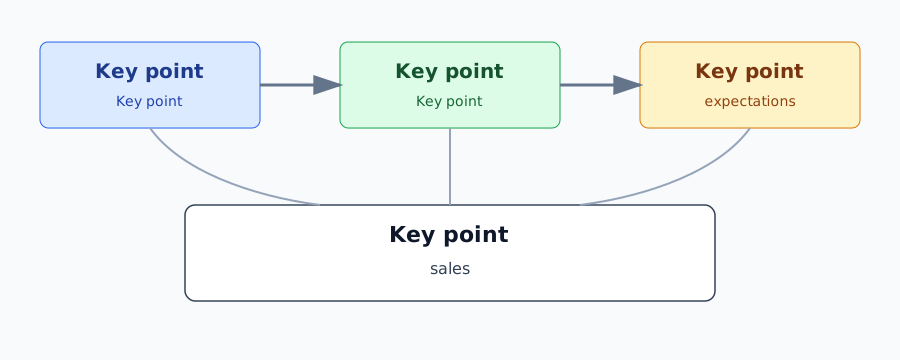
Illustration: What the market is seeing in the Unitree IPO
Interpretation in the stock market
The reason why Unitree IPO is attracting attention in the market is because of the strong robot theme itself.
The AI market will expand to GPUs, data centers, electric power, and optical communications from 2023 to 2025. The next issue that has emerged is physical AI. This is the stage where AI not only creates sentences and images on a screen, but also moves the real world through robots.
In that sense, Unitree can easily be seen as a "China's physical AI stock." If we were to call it an AI stock, it would be more appropriate to refer to it as an AI robot stock that has a robot body and a tangible intelligent model, rather than a generative AI app or semiconductor stock.
However, it cannot be overlooked that as an IPO stock, expectations tend to be high. Humanoid robots have big dreams, so valuations tend to rise first. The more bullish the market becomes, the more likely the stock price will react to even a slight decline in gross profit margin, increase in costs, or slowdown in shipments after a company goes public.
Personally, when looking at Unitree, I feel it is better to look at "actual demand in 2026-2027" before looking at "the future of robots."
Will sales to universities and research institutions continue? Will corporate demonstrations not end with one-shot demonstrations, but will expand to the introduction of multiple devices? Will maintenance costs and software income accumulate? If you can't see this, the market will cool down midway through, even if sales are growing.
Bullish scenario
The bullish scenario is pretty clear.
Unitree will dominate the research, education, and demonstration markets with its low-cost aircraft, and from there will expand horizontally into corporate introduction, factory experiments, entertainment, security, inspection, and service areas.
In this case, the company is not just a finished product manufacturer, but a developer platform for humanoid robots. As the number of units sold increases, the accumulation of control software, parts, maintenance, applications, and data becomes more effective.
The direction is also in line with the Chinese government's strategic industries. Declining birthrate and aging population, advancement of the manufacturing industry, AI industrial policy, and strengthening of domestic supply chains. Humanoid robots are a theme that is easy to follow in China's industrial policy.
If Unitree can increase sales while maintaining a certain level of gross profit margin, it will change its perspective from a "theme stock" to a "high-growth manufacturing company."
Bearish scenario
The bearish scenario is just as realistic.
First, the current applications of humanoid robots are still limited. Research, education, exhibitions, and demonstration experiments may sell, but there are other barriers to working long hours in a factory or at home.
If it is a factory, it must not stop, be hard to break, be safe, be able to link with existing lines, and be easily maintained. At home, safety, price, noise, operability, and privacy become even more important issues.
The fundamental question remains whether it really needs to be humanoid. In many cases, an AMR is sufficient for a warehouse, a dedicated robot arm is sufficient for a factory, and a four-legged robot or drone is sufficient for inspections. Humanoid robots are attractive for their versatility, but versatility often comes with cost and complexity.
Moreover, competition is strong. Within China, companies such as DEEP Robotics, AgiBot, and Leju Robotics are growing, while overseas companies include Tesla, Boston Dynamics, Figure AI, and Agility Robotics.
Even if Unitree is the first to achieve mass production, winning in this market is not determined by that alone.
Geopolitical risks also need to be factored in
Unitree is a Chinese company. Affected by US-China tensions, export controls, tariffs, high-tech regulations, and data security.
Especially when selling humanoid robots in the European and American markets, it is not enough to simply export machines. Since cameras, sensors, AI processing, remote control, cloud connectivity, and log management are involved, data security is often an issue.
It would be great if the Chinese domestic market could continue to grow at a high rate, but if a company's valuation is high based on global expansion, regulatory risks become difficult to ignore.
KPIs to watch after listing
If you're following Unitree as an IPO theme, you'll want to look at the following KPIs rather than flashy news.
| KPI | Reasons to watch |
|---|---|
| Number of humanoid robots shipped | Is actual demand growing, not the theme? |
| Sales composition by product | Are we transitioning from dependence on four legs to human-based one? |
| Main sales ratio | Will there be profit even with a low price strategy |
| R&D expense ratio | How much is technology investment putting pressure on profits |
| Selling expense ratio | Are the costs of demonstration, exhibition, and channel expansion too high? |
| Operating CF | Is there cash remaining in addition to accounting profits |
| Customer composition | Is it centered on research institutions or expanding to corporate implementation? |
| Maintenance/Software income | Is it possible to move from one-time sales to recurring revenue |
Particularly important are profits over sales, and cash over profits.
Robotic companies tend to increase their inventory, parts procurement, sales network, and R&D expenses when sales are increasing. It is difficult to judge the quality of growth without seeing whether operating CF collapses.
Investment thematic implications of Unitree IPO
Unitree's IPO is not just about Chinese stocks.
In terms of Japanese stocks, it will also affect how the entire robot supply chain is viewed, including Fanuc, Yaskawa Electric, reducers, motors, sensors, FA, precision parts, electronic parts, batteries, and materials.
However, it is not as simple as saying that all robot-related stocks will be bought because Unitree goes public.
What the market will watch is which companies will actually benefit from expanding mass production of humanoid robots. Are they included in the parts supply? Is the unit price high? Will mass production be profitable? Will prices not collapse due to competition?
Since the dreams of the physical AI market are big, stock selection tends to be rough. There is a difference between companies that stand out through videos and companies that can make a profit.
There is a considerable difference in temperature here between the latest quarterly and full-year results. If you only look at the robot-related label, everything seems to be heading in the same direction, but the actual financial results are not so clear.
| Area | What can be seen from the latest financial results of representative stocks |
|---|---|
| FA/Robot body | Fanuc will increase sales by 7.6% and operating profit by 15.7% in the fiscal year ending March 2026. On the other hand, Yaskawa Electric's sales increased by 0.8%, but its operating profit was -5.7% and its net profit was -36.6%. Although the themes are strong, the current profit momentum is mixed. |
| Precision parts/reduction gears | Harmonic Drive Systems' sales increased 7.0% and operating income improved significantly from its low level. However, the net profit was -53.7%. The reducer theme is easy to understand, but I would like to confirm the quality of profits. |
| Automation/Control Components | SMC's sales increased by 6.4%, while operating income increased by 0.2%. This shows that even if demand returns, profits will not be able to grow completely depending on price, costs, and mix. |
| Electronic components | TDK's sales increased by 13.6% and operating income increased by 21.5%. Murata Manufacturing is enjoying a tailwind from demand for parts for AI servers and data centers, but operating income was only +0.8%. We need to look at it in a tug-of-war with not only robots but also AI infrastructure demand. |
| Motors and small parts | MinebeaMitsumi's sales increased by 9.3% and operating income increased by 10.1%. On the other hand, Nidek's operating income has fallen significantly in the latest 2nd quarter report. It's still hard to say that just because it's a motor, it automatically wins. |
In other words, it is possible that the Unitree IPO will ignite Japanese robot-related stocks. However, the stocks that are bought there are different from the stocks that are selected based on financial results. Even if theme funds come in at a listing event, the next thing the market will look at is orders, profit margins, operating cash flows, and whether there is really demand for mass production of humanoid robots.
Summary
Unitree Robotics' IPO is an event where the market will gauge whether humanoid robots can move from "laboratory demo" to "mass production business."
The company's appeal is low prices, a track record of mass production, in-house production of parts, a high gross profit rate of around 60%, and rapid growth in sales of humanoid robots. Looking at sales and profits in 2025, this is no mere pipe dream.
However, as shown by the decline in profits in Q1 2026, growth investments are already starting to put pressure on profits. What the market is asking from this point is sustainability of earnings, not topicality. Once a company is bought as a company capable of mass production, it can be seen whether the company can still make a gross profit even with mass production.
Humanoid robots could become the next big theme in the AI market. However, the companies that will win will not be those that put on showy demonstrations, but will be those that produce machines that are hard to break, that can be made cheaply, that continue to sell, and that can be used in the field.
Unitree is one of those candidates. Not a winner yet. In 2026-2027, the market will take a very hard look at the difference.
Source
- Shanghai Stock Exchange, Racing to Become the First Humanoid Robot Stock on the A-Share Market! Unitree Robotics' STAR Market IPO Application Accepted, Planning to Raise RMB 4.202 Billion
- Yushu Science and Technology Co., Ltd., “Information on the invitation to publish on the public research and development board (report)”, March 20, 2026
- 1 / 17 / 2026/0320/813654.
- DoNews, Usukuri IPO: 68% increase in interest rates this year
- Buying Company, Usuo Technology Board IPO General Meeting June 1st Recruitment Fee 42.02 yen
- The Paper, Yusu Technology Board IPO General Meeting on June 1st, first half of the year costing more than 10 yen
- Reuters Breakingviews, China's robot champion has everything to lose
- MarketScreener / Reuters, Unitree plans Shanghai IPO, testing interest in humanoid robots