

Stop height background
This rise is not simply a result of low-ranking stocks.
Muromachi Chemical is a company that handles pharmaceuticals, health foods, and chemicals, but the market has recently responded to its chemical products business, especially its ion exchange resins.
The company's high-purity resins are used to suppress impurities in the production of ultra-pure water and high-purity chemicals. The official ion exchange resin information site describes high-purity resin as a resin with significantly reduced metal impurities and residual organic matter, and indicates its use as a final stage polisher used in ultrapure water production equipment such as semiconductor manufacturing equipment.
In the company's product materials published on IPROS, the application scenarios include the production of ultrapure water in semiconductor manufacturing processes, and the purification of electronic material chemicals and process fluids.
This explanation is quite easy to understand in the 2026 market.
Investment themes for AI semiconductors are expanding beyond GPUs and manufacturing equipment to include water treatment, chemicals, cleaning, electricity, and cooling. Muromachi Chemical suddenly entered the market's sights as a brand for peripheral materials.
It's not just speculation, the 3Q results are also strong
If it's just a theme, it will be completed in a short period of time.
The strong buying trend this time is also backed by the company's business performance.
The main figures for the cumulative third quarter of the fiscal year ending May 2026 are as follows.
| Item | 3Q cumulative results | Year-on-year comparison | Full-year forecast | Progress rate |
|---|---|---|---|---|
| Sales | 5.651 billion yen | +16.8% | 7.700 billion yen | 73.4% |
| Operating income | 546 million yen | +59.1% | 700 million yen | 78.0% |
| Ordinary profit | 514 million yen | +44.8% | 660 million yen | 77.9% |
| Net profit | 337 million yen | +35.7% | 470 million yen | 71.7% |
| EPS | 84.11 yen | +34.8% | 117.02 yen | 71.9% |
The growth in operating income is greater than the growth in sales. This is the easiest place for the market to see.
It's not just an increase in sales, but an improvement in profit margins. The operating income progress rate has reached 78.0% as of 3Q, which is not bad compared to the full-year plan.
In other words, this surge is not a complete dogfight.
In addition to the `semiconductor theme,'' the conditions also overlapped: `small stocks that are actually increasing profits.'' I think this is the reason why the stop was bought high.
Illustration: Muromachi Chemical materials as seen by the market
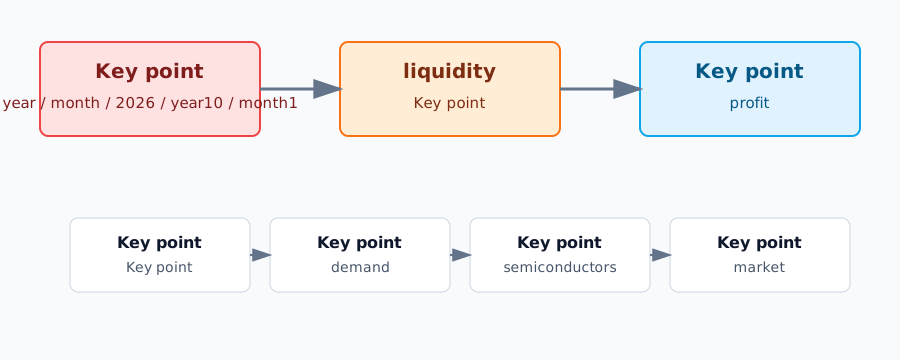
Why was ion exchange resin for semiconductors reconsidered?
In semiconductor manufacturing, water purity affects process quality.
In wafer cleaning, chemical dilution, and process liquid purification, even trace amounts of metal ions and organic substances can affect yield. The more advanced the semiconductor, the higher the quality requirements for these peripheral processes.
Ion exchange resin is a component that removes ionic impurities from water and chemical solutions. Although it is not a flashy device, it is similar to consumables and peripheral parts that support manufacturing quality.
What the market has reconsidered this time is this ``unremarkable but must-see'' position.
If semiconductor investment continues, demand will expand not only for manufacturing equipment but also for peripheral materials such as ultrapure water, chemicals, cleaning equipment, filters, and resins. Muromachi Chemical was a small-cap stock that was easy to associate with.
However, there are some caveats.
Even if it is for semiconductors, it is difficult to see in detail just from the financial results report, it is difficult to see in detail which customers, for which applications, and how much sales there are. If the market arbitrarily overestimates this, it tends to lead to expectations.
PFAS regulations will also be a medium-term theme
Another thing that cannot be overlooked is PFAS.
PFAS is a general term for organic fluorine compounds, and is attracting attention in the context of environmental and water quality regulations. Muromachi Chemical has also published materials introducing PFAS removal technology using ion exchange resins, which are also connected to the water treatment theme.
If semiconductors are the theme of "AI/manufacturing investment," PFAS is the theme of "environmental regulations/water quality improvement."
These two are quite compatible in the market.
However, PFAS-related products take time to develop policies, adopt local governments, demonstrate testing, and develop projects. It's a big theme, but it's too early to assume that sales will jump right away.
From a medium-term perspective, the following confirmations regarding PFAS will be necessary.
| Points to check | How to view |
|---|---|
| Demonstration/employment results | Are you progressing from technology introduction to sales projects? |
| Projects for local governments and companies | Can there be continued demand |
| Processing cost | Is it competitive compared to other methods |
| Replacement demand | Will repeat products be produced as consumables |
PFAS is not a dream material, but a theme that requires implementation and profitability.
PER looks cheap, but there is a sense of overheating
Looking at the company's expected EPS of 117.02 yen compared to the stock price of 1,112 yen, the PER is approximately 9.5 times.
Based on this number alone, it does not seem extremely expensive for a semiconductor-related theme.
However, when it comes to small-cap stocks, it's best not to rely solely on the P/E ratio.
Immediately after the stop high, short-term funds tend to concentrate. The stock is strong while the trading volume increases rapidly and the buying continues, but when the buying stops, the market tends to become thin. In particular, stocks that suddenly attracted attention as semiconductor-related stocks are likely to be sold to take profits if the overall sector sentiment deteriorates.
In other words, the current P/E ratio is supportive, but not a panacea.
If business results go as planned, the stock will remain undervalued. On the other hand, if the profit margin of the chemicals business slows down, expectations for semiconductors are not reflected in the numbers, and there are no follow-up reports on PFAS materials, it will be difficult to support the stock price just by a low P/E ratio.
Points to see in the short term
In the short term, it is better to look at supply and demand rather than the quality of materials.
| Short-term check | Meaning |
|---|---|
| Approaching the stop high the next day | Will the buying trend continue |
| Hidden line after a sharp increase in trading volume | It is likely to be the first move of profit-taking selling |
| Overall sentiment of semiconductor stocks | Will theme funds continue |
| Battle around 1,112 yen | Psychological standards for short-term investors |
| Increase in margin buying | Will it lead to future selling pressure |
If you look at this stock in the short term, it's more about supply and demand than corporate analysis.
Even good companies experience wild fluctuations immediately after becoming a theme stock.
Points to see in the medium term
If we look at it from a medium-term perspective, it's pretty clear what we want to see in the next financial results.
| Mid-term check | Perspective |
|---|---|
| Sales of chemicals business | Is demand for semiconductors continuing? |
| Operating profit margin | Is the increase in sales turning into profit? |
| Achieving full-year plan | Can operating income exceed 700 million yen |
| PFAS-related projects | Should we move from technical themes to actual demand |
| Raw materials/purchasing prices | Can we maintain improvement in product mix |
The numbers as of 3Q are good. However, what the market is looking for is confirmation of the following:
“Is demand for semiconductors really growing?”
“Isn’t the improvement in profit margin temporary?”
“Will PFAS become not just a hot topic but also a case?”
If you can see this, you can go one step further from simply high-priced stocks to performance-themed stocks.
View as an investor
Muromachi Chemical is not a flashy AI stock.
However, when investment themes in AI and semiconductors expand from manufacturing equipment to peripheral materials, these water treatment and purification component companies may suddenly be reconsidered.
I think the current stop high is a typical example of this.
In the short term, it should be viewed as a small-cap stock with money invested in semiconductor themes. The upward momentum is strong, but the collapse is also quick.
In the medium term, we will look at whether the 3Q profit increase is genuine. If the 16.8% increase in sales and 59.1% increase in operating profit continues, it will be difficult for the company to become a mere theme stock.
However, if profit margins slow down in the next fiscal year, the market will cool down immediately. Just the word "semiconductor-related" won't buy people for a long time.
Summary
The main reason for Muromachi Chemical's (4885) stop high was that high-purity ion exchange resins were reconsidered as peripheral materials for semiconductors and AI.
Cumulative 3Q sales were 5.651 billion yen and operating income was 546 million yen, showing strong performance. The progress rate towards the full-year operating profit forecast of 700 million yen is 78.0%, and there is support from the performance side.
On the other hand, the stock price moved rapidly as a short-term theme stock. The P/E ratio of approximately 9.5 times is supportive, but there is a sense of overheating in supply and demand after the peak rise.
The future focus will be on how high-purity resins for semiconductors and PFAS-related products will be reflected in sales and profits, rather than being a hot topic.
This material is interesting. However, it is best not to change the viewing order. Sales are more important than themes, profit margins are more important than sales, and continuity is more important than profit margins.
Source
This article was created based on the target company's financial results, official product information, and stock price information.
- "Summary of financial results for the third quarter of the fiscal year ending May 2026 [Japanese GAAP] (non-consolidated)", Muromachi Chemical, disclosure date: 2026-04-14
- High Purity Resin (Highly Crosslinked Resin) | Ion Exchange Resin General Center by Muromachi Chemical Co., Ltd.
- Muromac HG series for semiconductors | Muromachi Chemical
- Yahoo! Finance Muromachi Chemical (4885) stock price information