
Facts to check first
It would be better to organize the points at issue in a more practical manner.
| Item | Contents |
|---|---|
| Brand | Yamazaki (6147) |
| Status on the TSE | Designated as a stock to be delisted after being a stock under supervision |
| Stock delisting designation period | May 27, 2026 to September 30, 2026 |
| Scheduled date for delisting from the TSE | October 1, 2026 |
| Reason | Non-compliance with listing maintenance standards |
| Criteria that did not meet | Market capitalization of outstanding shares |
| Market capitalization of outstanding shares as of March 31, 2025 | 700 million yen |
| Standard market criteria | 1 billion yen or more |
| Fukusho Securities / Securities Securities | The company explains that it is possible to continue buying and selling |
On the TSE Standard Market, the standard for maintaining listing is a market capitalization of 1 billion yen or more. As of March 31, 2025, Yamazaki had only 700 million yen, and even after the improvement period, compliance with the standards was not confirmed.
Looking at it chronologically, as of April 1, 2026, it was a "stock under supervision (under confirmation)". This was because there was a risk that compliance with standards could not be confirmed after the improvement period ended. Subsequently, nonconformity was confirmed in a review based on the distribution status table of stock certificates, etc. submitted by the company, and a decision was made to delist the company from the TSE on May 27, 2026. This is not a story that says there is still a grace period until March 2027.
If you just look at this part, you might be able to dismiss it as a "delisted stock." But that's a little rough.
The impact of not being able to buy or sell on the TSE is significant. It will be easier for them to be excluded from margin trading and institutional investors, and it will be less easy for individual investors to buy and sell. On the other hand, since it is expected that trading will continue on the Fukusho Securities and the Securities Stock Exchange, the view is different from ``a company that will go completely private.''
In other words, the problem this time is not `valuelessness,'' but a sudden decline in liquidity'' and `a decline in market confidence.''
The real problem is not just the standards for maintaining listing
On the surface, it is a lack of market capitalization of outstanding stocks.
However, I think what the market is really looking at is the difficulty in charting a future growth story.
Yamazaki's main products are machine tools and transportation equipment. The machine tool business mainly handles machine tools for custom-made production for the automobile industry. Company data also states that the main customer of the machine tools division is the automobile industry.
In this business, when times are good, the numbers come up all at once. If customers' capital investment moves, orders and sales are likely to jump.
On the other hand, it will be difficult if investment stops. Fixed costs do not fall immediately, and a gap in the number of projects directly leads to a deficit. Machine tool sales for the fiscal year ending March 2026 were 882 million yen, down 44.8% from the previous fiscal year. Under these circumstances, even if the transportation equipment business provides some support, it will be difficult for the entire company to remain in the black.
This is the difficulty typical of small and medium-sized local manufacturers.
The technology is there. We also have the ability to respond on-site. However, it is small and has difficulty absorbing waves of orders. The market is looking at that.
Yamazaki is a typical capital investment cyclical stock
If you look at Yamazaki from the perspective of a growth stock, you'll be far off the mark.
This company's performance is strongly linked to customers' capital investment. Automotive-related production equipment, labor-saving equipment, and dedicated machine tools. In either case, the client only makes a move when they decide to invest now.
Therefore, what you should watch is the following order:
| Points to see | Meaning |
|---|---|
| Machine tool orders | Have we entered a recovery phase |
| Automotive projects | Confirmation that existing mainstays have bottomed out |
| Labor-saving equipment | Turning labor shortage themes into actual demand |
| Semiconductor/Environment related | Can dependence on automobiles be reduced |
| Fixed cost absorption | Will sales recovery turn into profit |
| Operating CF | Can you maintain cash flow even in the red? |
Currently, the shift to electric vehicles, the slowdown of the Chinese economy, the cautious attitude toward investment by domestic small and medium-sized manufacturers, and the continued high costs of raw materials, labor, and energy are weighing on the economy. Of course, there is room for recovery in individual projects, but the industry as a whole remains in an environment where it is difficult to stabilize orders.
The numbers show that.
For the fiscal year ending March 2026, sales will be 2.327 billion yen and operating loss will be 260 million yen. The company's forecast for the fiscal year ending March 2027 is sales of 2.92 billion yen, operating income of 60 million yen, ordinary income of 41 million yen, and net income of 24 million yen.
The medium-term management plan targets for the fiscal year ending March 2027 were sales of 3.4 billion yen and operating income of 100 million yen. In other words, the latest company forecasts have been revised to a level lower than the medium-term plan targets, which also shows the severity of the business environment.
This is a plan to restore the surplus. However, in order to return from an operating loss of 260 million yen to an operating profit of 60 million yen, a mere recovery in sales is not enough. Profitable projects, fixed cost absorption, and cost control are all needed at the same time.
Now comes the difficult part.
Semiconductor/environment related is a hope, but it's not an easy task
Yamazaki has room for labor-saving equipment and new businesses. The company also touches on environment-related areas such as electronics business, micro/nano bubbles, and wind/solar power generation.
I understand that the market wants to have high expectations.
In particular, in Japanese stocks in 2026, funds are likely to go to AI, semiconductors, data centers, defense, and power infrastructure. Even small-cap stocks may attract short-term funds if they are seen as ``semiconductor-related.''
However, I want to take a very calm look here.
The world of semiconductor manufacturing equipment has high barriers to entry. Technology, quality assurance, customer certification, mass production experience, maintenance system, and financial strength are tested. It is not a simple market where existing machine tool technology can be turned into a highly profitable semiconductor equipment business.
Rather, a realistic route to re-evaluation is not to specialize in semiconductors, but to expand existing processing, automation, and unit technologies to semiconductor peripherals, electronic components, inspection, jigs, and labor-saving equipment.
If sales and profits appear here, the perspective will change. On the other hand, if the theme alone does not produce numbers, the market will quickly cool down.
2027 Plan Hurdles
The company's forecast for the fiscal year ending March 2027 is for a return to operating profit.
| Item | Results for the fiscal year ending March 2026 | Latest forecast for the fiscal year ending March 2027 | Medium-term plan targets for the fiscal year ending March 2027 |
|---|---|---|---|
| Sales | 2.327 billion yen | 2.920 billion yen | 3.400 billion yen |
| Operating income | -260 million yen | 60 million yen | 100 million yen |
| Ordinary profit | -280 million yen | 41 million yen | 80 million yen |
| Net income | -360 million yen | 24 million yen | - |
Sales are expected to recover by approximately 590 million yen. Operating income will need to improve by approximately 320 million yen.
This is quite large.
Recovery in demand for machine tools, stabilization of transportation equipment, fixed cost reductions, and cost improvements must proceed at the same time. Moreover, labor costs, raw material costs, and energy costs are now likely to put pressure on profit margins.
This is why it is difficult for the market to become bullish.
There is a ``surplus forecast''. However, what investors want is not the forecast itself, but the repeatability of profitability. Backlog of orders, highly profitable projects, sales in new fields, and low fixed costs. Unless this aspect can be confirmed on a quarterly basis, it will be difficult to continue reevaluating.
What happens to shareholders after delisting?
This is where individual investors tend to misunderstand.
Even if a company is delisted from the TSE, shareholder rights will not immediately disappear. The stock will remain. The right to vote at general shareholders' meetings and the right to receive dividends, if any, remain.
However, the practical inconvenience becomes greater.
| Issues | Impact |
|---|---|
| Trading market | Trading will no longer be possible on the TSE |
| Continuation of trading | The company explains that it is possible to continue trading on the Fukusho Securities and Securities Securities Securities |
| Liquidity | Easily lower than TSE |
| Price formation | There are few buyers and prices tend to jump |
| Dealing with securities companies | Need to confirm whether Fukusho/Fukusho Securities can be handled |
| Credit transactions | Subject to cancellation of system credit/loan selection |
| NISA, etc. | Handling confirmation required for each securities company |
In other words, the stock will remain, but you won't necessarily be able to sell it when you want to.
This is the biggest one.
Particularly for stocks with low market capitalization and low liquidity, such as Yamazaki, being removed from the TSE will further reduce the depth of trading. Even if there is a price, whether you can actually dispose of a large quantity is another matter.
In practical terms, the main scenario is that only the TSE is delisted, and trading remains on the FSE and SSE. Even in this case, it is necessary to check to what extent major online securities companies such as SBI Securities and Rakuten Securities can handle FSE and SSE issues. If there is no handling, it may be difficult to sell even if you can hold it.
On the other hand, complete delisting is different. If a company were to go completely unlisted, it would require over-the-counter transactions and procedures via a shareholder registry administrator, which would further reduce liquidity. At present, Yamazaki is at a stage where it is necessary to consider `delisting from the TSE'' and `prospects for continued listing on the FSE/SSE'' separately.
Re-evaluation scenarios remain
There's no need to be completely pessimistic.
In Japan's manufacturing industry, the demand for labor shortages, labor saving, automation, and factory DX continues. This could be a tailwind for Yamazaki.
Labor-saving equipment is not just a theme. There are not enough people on site. The number of skilled workers will also decrease. The smaller the manufacturing industry, the more there remains a need for work automation and improvements to jigs and equipment.
Yamazaki's strength is that it has more than 600 types of dedicated machine tool units and can respond to high-mix, low-volume production and individual needs. There is room for the company to pick up on-site niche demand, which is different from large standard equipment manufacturers.
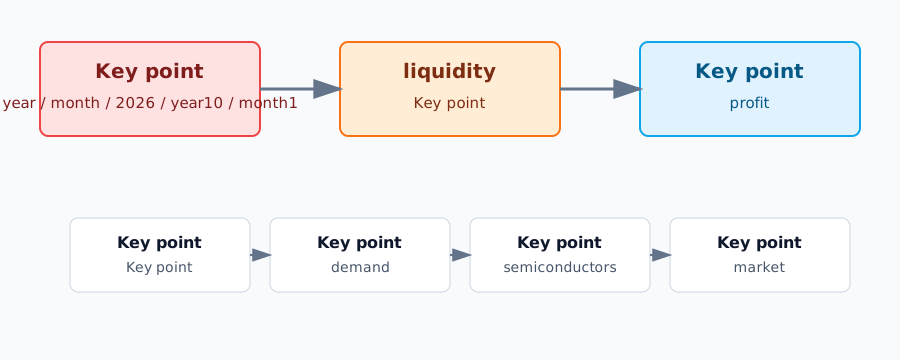
If it were to be reevaluated, the process would be as follows.
- Machine tool orders bottom out
- The transportation equipment business maintains a stable surplus
- Labor-saving equipment increases sales
- Semiconductor/electronic parts/environment-related projects become numerical
- Operating profit margin improves and operating CF is maintained
If we can confirm this order, we may be able to reconsider and buy the stock even with low liquidity.
However, after delisting from the TSE, the hurdles for revaluation will rise. It is difficult for institutional investors to enter, and it is also difficult for individual investors to trade. In other words, even if business restructuring progresses, it may take some time for it to be reflected in stock prices.
Diagram: Risks and reevaluation process you want to see in 6147
Organizing from an investment perspective
| Perspective | Evaluation | Comments |
|---|---|---|
| Stability | △ | Large fluctuations in orders, resulting in deficit in the fiscal year ending March 2026 |
| Maintain listing on the TSE | × | Scheduled to be delisted from the TSE on October 1, 2026 |
| Buying and selling with Fukusho Securities and Securities Securities | ○ | The company explains that it is possible to continue |
| Room for short-term rebound | △ | Price movements specific to delisted stocks are possible, but are highly speculative |
| Long-term growth | △ | Uncertain until profitability in new fields is confirmed |
| Liquidity risk | Very high | Be even more careful after delisting from the TSE |
| Expectations for reconstruction | Some | Demand for labor saving and automation is a medium-term theme |
| Need for financial improvement | Large | Focus on recovering profits after deficit and increasing capital |
In the short term, there is a possibility of wild price movements typical of stocks to be delisted. However, it is more of a supply and demand event than an investment.
I would like to look at the scenarios that are likely to occur in the future in the following order.
| Scenario | View |
|---|---|
| Delisting from TSE, only FSE and SSE remaining | Most likely scenario at the moment |
| Capital alliance/TOB/MBO | Possibility remains due to low market capitalization, but we are waiting for concrete information |
| Re-evaluation based on performance improvement | Important from a business perspective. However, a liquidity barrier remains after the decision to delist from the TSE |
In that sense, it is a stock that is difficult to judge based on standard PER and PBR alone. Trading volume, major shareholder trends, capital policy, alliances, presence or absence of TOB, handling status of securities companies. These practical materials become as important as financial results.
If we look at it from a medium- to long-term perspective, there is only one focus.
Can we change our structure to one that can generate profits?
Reduce car dependence. Increase high value-added projects. Expand labor-saving equipment. Accumulate sales of semiconductors, electronic components, and environment-related products as actual demand. If this is not done, it will be difficult for the market evaluation to recover, regardless of whether the company is delisted from the TSE.
Final judgment
The current 6147 can best be viewed as a ``small manufacturing industry in the process of rebuilding.''
Delisting from the TSE is a major negative factor. In particular, a decline in liquidity has a real negative impact on individual investors. Stockholder rights will remain, but the freedom to buy and sell will be reduced. It's best not to take this place lightly.
However, this does not mean that the company itself will soon become worthless. It is expected that sales will continue on the Fukusho Securities and Securities Securities Exchanges, and the business will remain. The question is whether the remaining businesses can generate enough profits from the market's perspective to warrant a reevaluation.
6147's biggest theme in 2027 is not maintaining its listing, but rebuilding its profit structure.
What we should focus on in future IRs is not just the words semiconductors or the environment. Orders, sales, profit margin, operating CF, fixed cost absorption, and track record in new fields. It remains to be seen whether this will be reflected in the numbers.
Even if the market is currently in the red, it will give money to companies that have a bright future. On the other hand, the situation is quite difficult for small manufacturing industries that have no clear future vision.
Yamazaki stands on the border.
Source/Reference materials
- Japan Exchange Group, Decision on delisting, etc.: Yamazaki Co., Ltd., Publication date: 2026-05-27
- Japan Exchange Group, [Tradeable shares | Details of listing maintenance standards] (https://www.jpx.co.jp/equities/listing/continue/details/02.html)
- Japan Exchange Group, How is the "market capitalization of outstanding shares" under the Listing Maintenance Standards calculated?
- Yamazaki Co., Ltd., "Notice regarding designation of our stock as stock under supervision (currently being confirmed)", Disclosure date: 2026-04-01
- Yamazaki Co., Ltd., "Summary of Financial Results for the Fiscal Year Ending March 2026 [Japanese Standards] (Consolidated)", Disclosure date: 2026-05-08
- Yamazaki Co., Ltd., Yamazaki's business
- Yamazaki Co., Ltd., Industry and positioning
- Yamazaki Co., Ltd., Medium-term Management Plan
- Confirmation date: 2026-05-28