
First, separate facts and estimates
In this news story, the reliability of the article changes greatly depending on how the numbers are used.
The first three things you should separate are:
| Classification | Contents | How to handle |
|---|---|---|
| Confirmed facts | CSRC official announcement, Futu/UP Fintech company disclosure | Can be concluded |
| External estimation | Trial calculation of the amount of affected assets by CITIC Securities, etc. | Specify as an estimate |
| Investor risks | Business continuity, transfer, KYC reinforcement, etc. of Japanese corporations | Treated as a scenario |
What is particularly dangerous is to simply write down the estimated value as ``determined selling pressure.''
Since there is a two-year liquidation period, there is no guarantee that the assets in question will be sold off on the market all at once. Actual movements will be dispersed, such as sales, withdrawals, transfers to legal channels, and reclassification to family accounts or corporate schemes on the Hong Kong side.
Still, if buy orders and new deposits stop, it will weigh on medium-term supply and demand for Hong Kong stocks and Chinese ADRs. This way of writing is probably the most accurate at this point.
What happened on May 22, 2026?
On May 22, 2026, the CSRC announced that Tiger Brokers, Futu Securities International, and Longbridge Securities, both domestic and foreign affiliates, engaged in securities marketing, order processing, and securities-related services in mainland China without the necessary licenses.
At the same time, the company explains that fund sales and futures-related operations are also illegal.
What is important here is that this announcement is not just a warning, but an advance notice of administrative penalties.
| Target | Contents that can be confirmed in official announcements and company disclosures |
|---|---|
| Futu Holdings | Proposed disposal of approximately 1.85 billion yuan. The breakdown includes approximately 470 million yuan forfeiture of illegal income and approximately 1.38 billion yuan in fines |
| UP Fintech / Tiger | Fine of approximately 308.1 million yuan, illegal income confiscation of approximately 103.1 billion yuan, total amount of approximately 411.2 million yuan |
| Longbridge | Although included in the CSRC announcement, individual amounts are harder to confirm than listed companies |
Regarding Futu, the company itself explained that the impact of approximately 1.85 billion yuan was reflected in the first quarter of 2026 financial results.
However, this is at the stage of advance notice, and the company has the right to make statements, pleas, and hearings. This is not a final figure determined. It is better not to omit this sentence.
Meaning of “2-year consolidation period”
Some suggested that `all accounts would be immediately frozen'' and `all assets would be forcibly sold.''
Based on current reports and official explanations, this is an exaggeration.
China's policy is to liquidate illegal cross-border securities, term currency, and fund operations over a two-year period. In principle, existing mainland Chinese investors will be treated as follows.
| Action | View |
|---|---|
| New purchase | Restrictions |
| New deposit | Restricted |
| Sale of existing assets | Approved direction |
| Withdrawals | Directions allowed |
| Moving to the legal route | Potential options include Stock Connect, QDII, and cross-border financial management |
In other words, the problem is not a "forced bulk sale."
Rather, it will take two years for mainland investors' purchasing power and new capital inflows to stop.
This difference is huge. Rather than looking at short-term crash factors, the theme is to see how liquidity will shrink over the medium term.
How far has Futu's dependence on mainland China fallen?
Futu explained that as of the end of the first quarter of 2026, deposit accounts in mainland China accounted for approximately 13% of the total.
Looking at this part alone, it is tempting to say that Japan's dependence on mainland China is already small.
However, it's not that simple.
Futu's financial results for the first quarter of 2026 show customer assets of HK$1.22 trillion, total transaction value of HK$4.15 trillion, and margin trading and securities lending balance of HK$72.9 billion. Even though 13% of customers are from mainland China in terms of number of accounts, if the frequency of transactions and use of margin trading is high, the impact on profits will be greater than the account ratio.
Based on the transcription of financial results briefings, mainland Chinese customers account for approximately 17% of assets and contribute approximately 20% to sales. This is not a number that can be confirmed solely from the text of Futu's financial results release, so I would like to note in the article that it is based on the financial results briefing.
| Indicators | Views that can be confirmed |
|---|---|
| Mainland China deposit account ratio | Approx. 13% |
| Mainland China customer asset ratio | Approximately 17% based on financial results briefing transcription |
| Contribution to sales in mainland China | Approximately 20% based on transcription of financial results briefings |
What investors should look at is the return sensitivity, not the number of accounts.
Even if the number of customers in mainland China decreases, if new deposit accounts and customer assets increase in Hong Kong, Singapore, Japan, the United States, Malaysia, etc., Futu will be able to change its evaluation from a `mainland-dependent online brokerage'' to a `global securities app.''
On the other hand, unless overseas growth can compensate for the decline in domestic demand, the regulatory shock will not be a temporary phenomenon.
How should we view the figure of 5.1 trillion yen?
According to estimates by CITIC Securities and others, the assets related to mainland investors in the Hong Kong market that will be subject to liquidation this time are estimated to be around HK$250 billion at most. It is easy to come up with a figure of around 5 trillion yen in Japanese yen terms.
Furthermore, there are estimates of HK$150 billion to HK$180 billion for Futu-related costs and HK$45 billion to HK$50 billion for Tiger-related costs.
However, this is not an officially confirmed value.
If you're writing an article, it's safe to do something like this:
According to external estimates such as CITIC Securities, the amount of Hong Kong-related assets that will be affected is estimated at a maximum of HK$200 billion to HK$250 billion. However, this is not the planned sale price, but an estimate of the size of the assets that could be the target.
Your impression will change considerably depending on whether or not this sentence exists.
It would be misleading to read that HK$250 billion would be "sold all at once." The correct explanation is that buying may stop and sales, withdrawals, and transfers may proceed over time.
Impact on Hong Kong stocks and China ADR
Stocks that are likely to be affected are those that retail investors in mainland China tend to like.
Specifically, these include Hong Kong tech stocks, emerging stocks related to AI and semiconductors, and Chinese ADRs listed in the US.
| Sensitive areas | Reasons |
|---|---|
| Hong Kong tech stocks | Mainland individuals have strong trading participation |
| China ADR | There are people who accessed US stocks via Futu/Tiger |
| High volatility stocks | Easily affected by margin trading and short-term trading |
| New IPO stocks | Supply and demand will change as the enthusiasm for retail funds weakens |
On the other hand, when looking at the Hong Kong market as a whole, some believe that HK$250 billion is not a scale that would destroy the entire market.
Therefore, it is best to look at this in two stages.
First, from a macro perspective, it is not a systemic risk for the Hong Kong market as a whole. However, on a micro level, supply and demand could weigh on stocks where mainland retail funds via Futu/Tiger were concentrated.
The market dislikes this "localized selling pressure."
What should Japanese moomoo users worry about?
It's quite easy to misunderstand here.
moomoo Securities Co., Ltd. is a financial instruments business operator registered in Japan. The company profile shows that the company is registered as a financial instruments business operator under Kanto Local Finance Bureau (Kinsho) No. 3335 and is a member of the Japan Securities Dealers Association.
At this time, we have not confirmed that Japan's Moomoo Securities has been disciplined by the Japanese Financial Services Agency due to this incident with the Chinese authorities.
In other words, the points of contention for Japanese users should be divided as follows.
| Points of discussion | Perspectives |
|---|---|
| Registration of a Japanese corporation | Registered as a domestic financial instruments business operator |
| Customer assets | There is a framework for segregated management system and investor protection fund system |
| Parent company risk | See separate fines, regulations, and revenue impact for Futu |
| Practical risks | Administrative delays in transfers and withdrawals may occur during business restructuring or withdrawal |
This does not mean that assets will be immediately confiscated.
However, if you look at it as an account for storing long-term core assets, you should not ignore the regulatory risk of the parent company. In the unlikely event that the group's strategy changes or the Japanese business is reorganized, practical inconveniences may arise, such as the transfer of shares to other companies, withdrawals, and trading suspension periods.
The important thing here is to distinguish between legal security and operational liquidity.
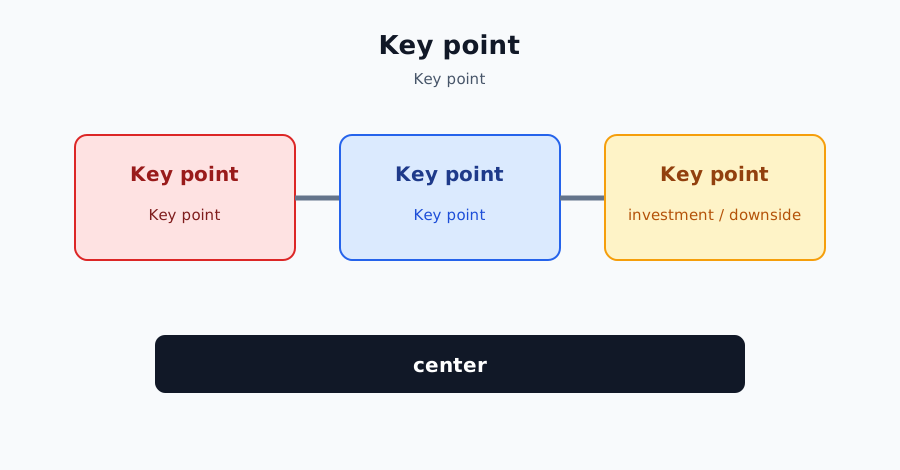
Illustration: Where should this risk be divided?
Investor defense measures
The practical lesson to be learned from this case is to separate securities accounts by function.
Apps like moomoo have strengths such as the amount of information, charts, US stock data, screening, and community features. Being an excellent tool is one thing, but whether it's the best place to store long-term assets is another.
In reality, it is easy to use them in the following ways.
| Usage | Account concept |
|---|---|
| New NISA / long-term core assets | Accounts with strong business continuity and transfer experience, such as major domestic online securities companies |
| Information collection/chart analysis | Utilize high-performance apps such as moomoo |
| Short-term trade/small amount experiment | Tolerable regulatory/administrative delay risk |
| Overseas stocks/ADR | Check parent company risks, transferability, and withdrawal routes in advance |
This is not a story that criticizes any particular securities company.
Rather, when using foreign tech securities, you should not only look at the convenience of the app, but also the parent company, regulatory jurisdiction, customer asset protection, and transfer procedures.
Indicators to watch in the future
If you look at Futu or TIGR, it's not enough to just follow the rebound in stock prices.
I would like to confirm the following numbers.
| Indicators | Reasons to watch |
|---|---|
| Number of new overseas deposit accounts | Can the decrease in mainland China be compensated |
| Regional diversification of customer assets | Will Hong Kong, Singapore, Japan, etc. grow? |
| Margin transaction balance | View profit sensitivity due to decrease in mainland customers |
| Return of non-GAAP profit | Confirm earning power excluding impact of fines |
| Regulatory costs | See increases in KYC, AML, and compliance costs |
| Japanese corporation disclosure/campaigns | Do they really intend to grow the Japanese market? |
Once stock prices fall significantly, they tend to rebound in the short term.
However, the real battle after the regulatory event begins with the next financial results. Will customer assets increase in overseas markets, absorb regulatory costs, and return profits? The market is still skeptical.
Summary
The latest crackdown on illegal cross-border securities transactions by Chinese authorities is not just an isolated issue involving Futu, Tiger, and Longbridge.
The event was held to systematically organize the route through which mainland Chinese personal funds flow to Hong Kong and US stocks through overseas online securities.
However, I would like to make a calm distinction here.
The CSRC disposition plan and two-year restructuring policy are true. The estimate by CITIC Securities and others is HK$250 billion. At this point, we cannot confirm that moomoo's Japanese subsidiary's customer assets are in immediate danger.
For individual investors in Japan, it is important not to put too many accounts into one.
Long-term assets emphasize stability. Highly functional apps are used for information gathering and short-term trading. If the parent company's regulatory risk arises, check its practices regarding withdrawals, transfers, and trading restrictions.
This sense of distance is just right for this news.
Source/Reference materials
- c100028/ / c7634330/
- Futu Holdings “Futu Receives Investigation Notice and Administrative Penalty Pre-Notification Letter from the China Securities Regulatory Commission
- Futu Holdings “Futu Announces First Quarter 2026 Unaudited Financial Results”
- The Motley Fool "Futu Q1 2026 Earnings Call Transcript"
- UP Fintech Holding Limited “SEC Filings”
- China State Council News Office / Xinhua “China to penalize 3 brokerages as crackdown on illegal cross-border trading intensifies”
- Tonghua Shun Finance and Economics "[Chinese Trust Certificate: Cross-border expansion, industry adjustment, land adjustment, reflection of the port in the port, 2000~2500 yen port left and right] (https://stock.10jqka.com.cn/20260525/c676942009.shtml)";
- moomoo Securities “Company Information”