What Matters Most
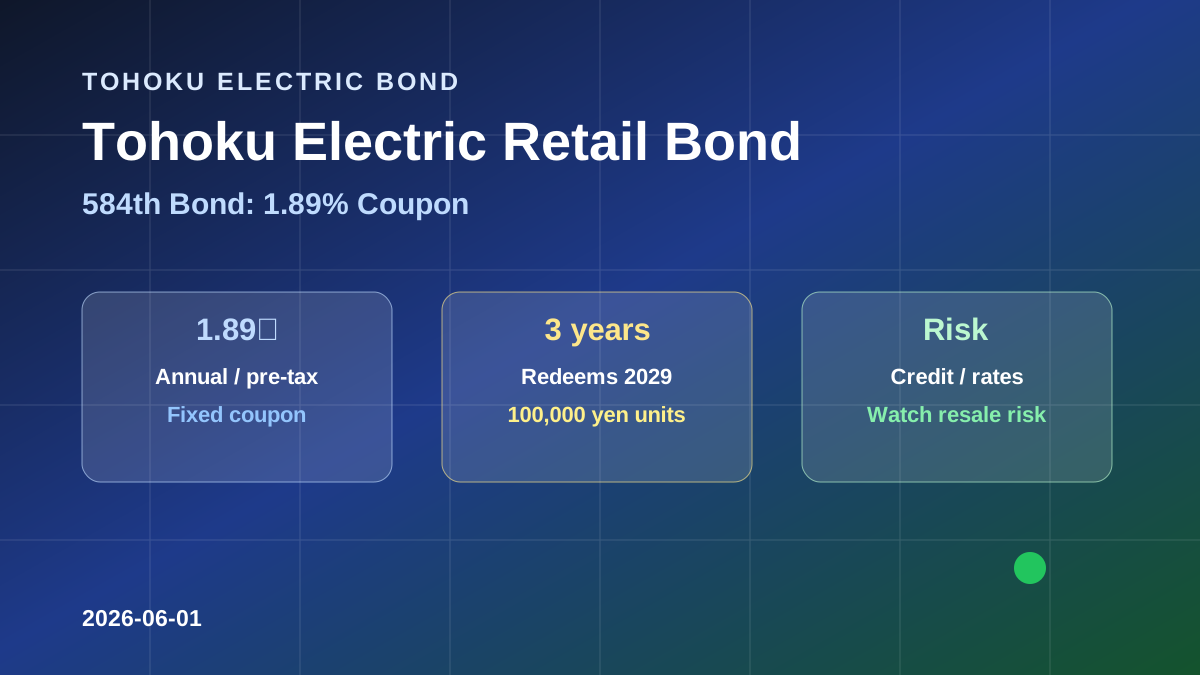
This is a three-year domestic retail bond with a 1.89% coupon.
It may catch the eye of investors looking for a higher return than bank deposits, but it is not the same as a principal-guaranteed deposit.
| Point to check | What to confirm |
|---|---|
| Coupon | Whether 1.89% is enough for the capital lock-up |
| Term | Whether the money can be held until June 19, 2029 |
| Credit risk | How to assess Tohoku Electric Power’s finances and ratings |
| Early sale | Whether price loss is possible if rates rise or markets deteriorate |
| Liquidity | Whether the bond can be sold at a desired price when needed |
If held to maturity, the bond is designed to redeem at par unless the issuer defaults.
But money that may be needed soon, emergency savings, or near-term spending funds should not be placed in a product that may need to be sold before maturity.
Basic Terms
According to Tohoku Electric Power’s announcement, the 584th bond is an unsecured corporate bond for individual investors.
Proceeds are planned for capital expenditures, bond redemption funds, and loans to Tohoku Electric Power Network.
| Item | Details |
|---|---|
| Issuer | Tohoku Electric Power Co., Inc. |
| Total issue amount | 15 billion yen |
| Denomination | 100,000 yen |
| Issue price | 100 yen per 100 yen of face value |
| Redemption price | 100 yen per 100 yen of face value |
| Coupon | 1.89% per year |
| Investor yield | 1.89% per year |
| Payment and issue date | June 19, 2026 |
| Maturity | June 19, 2029 |
The 100,000 yen denomination is accessible for retail investors.
However, the risk types do not change because the ticket size is small. Corporate bonds are not covered by deposit insurance. They are investments in the issuer’s credit.
Offering Schedule
| Date | Event |
|---|---|
| May 29, 2026 | Terms set |
| June 1, 2026 | Offering starts |
| June 18, 2026 | Application deadline |
| June 19, 2026 | Payment and issue date |
| June 19, 2029 | Maturity date |
Acceptance times and allotments differ by securities company.
Mizuho Securities’ notice states that its online offering period runs from 9:00 on June 1 to 15:30 on June 18, 2026.
Because sales amounts are limited, subscriptions can close before the final date.
How To View The 1.89% Coupon
The pre-tax coupon is 1.89% per year.
Mizuho Securities’ notice shows an after-tax coupon of 1.506% per year, reflecting Japan’s 20.315% tax on interest.
For a 100,000 yen investment, simple pre-tax annual interest is 1,890 yen.
100,000 yen x 1.89% = 1,890 yen per year before taxActual proceeds vary depending on tax treatment, holding period, account type, and interest payment periods.
The key is not to look at coupon alone. This is a product that pays 1.89% per year in exchange for locking funds for three years and taking issuer credit risk.
If rates rise after purchase, the price may fall if sold before maturity.
Ratings Are High, But Risk Is Not Zero
The bond is rated A+ by R&I and AA by JCR.
As a domestic electric utility bond, it may be viewed as relatively high quality.
But a rating is not a guarantee of principal or interest.
The issuer’s financial condition can change because of fuel costs, electricity supply and demand, regulation, interest rates, capital investment burden, nuclear policy, and transmission/distribution policy.
The order of analysis should be:
Coupon
↓
Issuer credit quality
↓
Can the money be held to maturity?
↓
Early-sale price risk
↓
Concentration within the portfolio
This should be viewed as accepting credit risk for a higher coupon than deposits, not as “safe because it is an electric utility.”
What Is The Pari Passu Clause Among Bonds?
This bond has a pari passu clause among bonds.
In simple terms, if Tohoku Electric Power later provides collateral to other unsecured bonds, this bond would receive equivalent treatment.
This is an investor-protection clause.
However, it does not mean the bond is secured from the start. The bond is an unsecured bond.
Benefits
| Benefit | Details |
|---|---|
| Clear fixed coupon | 1.89% per year |
| Three-year term | Maturity is visible and not ultra-long |
| 100,000 yen denomination | Accessible for individual investors |
The fixed coupon makes interest income easier to estimate.
The three-year term is easier to manage than a long 10-year bond. The 100,000 yen denomination also makes it easier for individuals to try bond investing in small size.
But visible coupon does not mean no risk.
Risks To Check
| Risk | Details |
|---|---|
| Credit risk | Deterioration in Tohoku Electric Power’s finances may affect principal or interest |
| Price fluctuation risk | Early sale price can fall due to rates or credit conditions |
| Liquidity risk | It may not be possible to sell at the desired price |
| Rate-rise risk | If rates rise after purchase, existing bond prices tend to fall |
| Concentration risk | Too much exposure to one issuer or sector |
The most important practical risk is loss on early sale.
Even if you intend to hold to maturity, unexpected cash needs can arise. Corporate bonds do not always sell at par.
Who Might Consider It?
| Potentially suitable investor | Reason |
|---|---|
| Has surplus funds not needed for three years | Easier to hold to maturity |
| Wants a higher coupon than deposits | Fixed 1.89% coupon is visible |
| Does not want stock-like volatility | Bond-oriented investment |
| Understands issuer credit risk | Corporate bonds depend on issuer credit |
It is less suitable for:
| Less suitable money | Reason |
|---|---|
| Money needed within a few months | Early sale may be required |
| Emergency savings | Not a principal-guaranteed deposit |
| Money seeking capital gains | Corporate bonds mainly provide interest income |
| Investors who do not want issuer analysis | Credit risk is central |
Conclusion
Tohoku Electric Power’s 584th bond has simple, easy-to-understand terms: 1.89% coupon, three-year maturity, 100,000 yen denomination, and ratings of A+ by R&I and AA by JCR.
It can be seen as an option for investors seeking income above deposits.
But a corporate bond is not a deposit.
If sold before maturity, price fluctuation can occur. Credit risk and liquidity risk also remain.
The key question is not only whether 1.89% is high.
Is this money unused for three years?
↓
Can you accept Tohoku Electric Power credit risk?
↓
Can you assume no early sale?
↓
Is the exposure size appropriate within total assets?
If the answer is unclear, the coupon alone should not drive the decision.