
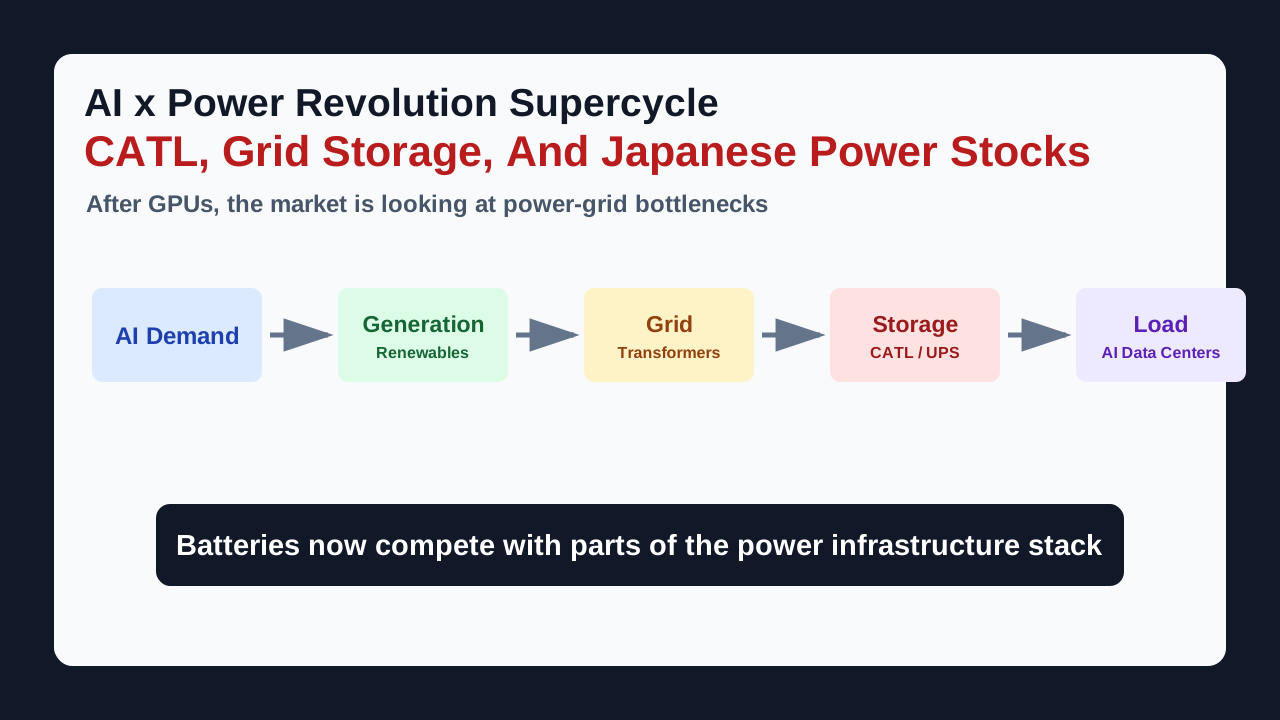
The Core Point: AI's Constraint Is Spreading From GPUs To Power
The first stage of the AI rally was naturally centered on NVIDIA, HBM, advanced packaging, and semiconductor equipment. Compute was scarce, so the market bought compute.
By 2026, the story has widened.
Building an AI data center is not finished when GPUs are procured. It requires high-capacity power intake, transformers, switchboards, backup power, UPS systems, cooling, optical networks, power contracts, renewable connections, and, in many cases, grid-scale storage. The bottleneck is moving from semiconductors alone to physical power infrastructure.
The value chain is easier to understand as one sequence.
AI demand
  ↓
new data centers
  ↓
large-scale power intake, substations, and distribution
  ↓
renewable interconnection and grid upgrades
  ↓
grid-scale storage and UPS systems
  ↓
stable power supply and AI uptime
For institutional investors, however, one more layer needs to be inserted: power utilities and balancing markets.
AI demand
  ↓
AI data centers
  ↓
transmission grids and interconnection
  ↓
power utilities and grid operators
  ↓
balancing markets, capacity markets, wholesale power prices
  ↓
grid-scale storage and peak-power resources
The real bottleneck is generation capacity, grid connection, and balancing. Cables and transformers matter, but they are not enough. In the end, the question is which utility area the data center is in, which grid it connects to, and how the system balances demand across hours and seasons.
The power scale is also changing. Definitions vary by project, but a traditional data center may sit around 20-50 MW, large AI-oriented facilities are often discussed in the 100-500 MW range, and hyperscale AI campuses are beginning to move toward the 1 GW class. At that point, the facility is no longer just IT infrastructure. It looks more like a large industrial load or a power-plant-scale demand source.
The IEA expects global data center electricity consumption to rise from about 485 TWh in 2025 to roughly 950 TWh in 2030. The exact numbers will move, but the direction is clear enough. AI data centers are becoming demand sources that power utilities and grid planners cannot treat as marginal.
The market still uses the broad phrase "AI-related stocks", but the internals are splitting apart: GPUs, optical networking, power equipment, data centers, storage, and materials. Treating them as one basket can lead to lazy investment conclusions.
CATL Is Starting To Look Less Like An EV Battery Maker And More Like A Storage Infrastructure Company
Seeing CATL only as an EV battery maker is becoming an outdated frame.
CATL is, of course, still the global leader in EV batteries. The bigger change is that it is expanding its revenue base into grid-scale storage, data-center-related storage, and renewable-energy integration.
What the market is watching is not just a broader business description.
The EV market is no longer moving in a straight line. Chinese battery makers have high share, but the price competition is harsh. That is why investors are becoming less willing to value CATL only on EV unit growth. The newer question is simple: can ESS become a real second pillar?
If EV demand slows more than expected, continued growth in grid-scale storage could help protect utilization and earnings. What the market wants from CATL is a transition from an EV-dependent battery maker into a power infrastructure company. Without that proof, even the global leader can still be treated as just another name in a battery price war.
In its 2025 annual-report release, CATL said lithium-ion battery sales rose to 661 GWh and that, based on SNE Research, its energy storage battery shipments accounted for 30.4% of the global market in 2025. In storage, it is not merely a participant. It is already one of the defining players.
Reuters also reported that a CATL executive responsible for European energy storage systems said energy storage could rise from about 25% of global sales now to 50% by 2030. Five years earlier, the figure was reportedly only about 2%. That is a meaningful portfolio shift.
The key is not to define CATL's competitors too narrowly.
As grid-scale batteries spread, they absorb renewable volatility, discharge during peak hours, and replace part of the function previously supplied by gas peakers or pumped hydro. If costs fall, lifetimes improve, and control software matures, batteries become grid-balancing assets, not just battery products.
The comparison set changes.
| Framework | Competitive Set |
|---|---|
| CATL as a traditional battery maker | BYD, LG Energy Solution, Samsung SDI, Panasonic |
| CATL as a power storage company | Gas peakers, pumped hydro, peak-power infrastructure, balancing markets, utility capex |
For equity markets, this is a major distinction. CATL is easier to understand as a 2030s structural story if it is tied to renewables, AI data centers, and grid stabilization rather than only to EV unit growth.
Still, the rerating needs numbers. If ESS shipments grow but average selling prices fall too quickly, profit may not follow. The market is not only asking whether the sales mix changes. It is asking whether ESS can defend margins and actually absorb the pressure from EV price competition.
The conditions for a CATL rerating are fairly clear. A higher ESS revenue mix is not enough. Margins need to hold. More importantly, the market needs to believe that CATL's business structure has become less exposed to EV price competition. If that becomes visible, CATL can start to be viewed less as a battery manufacturer and more as a power infrastructure stock.
The biggest ESS risk sits in the same place.
Shipments can rise while profits disappoint if cell prices and system prices keep falling. Grid-scale storage can become a huge market, but it can also become a highly competitive one. Battery makers, PCS suppliers, EPC firms, operators, utilities, and aggregators all need a share of the economics. It is still too early to assume CATL keeps all the margin.
Investors should therefore watch ESS margins, not only ESS shipments. If volume grows but gross margin falls, equity markets will not reward the story blindly. If CATL can defend ESS profitability while absorbing EV price pressure, the stock narrative changes much more meaningfully.
Battery Demand In 2027: The EV Lens Is No Longer Enough
The IEA's Global EV Outlook 2026 says EV battery deployment is expected to rise from around 1.2 TWh in 2025 to almost 3 TWh by 2030 in both the CPS and STEPS scenarios.
Add grid-scale storage, data-center backup power, commercial vehicles, and stationary storage, and the global battery market cannot be read from EV demand alone. As an investor assumption, a combined EV plus ESS demand range of roughly 1.6-1.9 TWh in 2027 is plausible.
That range is not an official forecast. It is an investment-case assumption used in this article. EV sales, subsidies, interest rates, grid connection queues, raw-material prices, and inventory cycles can all move the number.
The more important point is not whether the clean number is 1.6 TWh or 1.9 TWh. It is where the scenario can break.
Chinese subsidies, a European EV recovery, U.S. tariff policy, interest rates, leasing residual values, and grid-connection delays can all change the demand picture quickly. ESS is especially vulnerable to gaps between announced plans and actual deployment. Permits, land, interconnection, utility contracts, and procurement prices all matter. Projects can look real on paper and still take a long time to start operating.
The market is moving into a phase where it cares less about total-demand estimates and more about how many projects actually break ground, start operating, and turn into recognized revenue for battery makers.
Around 2027, three market points matter most.
| Issue | Market Read |
|---|---|
| China's two leaders | CATL and BYD retain advantages in scale, LFP, cost, and domestic demand |
| Non-Chinese producers | Policy support helps in North America and Europe, but cost pressure remains heavy |
| ESS | Energy storage can absorb part of an EV slowdown and broaden battery makers' revenue base |
The underappreciated point is that ESS is no longer a small side business. Even if EV demand pauses, renewable power and AI data centers can keep battery demand alive.
Sodium-Ion Batteries May Move Real-World Prices Before Solid-State Batteries Do
Solid-state batteries are exciting. But through 2027, sodium-ion batteries may be more relevant for actual pricing and supply.
CATL's Naxtra sodium-ion battery has been reported with energy density around 175 Wh/kg. The point is not that sodium-ion immediately beats LFP everywhere. The more realistic use cases are low-cost EVs, light commercial vehicles, cold-weather applications, and parts of stationary storage where lithium dependence can be reduced.
The important question is not whether sodium-ion becomes the hero chemistry for high-performance EVs. It is whether it lowers prices in commodity battery segments.
| Area | Likely Change |
|---|---|
| Low-cost EVs | Sodium-ion may be used alongside or partly instead of LFP to push down battery cost |
| Stationary storage | Weight constraints are looser, while price and life matter more |
| Resource markets | Long-term expectations for lithium, nickel, and cobalt demand may become less secure |
| Materials | Hard carbon, electrolytes, separators, and soda-ash-related materials become more closely watched |
This should not be turned into a dream story. The real test is mass-production yield, cycle life, safety, low-temperature performance, cell cost, pack design, and procurement contracts. Sodium-ion announcements do not instantly replace lithium batteries.
Still, the investment theme is large. EV investing is shifting from resource scarcity to material optimization and low-cost system design.
Toyota's Solid-State Battery: Separate Theme Value From Earnings Contribution
Toyota's solid-state battery program is one of the cleanest expectation stories in Japanese equities.
Toyota and Idemitsu have said they aim to commercialize all-solid-state batteries in 2027-2028, followed by full-scale mass production. Toyota and Sumitomo Metal Mining have also announced joint development for mass production of cathode materials used in all-solid-state batteries.
That matters. But investors need to keep the timeline clean.
Even if market introduction begins in 2027-2028, that does not mean solid-state immediately becomes the mainstream battery for mass-market cars. Initial deployment may be limited to premium models, small volumes, or validation-style launches, with broader adoption dependent on production yield, durability, cost, and supply chain readiness.
In the stock market, solid-state batteries can be a catalyst. As an earnings driver, however, the more realistic window may extend into the 2030s.
Confusing those two timelines is how investors mistake a theme rally for profit conversion.
Japanese Equities: Focus On The Grid Bottleneck, Not Only Battery Cells
For Japanese equities, this theme is more useful if investors avoid reducing it to battery-cell winners and losers.
CATL and BYD are on the side of lowering battery prices through scale and cost. Competing head-on in mass-produced cells is difficult for many Japanese companies. The more relevant exposure may be the equipment needed to connect AI data centers, renewables, and grid-scale batteries.
For Japanese stocks, the substation and cable names make the cleaner thematic argument. The more AI data centers are built, the more power intake equipment is needed. GPUs are not the only scarce item.
But this is where the trade gets harder.
The theme and the stock price are starting to separate. Cable names such as Fujikura, Furukawa Electric, and Sumitomo Electric are now often discussed as representative AI power infrastructure stocks. The honest investor question is probably: the theme makes sense, but do you buy it at the current price?
In this phase, "it is AI-related" is not enough. The question becomes whether orders and margins can exceed the expectations already embedded in the stock. A correct theme and a high investment return are not the same thing. Power infrastructure may be shifting from a theme-selection market to an earnings-selection market.
For institutional investors, the Japanese winners are easier to read by layer.
| Layer | Main Companies | What The Market Is Watching |
|---|---|---|
| Layer 0: Power utilities and balancing | TEPCO Holdings (9501), Kansai Electric Power (9503), Chubu Electric Power (9502) | Generation capacity, grid connection, power prices, balancing markets, fuel, nuclear, and regulatory risk |
| Layer 1: Cables and grid links | Fujikura (5803), Sumitomo Electric Industries (5802), Furukawa Electric (5806) | Power cables, optical cables, submarine cables, backlog, copper prices, capacity expansion, valuation |
| Layer 2: Power equipment | Hitachi (6501), Meidensha (6508), Takaoka Toko (6617), Daihen (6622), Fuji Electric (6504) | Transformers, switchboards, power electronics, pricing, delivery times, capex cycle |
| Layer 3: Storage and UPS | GS Yuasa (6674), Nichicon (6996), Mitsubishi Electric (6503) | UPS, storage solutions, project margins, data-center redundancy |
| Layer 4: Battery materials and FA | Asahi Kasei (3407), Toray (3402), Nippon Shokubai (4114), Hirata (6258), CKD (6407) | Separators, electrolytes, LiFSI, line replacement, mass-production adoption, inventory cycles |
This makes the AI power theme less monolithic. Utilities carry regulatory and fuel-price risk. Cable stocks can run ahead of earnings. Power-equipment names are judged on backlog and pricing. Storage and materials names still need proof of technology adoption and margins.
Power Utilities And Balancing Markets
Leaving this layer out makes the AI power thesis incomplete.
Power utilities such as TEPCO Holdings (9501), Kansai Electric Power (9503), and Chubu Electric Power (9502) ultimately absorb data-center electricity demand. They are not simple growth stocks. Fuel prices, nuclear operations, regulation, wheeling charges, capacity markets, regional supply-demand balance, and political risk all matter. That is why they are harder to buy as a clean AI theme than cable stocks.
Still, if data-center demand accumulates as large industrial load, the market's view of utilities can change. The key is not only generation volume. It is grid connection and balancing. As renewable power grows, the gap between day and night, sunny and cloudy days, weekdays and weekends becomes more volatile. AI data centers add large, hard-to-interrupt demand on top of that.
Japan's balancing market is the mechanism through which transmission and distribution operators procure the balancing capacity needed for frequency control and supply-demand adjustment. Batteries, demand response, and generation assets can all participate. If CATL's ESS business is truly moving into power infrastructure, the important question is not only how many batteries it sells, but where those batteries sit inside market design.
In this site's earnings summaries, TEPCO's recurring profit improved in FY2026/3, but the company fell into a net loss due to special losses. Kansai Electric maintained a high profit level but guided for a sharp profit decline in FY2027/3. Chubu Electric increased recurring and net profit, while operating profit declined. None of these stocks can be valued only through the AI power lens. But they are an essential layer when analyzing demand growth, fuel costs, regulation, grid investment, and balancing economics.
Substations And Power Equipment
Hitachi (6501), Meidensha (6508), Takaoka Toko (6617), Daihen (6622), and Fuji Electric (6504) are often viewed in the context of substation equipment, switchboards, power electronics, and power-management systems.
But the market does not treat all of these names with the same temperature.
Hitachi is not really a pure AI power theme stock. It is a large social infrastructure company chasing projects across power grids, rail, industry, and digital systems. AI data centers are part of the story, but Hitachi is closer to a broad infrastructure compounder than a narrow theme stock.
Meidensha and Takaoka Toko sit closer to the transformer and grid-equipment shortage story. Investors are more likely to ask whether backlog is truly building and whether price revisions can stick. Daihen and Fuji Electric mix transformers with power electronics, power management, and industrial power systems. In other words, even within "grid stocks", the market's angle is not the same.
In this site's earnings summaries, Hitachi's FY2026/3 full-year revenue was 10,586.781 billion yen, with operating profit of 1,199.275 billion yen, up 23.4% year over year. Fuji Electric's revenue was 1,227.595 billion yen, with operating profit of 136.620 billion yen, up 16.1%.
Those numbers alone do not prove a pure AI-power winner. But they do show that the heavy electrical equipment cycle has enough earnings substance to be reconsidered by the market.
Power Cables And Networks
Sumitomo Electric Industries (5802), Fujikura (5803), and Furukawa Electric (5806) are easier to connect to power-grid upgrades, submarine cables, data-center connectivity, and optical networks.
Fujikura's FY2026/3 full-year revenue was 1,182.358 billion yen, with operating profit of 188.707 billion yen, up 39.2% year over year. The numbers are strong. The harder question is how much the share price has already priced in.
Cable stocks are not just second-order AI beneficiaries. They are being revalued as companies sitting on physical constraints in both power and communications networks. Still, even with strong backlog, copper prices, FX, project timing, capex, and margin normalization need to be watched.
This matters. Even when a company like Fujikura has strong earnings, the hurdle rises if the stock price has already run ahead. The market is less likely to be satisfied with "there is AI demand" alone. It will check order quality, profitability, capacity expansion, and the next guidance.
Is the market buying Fujikura today, or is it already buying Fujikura several years from now?
That is the dividing line. The first can be explained by current earnings momentum. The second requires more than another decent quarter. When a stock is bought on future expectations, it can stop rising even without bad news, simply because the catalyst is already priced in or profit-taking starts. That is the difficult part of the cable trade.
UPS, Storage, And Data-Center Power Systems
Mitsubishi Electric (6503), Nichicon (6996), and GS Yuasa (6674) are commonly discussed around UPS systems, battery storage, power control, and cooling or power-adjacent data-center equipment.
For AI data centers, even a short outage can be costly. Power quality, redundancy, emergency power, and backup power are less glamorous than servers or GPUs, but they are essential in implementation.
This area has strong thematic appeal, but project profitability can vary widely. Winning large orders is not enough if margins are thin. The market will eventually look through order headlines and ask about gross margin, cash conversion, and repeatability.
High-Value Materials And Factory Automation
Asahi Kasei (3407) and Toray (3402) are often watched for separators and thin-film materials. Nippon Shokubai (4114) is tied to electrolyte-related materials. Hirata (6258) and CKD (6407) can be linked to battery line automation.
Materials stocks are tricky if bought only on theme. Pricing power, customer mix, yield, capex burden, and inventory cycles can change earnings quickly. Even if sodium-ion and solid-state headlines increase, investors still need to confirm which materials are actually adopted in mass production.
Areas That Deserve More Caution
Panasonic Holdings (6752) and Toyota Motor (7203) should not simply be described as losers. Both have strengths in premium batteries, vehicle control, solid-state development, hybrid strategy, and multi-path electrification.
The issue is cost competition in mass-produced cells. Chinese scale is powerful. In this site's FY2026/3 summary, Panasonic Holdings' revenue was 8,048.722 billion yen and operating profit was 236.407 billion yen, down 44.6% year over year. One year does not define the company, but battery investing cannot ignore margin pressure and price competition.
Toyota's solid-state story is similar. It is a powerful catalyst, but a 2027-2028 market introduction and a 2030s earnings contribution should be analyzed separately.
Four Checks For Investors
This is a long-cycle theme. That makes headline investing dangerous.
| Check | What To Watch |
|---|---|
| Real orders | Are orders tied to AI data centers, renewables, or grid upgrades? |
| Margins | Are large projects profitable, and can ESS or equipment price declines be absorbed? |
| Power markets | How do utilities, balancing markets, capacity markets, and wholesale prices change? |
| Valuation | Has the market already priced in the theme? |
| Mass production | Can sodium-ion, solid-state, and ESS products be scaled profitably? |
My own read is that the center of the theme is not simply "AI increases electricity demand." The sharper point is that AI data centers cannot achieve high uptime unless power supply becomes more stable.
Power is not a dream.
It may be the most boring constraint in the AI boom. GPU shortages make headlines. But in real projects, the delays can come from missing transmission lines, unavailable transformers, or slow grid interconnection. The market likes dramatic technology stories, but AI data centers ultimately run on physical infrastructure.
That is what makes the theme interesting. It is not flashy. If anything, it is almost too mundane. But mundane constraints can show up quickly in pricing power and backlog once capacity gets tight.
Final Conclusion
The 2027-2035 AI trade cannot be explained by GPUs alone.
As AI data centers expand, power, substations, storage, cooling, and communications infrastructure are needed at the same time. CATL is beginning to look less like a pure EV battery maker and more like a power storage infrastructure company. If sodium-ion batteries scale, the market may focus less on lithium scarcity and more on low-cost, stable battery-system design.
In Japanese equities, the companies with the stronger thematic logic may be those that control grid bottlenecks rather than those trying to beat CATL on cell costs. Substation equipment, transformers, cables, UPS, high-value materials, and factory automation sit in the next implementation layer of the AI cycle.
One layer further out, power utilities and balancing markets also belong on the same map. AI data centers do not operate just because cables are installed. Generation capacity, grid connection, power prices, balancing resources, and capacity markets all have to work. The idea that CATL may eventually compete with gas peakers or pumped hydro only makes sense inside this wider electricity-market context.
But a correct theme does not automatically mean a correct stock price. From here, investors need to check orders, margins, cash flow, capex, and valuation one by one.
In fact, the more a stock has already been bought, the harder the next earnings test becomes. Cable and substation stocks are easy to buy under the label "AI power infrastructure", but what remains after the label is much more mundane: are orders actually increasing, are gross margins holding, can capex be recovered, and is guidance still conservative?
The theme is not over. The entry point of the trade is changing. After the 2024-2025 phase of buying anything close to AI, the second half of 2026 may become a market that keeps only the companies able to convert AI power demand into earnings.
Sources
- IEA: "Electric vehicle batteries - Global EV Outlook 2026"
- IEA: "Energy and AI"
- C&C Technology Group: "Data Center Power Consumption: How Many Megawatts Does a Data Center Use?"
- USPE Global: "What are the Power Requirements for a Data Center?"
- TEPCO Power Grid: "Balancing Market"
- CATL: "Zero-Carbon Technology Powers 'All-Domain Growth': CATL Releases 2025 Annual Report"
- Reuters / MarketScreener: "Chinese battery maker CATL expects energy storage to make up half of global sales by 2030"
- Toyota Motor: "Idemitsu and Toyota Announce Beginning of Cooperation toward Mass Production of All-Solid-State Batteries for BEVs"
- Toyota Motor: "Sumitomo Metal Mining and Toyota Collaborate on Mass Production of Cathode Materials for All-Solid-State Batteries"
- This site: "TEPCO Holdings: FY2026/3 Full-Year Results | Recurring Profit Improvement But Net Loss"
- This site: "Kansai Electric Power: FY2026/3 Full-Year Results | High Profit Maintained But FY2027/3 Profit Decline Planned"
- This site: "Chubu Electric Power: Revenue of 3,546.041 Billion Yen (-3.4%) | FY2026/3 Full-Year Results"
- This site: "Fujikura: Revenue of 1,182.358 Billion Yen (+20.7%) | FY2026/3 Full-Year Results"
- This site: "Hitachi: Revenue of 10,586.781 Billion Yen (+8.2%) | FY2026/3 Full-Year Results"
- This site: "Fuji Electric: Revenue of 1,227.595 Billion Yen (+9.3%) | FY2026/3 Full-Year Results"
- This site: "Panasonic Holdings: Operating Profit -44.6% | FY2026/3 Full-Year Results"