
[Summary]
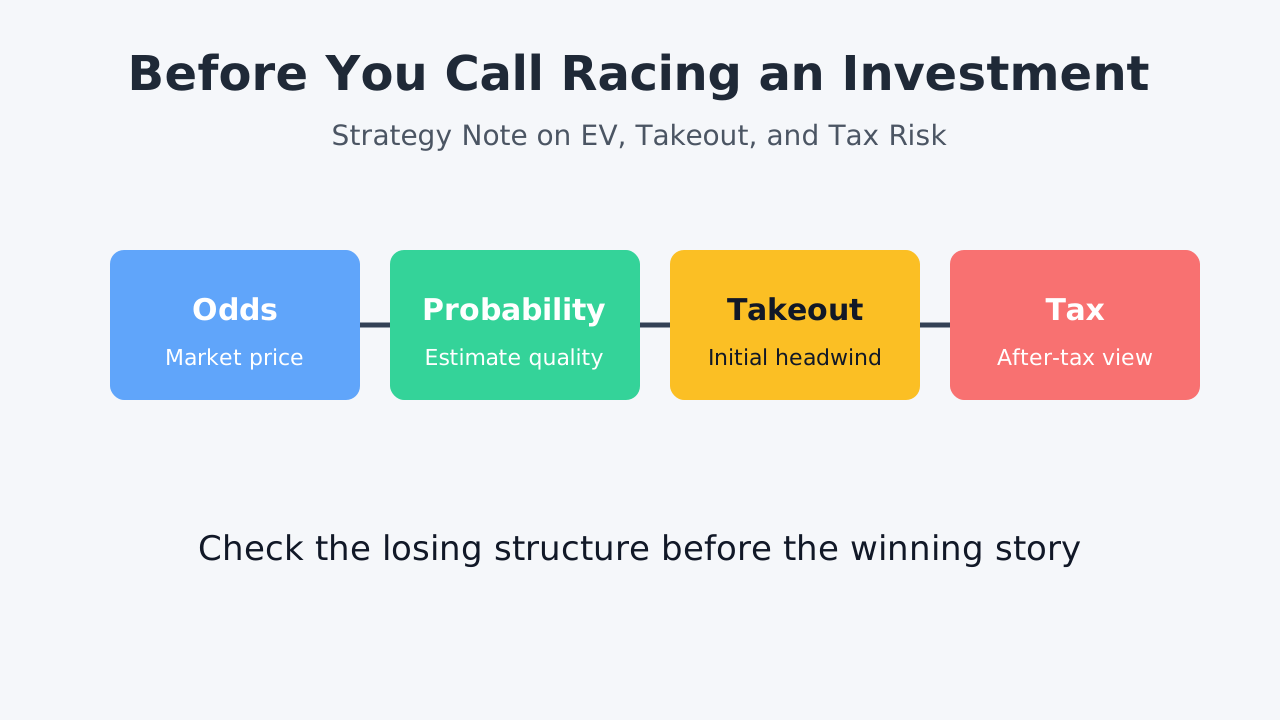
Before you call horse racing an investment, this strategy note reviews the realities to check: JRA takeout, expected value, market-implied probability from odds, overfitting, the Kelly criterion, tax risk, and bankroll management. In this article, the word "investment" is not used as a recommendation. It is used as a metaphor for analyzing expected value, risk, and money management.
What this article covers
This article does not organize horse racing as a way to make money. It treats horse racing as an object for examining expected value, takeout, after-tax return, and bankroll management.
Specifically, it explains:
- Why horse racing is negative-sum for bettors as a group.
- Why expected value matters more than hit rate.
- How to read market-implied probability from odds.
- Why overfitting and bankroll management failures are common.
- How to think about tax, terms-of-use, and addiction risks.
First, the conclusion
If you approach horse racing from a quantitative betting perspective, the core ideas are these:
- Market odds are prices that reflect the view of the betting market.
- Expected value appears only when your estimated probability is higher than the market-implied probability.
- Any edge must remain after takeout, taxes, model error, and losing-streak risk.
This article does not recommend buying betting tickets. The word "investment" is used as a metaphor for analyzing expected value, risk, and money management. Horse racing is a public wagering activity with loss risk, and it is not something to fund with money needed for daily life.
Even so, "investment" here has to be understood in a very strict analytical sense.
Unlike stocks or bonds, horse racing does not derive its return source from corporate profits, interest payments, or economic growth. Horse racing distributes payouts from the money wagered by bettors. Once takeout exists, bettors as a group are in a negative-sum market.
So if you look at horse racing through an investment lens, the first question should not be "how can I target a high expected return?"
It should be:
Can any edge still remain in a market that starts with such a heavy cost burden?
Why the horse racing market is negative-sum
JRA payout rates are set by bet type. As of June 2026, based on JRA's official information, win and place bets pay out at 80%, bracket quinella, quinella, and wide bets at 77.5%, exacta and trio bets at 75%, trifecta at 72.5%, and WIN5 at 70%.
In other words, the takeout rate is roughly 20% to 30%.
Suppose the betting market buys JPY 1,000,000 worth of tickets. If the payout rate is 75%, the payout pool is JPY 750,000. The remaining JPY 250,000 is taken out.
Bettor wagers: JPY 1,000,000
 ->
Takeout: JPY 250,000
 ->
Payout pool: JPY 750,000
Someone can win.
But at the aggregate level, money has already left the market. This is the heaviest condition when treating horse racing as an investment-like object of analysis.
Stock investing also has commissions, taxes, and spreads. But equity markets have return sources such as corporate earnings, dividends, and economic growth. Horse racing does not have that kind of market-wide return source. That difference matters.
Look at expected value, not hit rate
A common mistake in horse racing is assuming that a high hit rate is good.
In practice, expected value is what matters.
Using payout odds in a simple way, expected return can be written as:
Expected return = estimated probability x oddsIf you want to express it as a return on investment:
Expected ROI = estimated probability x odds - 1Suppose a horse is priced at odds of 12.0, and your model estimates its probability at 10%.
Expected return = 10% x 12.0 = 120%
Expected ROI = 120% - 100% = +20%
If that premise is correct, the expected value is positive.
By contrast, even if you believe a 1.1-odds horse has an 80% chance of coming in:
Expected return = 80% x 1.1 = 88%The expected value is negative.
This is the cold part of the discussion.
"Easy to hit" does not necessarily mean "easy to profit from." The same is true in investing: if you only look at win rate, the payoff ratio and costs can beat you.
Market-implied probability and estimated probability
Odds are prices created by bettor money.
The probability reverse-engineered from odds is called the market-implied probability here. Strictly speaking, you need to account for takeout and bet-type payout mechanics, but for a beginner-friendly approximation:
Market-implied probability ~= 1 / oddsIf the odds are 5.0, the market is roughly implying a probability of around 20%.
Quantitative horse-racing analysis looks for situations where:
Estimated probability > market-implied probabilityFor example, the market may be pricing a horse as if its chance is around 20%, while your model estimates 25%. If that gap truly exists, there is a price distortion.
The hard part is "if that gap truly exists."
You may believe your model is smarter than the market, but it may simply be overfit to historical data. Or you may just be attaching a rational story to a psychological desire to bet on a long shot.
Horse-racing quant analysis is not only about reading the horse. It is also about doubting your own illusion.
Market efficiency and the difficulty of beating odds
One reason sustainable profitability is difficult is that betting markets are often surprisingly efficient.
Public information is quickly incorporated into odds. When thousands of participants analyze the same race, obvious pricing mistakes tend to disappear rapidly.
That does not mean markets are perfectly efficient. It means any edge must be large enough to overcome takeout, execution friction, tax drag, and model error.
For a quantitative betting approach, this is the real bar. It is not enough to find a horse that looks interesting. The question is whether the market price is still wrong after other bettors, odds movement, and takeout have already done their work.
Dynamic edge disappears quickly
The truly difficult part of horse-racing quant work is that edge is not fixed.
Suppose a feature is useful.
For example:
- A horse returning from a specific outside training facility.
- The interaction between a bloodline and a particular track condition.
- A horse that suffered serious traffic trouble in its previous race.
- Conditions involving a jockey or stable that tends not to attract public money.
- Inside or outside draw bias.
If the market is overlooking those conditions, expected value may appear for a while.
But that distortion will not remain forever.
Once other participants notice the same feature, money flows in. Odds fall. A condition that was profitable yesterday may simply become normal today.
In that sense, the edge in horse-racing quant work is not static. It is dynamic.
Discover a feature
 ->
Market money enters
 ->
Odds adjust
 ->
Expected value thins out
 ->
Search for the next distortion
In English, this is close to the idea of an adaptive edge: an edge that changes with the market environment.
But the more impressive the phrase sounds, the more ordinary the actual work becomes. What matters is not making dramatic predictions. It is detecting model decay.
- Has recent ROI declined?
- Are odds for a specific condition lower than they used to be?
- Is expected ROI still there, rather than just hit rate?
- Are you chasing a feature that the market has already priced in?
In investing, well-known anomalies tend to fade over time. Horse racing is similar. Because the takeout burden is heavy, you need to be even more sensitive to edge decay.
Overfitting is the biggest enemy
Horse-racing data contains a large number of features.
- Running time
- Track condition
- Draw
- Distance aptitude
- Bloodline
- Jockey
- Trainer
- Course configuration
- Previous-race details
- Race spacing
- Odds movement
The more materials you have, the easier it is to build a model that looks plausible.
The problem is that plausible models often fit the past too closely. A model that shows high ROI in one historical period can suddenly break in the next period. The same thing often happens in investment backtests.
At minimum, you need checks such as:
- Split training and validation periods while preserving time order.
- Check ROI in out-of-sample periods.
- Do not overtrust tiny samples created by overly narrow race conditions.
- Look at maximum drawdown, not only ROI.
- Check hit rate, average payout, losing streaks, and the bankroll curve together.
Winning in a backtest and surviving in real operation are different things.
In horse racing especially, last-minute odds movement, the effect of your own purchase size on odds, communication issues, and operational constraints matter. Expected value on paper can become something else when the ticket is actually bought.
Evaluate risk-adjusted returns, not just expected value
This is not a matter of indiscriminately buying tickets that appear to have high expected value.
Just as investors look at portfolio-level risk, horse-racing analysis must look at volatility in results.
For example, a strategy that targets high expected value using only win bets will often have a low hit frequency. If it catches a high payout, ROI can jump, but the bankroll curve can become very rough.
By contrast, adding place or wide bets can reduce volatility. But if the strategy leans too far into low odds, it becomes easier for takeout to win.
What matters is not one isolated expected-value estimate. It is the durability of the overall strategy.
| Item to check | Meaning |
|---|---|
| Average expected ROI | Theoretical edge per ticket |
| Variance | Volatility of returns |
| Maximum drawdown | How far bankroll can fall |
| Losing-streak probability | Whether the strategy can be executed continuously |
| Odds movement | Whether expected value remains at purchase time |
| After-tax return | What actually remains |
Borrowing finance terminology, this is close to the logic behind the Sharpe ratio or Sortino ratio.
But those concepts do not map cleanly onto horse racing. Race-by-race independence, odds movement, tax treatment, and purchase constraints all matter.
That is why it is better to estimate roughly while including execution slippage than to present the numbers too neatly.
The conclusion is the same here:
The more positive a strategy looks on paper, the more conservatively it should be treated in real operation.
Bankroll management: think fractional Kelly, not full Kelly
Even when expected value is positive, losing streaks will happen.
If bankroll management is wrong, your money can run out before the model's edge has a chance to show itself.
One well-known theoretical method is the Kelly criterion.
f* = (p x b - q) / bWhere:
| Symbol | Meaning |
|---|---|
| f* | Fraction of bankroll to wager |
| p | Estimated probability |
| q | Probability of losing, or 1 - p |
| b | Odds multiple minus 1 |
The Kelly criterion maximizes long-term bankroll growth if the probabilities and odds are estimated correctly.
In practice, applying it directly is dangerous.
Even a strategy with positive expected value can fail if position sizing is too aggressive. This is closely related to the classic concept of gambler's ruin, where a bettor runs out of capital before long-term probabilities have time to work.
The reason is simple: p is an estimate. If you overestimate the probability by only a few percentage points, the stake becomes too large. In a market like horse racing, where takeout and variance are large, full Kelly will often be too aggressive.
More realistic approaches are conservative:
- Reduce to half Kelly or quarter Kelly.
- Set a maximum stake per race.
- Set a daily or meet-level loss limit.
- Do not increase stake size after losing streaks.
- Never use money needed for daily life.
The purpose of bankroll management is not to win big in the short term.
It is to avoid fatal damage when the model is wrong.
Tax risk can be heavier than model risk
Tax is often overlooked in investment-style discussions of horse racing.
In Japan, payouts from public wagering are generally treated as occasional income. When calculated as occasional income, the deductible cost is basically the cost of the winning ticket that produced the payout. It is not safe to assume that losing tickets can be broadly deducted.
This is an awkward fit for quantitative betting.
For example, a strategy may buy many tickets and try to profit from the whole portfolio, including losing tickets. In that case, the treatment of losing tickets can have a major impact on after-tax return.
There have been Supreme Court cases in which, under certain conditions, horse-racing payouts were treated as miscellaneous income and the cost of losing tickets was recognized as necessary expense. But this does not mean that using automated purchase software automatically makes the income miscellaneous income. The judgment depends on factors such as the nature, scale, records, and continuity of the purchasing activity.
The National Tax Agency indicates that payouts may fall under miscellaneous income in cases such as when a person uses original conditions or purchase patterns, buys many tickets throughout the year, and it is objectively clear that the overall return rate over the relevant period exceeded 100%.
In other words, the tax treatment is highly fact-specific.
For a public article, this should not be stated too definitively. If large payouts or continuous purchasing are involved, it is necessary to consult a tax professional.
Be careful with words like automated purchase and API
When discussing horse racing like a quantitative betting strategy, it is tempting to use terms such as automated order placement or API integration.
However, JRA states that if a user connects non-official apps or software to place bets, it does not guarantee the success or content of those bets.
Therefore, in a public article, avoid wording such as:
Feed it into an automated order systemA safer expression would be:
Check the rules and terms of use, then maintain a purchase process and records.This is not a finance-theory issue. It is a practical terms-of-use risk.
Minimum metrics for horse-racing quant analysis
If you treat horse racing as an analytical object, these are the minimum metrics to check:
| Metric | Why it matters |
|---|---|
| Hit rate | Frequency of wins and losses |
| Average odds | Payout level when winning |
| ROI | Return relative to purchase amount |
| Expected ROI | Expected profit per unit |
| Maximum drawdown | How much the bankroll can decline |
| Losing streak length | Psychological and bankroll durability |
| Sample size | Distinguishing luck from skill |
| After-tax return | Amount that actually remains |
The especially important point is not to judge by ROI alone.
If a small number of high payouts is driving ROI, reproducibility may be weak. If losing streaks are too deep, a strategy may be theoretically positive but difficult to execute.
Numbers should be viewed as a set, not one by one.
Common beginner misunderstandings
A high hit rate does not mean you can win
If you keep buying low-odds tickets, your bankroll can shrink even while you are hitting.
In investment terms, this resembles a strategy with a high win rate but a poor payoff ratio.
Long-shot betting is not automatically better
Long shots are exciting.
But if the estimated probability is not above the market-implied probability, you are simply buying tickets that are likely to miss.
A complex model is not automatically stronger
The more features you add, the easier it becomes to fit the past.
The question is whether it works in the future.
You can win before tax and lose after tax
Occasional income, miscellaneous income, and necessary expenses are not minor details.
Before handling large amounts, this is an area where you should consult a professional.
Checklist for a strategy note
If you analyze horse racing through an investment lens, this order is useful:
Check the takeout rate
 ->
Read the market-implied probability
 ->
Estimate probability
 ->
Calculate expected value
 ->
Question overfitting
 ->
Set bankroll management rules
 ->
Check tax, terms-of-use, and addiction risks
If any one part of this flow is weak, long-term edge becomes very questionable.
Horse racing can be discussed in the language of financial engineering.
But the more you use that language, the more rigorously you have to look at the inconvenient numbers too.
Analyzing horse racing through an investment lens is not the same as recommending horse racing as an investment target. The former is a way to make risk visible. The latter is a claim that can influence readers' financial behavior. This article takes the former position and calmly organizes expected value, takeout, and after-tax return.
Conclusion: the conditions that remain as a strategy
If you think about horse racing as an investment-like object of analysis, the central question is not "will my prediction hit?" but "is the expected value positive?"
The key points are:
- JRA payout rates are 70% to 80% depending on bet type, so the betting market is negative-sum for bettors as a group.
- Expected value and ROI matter more than hit rate in horse-racing analysis.
- A theoretical edge exists only when estimated probability exceeds market-implied probability.
- Overfitting to past data can lead to large losses in real operation.
- Bankroll management methods such as Kelly must be used conservatively because model error is unavoidable.
- If tax, terms-of-use, and addiction risks are ignored, even a strategy with positive pre-tax expected value can effectively fail.
In the end, the most important thing when viewing horse racing through an investment lens is calmness.
Before looking for reasons to win, check the structure that makes you lose. Before talking about expected value, look at takeout and after-tax return. Before trusting a model, build in the possibility that the model is wrong.
Without that posture, the phrase "horse racing investment" becomes a convenient story rather than analysis.
Again, this article does not recommend horse racing or ticket purchases. Betting tickets carry loss risk and should not be funded with money needed for daily life. If you find it difficult to control purchasing behavior or if it affects your household finances, consider using public consultation resources related to gambling addiction.
Sources and references
- JRA, "How are payouts calculated?" https://www.jra.go.jp/faq/pop03/1_17.html
- National Tax Agency, "Income Tax Basic Circular, Article 34: Occasional Income" https://www.nta.go.jp/law/tsutatsu/kihon/shotoku/04/08.htm
- National Tax Agency, "Taxation of horse-racing betting ticket payouts" https://www.nta.go.jp/information/other/data/h30/keiba/index.htm
- National Tax Agency, "For those who received payouts from public wagering" https://www.nta.go.jp/publication/pamph/shotoku/kakuteishinkokukankei/koueikyougi/index.htm
- JRA, "JRA measures for gambling addiction" https://www.jra.go.jp/company/social/disorder/
- Consumer Affairs Agency, "For those troubled by gambling addiction" https://www.caa.go.jp/policies/policy/consumer_policy/caution/caution_012/