
Intraday Price Action and Key Indicators
| Indicator | Figure | How to read it |
|---|---|---|
| Previous close | 7,738 yen | A level that still included pre-Direct expectations |
| Open | 7,297 yen | A large gap down from the open |
| High | 7,307 yen | The rebound was limited |
| Low | 7,073 yen | More than 8% below the previous close at one point |
| Close | 7,215 yen | -523 yen, or -6.76% |
| Volume | 17,297,100 shares | Trading volume expanded sharply |
| Market capitalization | 9.29 trillion yen | Still one of Japan’s largest listed companies |
| PER, company forecast basis | 26.83x | Expectations cooled, but it is not yet a clear value stock |
| PBR, actual basis | 2.82x | Still reflects an IP-company premium |
| Margin buying balance | 14,397,100 shares | As of June 5, 2026. Positioning remains heavy |
| Margin ratio | 18.15x | Long margin positions dominate |
The stock recovered somewhat from its intraday low into the close. Still, it did not regain the 7,400 to 7,500 yen area. The short-term chart remains damaged.
The Three Main Factors Behind the Selloff
1. The announcements did not meet expectations for a major full-scale new title
Nintendo Direct revealed several pieces of new information. From a user perspective, the lineup had some depth. Third-party titles, existing IP updates, remakes and remasters, and additional details all help fill the transition period for new hardware.
But what the stock market really wanted was a major first-party, fully new title capable of pulling Switch 2 demand through the holiday season.
In particular, the absence of a mainline 3D Mario-level title weighed on investor sentiment. Reuters-related coverage also cited a Jefferies analyst’s view that the absence of 3D Mario for the holiday season has meaningful commercial implications.
The key point is not whether the presentation was bad. The key point is what the share price had already priced in.
Nintendo shares do not rise just because there are interesting-looking games. The market wanted a reason to immediately raise assumptions for FY2027 Switch 2 hardware units, software unit sales, digital sales, and operating profit.
This Direct did not quite reach that level.
2. Concern over Switch 2 sales momentum
For a game console cycle, killer software matters. It gives consumers the reason to buy the hardware.
The latest announcements were enjoyable for existing users and series fans. But investors viewed them as insufficient as a reason to revise hardware unit assumptions further upward.
Expectations for Switch 2’s initial launch have been high. That is why the market is sensitive to second-year demand and the sustainability of holiday-season momentum. As a hardware-cycle stock, Nintendo is not valued only on the first-year launch. The valuation changes depending on whether software can support engagement and attach rates in the second year and beyond.
If a major new first-party title had appeared, expectations for the holiday season could have moved another step higher. If the lineup looks centered on remakes and third-party support, concerns about sales momentum remain.
That difference showed up strongly in the share price.
3. Sell-the-news pressure and a reversal in margin positioning
Nintendo shares had risen into the June 9 close of 7,738 yen, pricing in event expectations in advance. A stock that rallies into an event is vulnerable to selling after the event if the surprise is even slightly insufficient.
This time, margin positioning made the move worse.
According to Yahoo Finance margin trading data, Nintendo’s margin buying balance was 14,397,100 shares as of June 5, 2026, with a margin ratio of 18.15x. For a large-cap Prime Market stock, that is heavy.
| Item | Figure | Date |
|---|---|---|
| Margin buying balance | 14,397,100 shares | June 5, 2026 |
| Margin selling balance | 793,100 shares | June 5, 2026 |
| Margin ratio | 18.15x | June 5, 2026 |
| Weekly change in margin buying balance | -847,500 shares | June 5, 2026 |
The margin buying balance had declined from the previous week, but the absolute amount remained large.
In a rising market, that kind of long positioning can reinforce momentum. But once the stock gaps down after an event, the same position turns into selling pressure.
Short-term profit-taking, stop-loss selling, margin-call avoidance, preemptive hedging, and trapped holders selling into rebounds can all overlap. When that happens, the stock can move more than the actual fundamental importance of the announcement.
That is what made this selloff look like a positioning reversal.
“Disappointment Selling” Is Too Shallow an Explanation
The market reaction to Nintendo Direct is not the same thing as fan satisfaction.
For game fans, remakes, third-party titles, and additional information on existing IP all have value. A broader lineup is not bad news.
But the stock market looks at something colder.
The market wanted evidence that the earnings model should go up. Will Switch 2 hardware sales exceed expectations? How many full-price titles can sell through during the holiday season? How much can downloads, DLC, online subscriptions, and IP-related revenue lift margins?
This Direct mattered as lineup reinforcement. But it did not seem strong enough to immediately move company guidance or market forecasts higher.
That is why the stock was sold.
The presentation was not necessarily a failure. Expectations were simply placed too high. Separating those two points is essential for reading Nintendo’s share-price move.
Technically, 7,400 to 7,500 Yen Becomes the Rebound-Check Zone
The short-term chart is now visibly damaged.
From the May 15 year-to-date low of 6,849 yen, the stock had recovered to 7,738 yen on June 9. Then it gapped down sharply after the event. For short-term traders, that is an unpleasant setup.
| Level | How to read it |
|---|---|
| Around 7,500 yen | If regained quickly, the market may treat the event selloff as temporary |
| Around 7,400 yen | A likely rebound-resistance zone |
| 7,073 yen | June 10 low; a level to watch for exhaustion selling |
| Around 7,000 yen | Psychological support |
| 6,849 yen | May 15 year-to-date low; a break would suggest a longer positioning cleanup |
If the stock quickly recovers 7,400 to 7,500 yen, the view that this was a one-off post-event selloff becomes easier to accept. If that zone draws heavy selling, the trapped long positions may need more time to clear.
This should be separated from the long-term Nintendo story. The short-term supply-demand balance has deteriorated.
The French Fine Is Not the Main Cause
Reports of a fine by French consumer protection authorities also served as a selling catalyst.
According to reports, Nintendo’s European unit was fined 35 million euros, or roughly 6.5 billion yen, over Nintendo Switch controller defects, and Nintendo accepted the payment.
But it is difficult to treat this as the main cause of the sharp selloff.
Nintendo’s FY2026 results were revenue of 2.313 trillion yen, operating profit of 360.1 billion yen, and ordinary profit of 542.1 billion yen. A 6.5 billion yen fine is not small, but relative to Nintendo’s earnings scale, it is within the range of a one-off cost.
It can affect sentiment. In a market already starting to unwind long positions after an event, this kind of news can be consumed as an additional reason to sell.
But as a financial impact, it is not the main story. The main story is expectations and positioning.
Fundamental KPIs to Watch
For Nintendo’s medium- to long-term case, the selloff alone should not drive the conclusion. Eventually, the market will return from the chart to business KPIs.
The five numbers to watch are these.
| Checkpoint | How to read it |
|---|---|
| Switch 2 hardware units | Whether first-year momentum carries into year two |
| First-party new titles | Whether they are strong enough to drive holiday hardware demand |
| Software unit sales | Whether hardware adoption is converting into software revenue |
| Digital sales | Whether the company is shifting from packaged software to higher-margin revenue |
| IP-related revenue | Whether movies, merchandise, and licensing can grow beyond one-off effects |
Switch 2 hardware units alone are not enough. Hardware must sell, software must sell, and digital sales must support margins. That full sequence is what makes it easier to justify a higher PER.
When the stock price is volatile, the numbers to watch often become more mundane.
PER Has Cooled, but It Is Not Automatically Cheap
At the June 10 close of 7,215 yen, Yahoo Finance’s company-forecast-based PER was 26.83x and PBR was 2.82x. The stock fell sharply from the June 9 close of 7,738 yen, so much of the pre-event heat has been removed.
Still, a PER in the 26x range does not automatically make the stock cheap.
Nintendo is both a hardware-cycle stock and an IP company. The market is not only asking whether Switch 2 had a strong first year. It is asking whether Nintendo can maintain high margins in the second year and beyond.
| Share price level | Approximate forecast PER | How to read it |
|---|---|---|
| 7,738 yen | 28.8x | A level with pre-event expectations still embedded |
| 7,500 yen | 27.9x | A quick recovery would signal improving positioning |
| 7,400 yen | 27.5x | Rebound-selling confirmation zone |
| 7,215 yen | 26.8x | June 10 close. Expectations cooled, but “cheap” is too strong a conclusion |
| 7,073 yen | 26.3x | June 10 low. A level to watch for selling exhaustion |
| 6,849 yen | 25.5x | Year-to-date low. A break would imply a longer positioning cleanup |
A lower PER is only the entrance. It is not the buy decision itself. Nintendo needs the next software catalyst and business KPIs to support a rerating.
Outlook and Investment View
This selloff was caused less by a genuinely poor Nintendo Direct and more by a pre-event hurdle that had been set too high.
In the short term, watch three things.
- Can the stock quickly recover the 7,400 to 7,500 yen zone?
- How much does the margin buying balance decline?
- Does heavy post-event selling run its course on volume?
Over the medium term, the focus shifts to software announcements for the holiday season. What the market really wants is a major first-party title that can support Switch 2’s second-year demand. If a new 3D Mario-level title appears, the market’s view can change.
Over the long term, Switch 2 hardware units, software sales, digital revenue, online subscriptions, and IP-related revenue remain the important variables. Nintendo will not be valued simply because it is a good company. It will be valued based on whether it can produce growth KPIs that justify the current valuation.
After this event, the priority list for investors has changed.
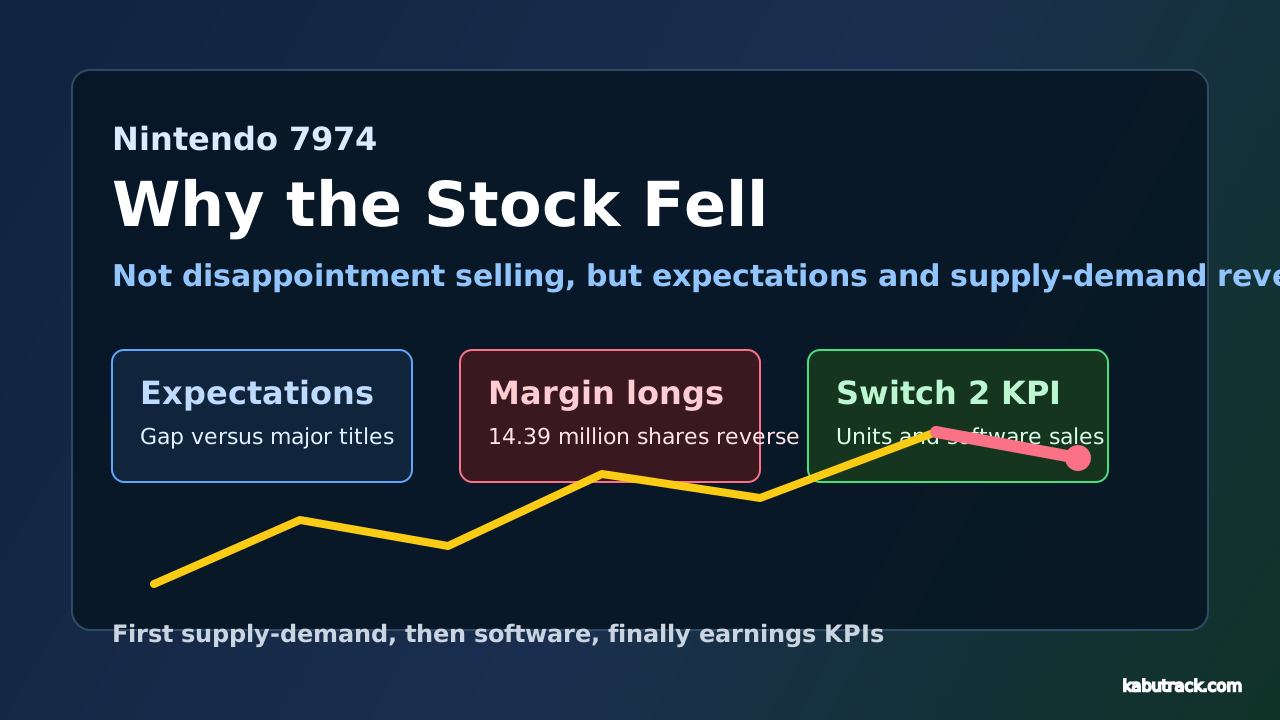
First positioning. Then software. Finally earnings KPIs.
Getting that order right is the most important point in reading Nintendo from here.
Overall View
Nintendo’s sharp fall looks more like a post-event positioning adjustment than a deterioration in fundamentals.
Nintendo Direct was not bad. But it was not quite the major catalyst the market had expected in advance. With more than 14 million shares of margin buying balance sitting on top of that, selling fed on itself.
In the short term, caution is still warranted. If the stock cannot quickly regain the 7,400 to 7,500 yen zone, rebound selling may remain overhead. If margin longs do not clean up, a second round of forced selling is possible.
For the medium to long term, however, the important issue is not this event reaction itself. It is whether Switch 2 adoption continues, whether strong first-party titles arrive for the holiday season, whether digital and online revenue support margins, and whether IP-related revenue can grow beyond the movie-cycle reaction.
Stocks often move not on the news itself, but on how much the market had expected before the news. Nintendo on June 10 is likely a textbook example.
Evaluating the Nintendo Direct and evaluating the stock-price reaction are two different tasks.
Sources and Note
This article is an investment analysis note based on Nintendo’s FY2026 earnings release, Nintendo’s official “Nintendo Direct 2026.6.9,” Reuters-related reporting, Yahoo Finance price and margin trading data, and reports on the French authority’s fine. It is not a recommendation to buy or sell any individual security. Market data such as share price, margin balances, PER, and market capitalization change over time.
- Nintendo, “IR Library: Earnings Releases”: https://www.nintendo.co.jp/ir/library/earnings/index.html
- Nintendo, “Nintendo Direct 2026.6.9”: https://www.nintendo.com/jp/nintendo_direct/index.html
- Yahoo Finance, “Nintendo (7974)”: https://finance.yahoo.co.jp/quote/7974.T
- Reuters-related report, “Nintendo shares slump as games pipeline disappoints market,” published: 2026-06-10
- FNN Prime Online, “Nintendo Europe fined about 6.5 billion yen by French authorities,” published: 2026-06-09