
Conclusion and Provisional Classification
This is a typical case of a highly thematic stock whose near-term direction can be driven by short-term events.
| Issue | Assessment |
|---|---|
| Primary view | Expectation adjustment |
| Trading stance (short term) | Conditional neutral (high volatility) |
| Core checks | LTV, NAV discount, Arm linkage |
| Turning point | Disclosures that demonstrate execution capability and clearer AI capital policy |
The strategic question is not "decline equals structural collapse." It is how investors should interpret the reset in expectations.
First, Separate Facts From Assumptions
The first step is to clarify the quality of the material.
| Item | Fact | Interpretation |
|---|---|---|
| Financing talks collateralized by OpenAI shares | Reports indicated that discussions had stalled | Because the collateral is an unlisted equity stake, pricing and liquidity questions are likely to arise |
| Recent stock reaction | The stock fell sharply on June 11 | Short-term risk avoidance overlapped with AI-related sentiment |
| Immediate financial deterioration | There are limited signs of immediately visible, severe financial deterioration | A simple "liquidity crisis" argument can become too reductive |
| Listing policy | There is little evidence that any OpenAI-related listing would be reflected immediately in the short term | Value reappraisal will require a longer time horizon |
The important point is that the collateral value of unlisted shares is harder to treat than that of listed shares. Whether an asset can be used as collateral does not necessarily match whether the asset has value.
What This Decline Reveals
1. This Is Not a Liquidity Concern, but a Reappraisal of AI Expectations
SBG has a large base of investment assets and is not the kind of stock that immediately collapses in the short term. The market's concerns followed this order.
- Conditions and valuation difficulty when using OpenAI as collateral
- Caution about the execution speed of AI investment expansion
- Partial adjustment of AI expectations that had already been priced in
2. This Is Not Just a One-Off News Item, but a Sentiment Chain
Large AI-related stocks tend to experience higher volatility from news triggers even before the quality of the material is fully assessed. This decline was a combination of "specific news plus sector adjustment," not a situation determined by one company-specific headline alone.
3. The Classification Axis Should Be Execution, Not Whether Expectations Exist
For this stock, investors ultimately need to watch three points.
- Separating asset value (Arm) from unlisted asset valuation
- The ability to manage debt and liquidity
- The speed at which equity value returns into market valuation
This shock effectively pushed those questions back onto the table.
SBG Strategy KPIs as of June 11
To avoid being swayed by short-term price moves, investors should prioritize the following checks.
| KPI | What to Confirm |
|---|---|
| LTV (debt to asset value) | Measures whether leverage remains within a healthy tolerance range |
| NAV discount | Shows the size of the discount versus market value |
| Arm share-price linkage | Shows how quickly listed market value is reflected |
| Capital policy information related to OpenAI | Confirms continuity in collateral use, refinancing, and additional investments |
| Liquidity (commitment lines and unused facilities) | Helps anticipate financing-stop risk |
| Room for share buybacks | A practical signal for narrowing the NAV discount |
The point most likely to be missed now is not "whether OpenAI has value." It is whether capital policy that includes OpenAI can actually be implemented.
Scenarios From June 11 Onward
Scenario A: Negative Bias (Currently Dominant)
- Restart of talks is delayed, leaving anxiety around the AI sector
- Higher liquidity costs worsen LTV
- Upside expectations for Arm also weaken
In this case, the thematic premium shrinks and the stock enters a range with elevated volatility.
Scenario B: Neutral (Main Assumption)
- Talks resume, but on conservative terms
- Financial deterioration signals remain limited
- The stock may rebound, but a sharp recovery is difficult
In this case, range-bound trading remains likely, with short-term reactions to each news item.
Scenario C: Positive (Reacceleration)
- Execution plans and financing policy become clearer
- LTV and NAV improve
- Arm valuation and shareholder-return capacity improve at the same time
In this case, the stock could regain upside as an expectation-adjusted re-enablement story.
Near-Term Investment Practice (June 11)
- Do not judge immediately from price action; prioritize post-event indicators.
- Evaluate the "OpenAI collateral" issue not in isolation, but by separating Arm and total asset value.
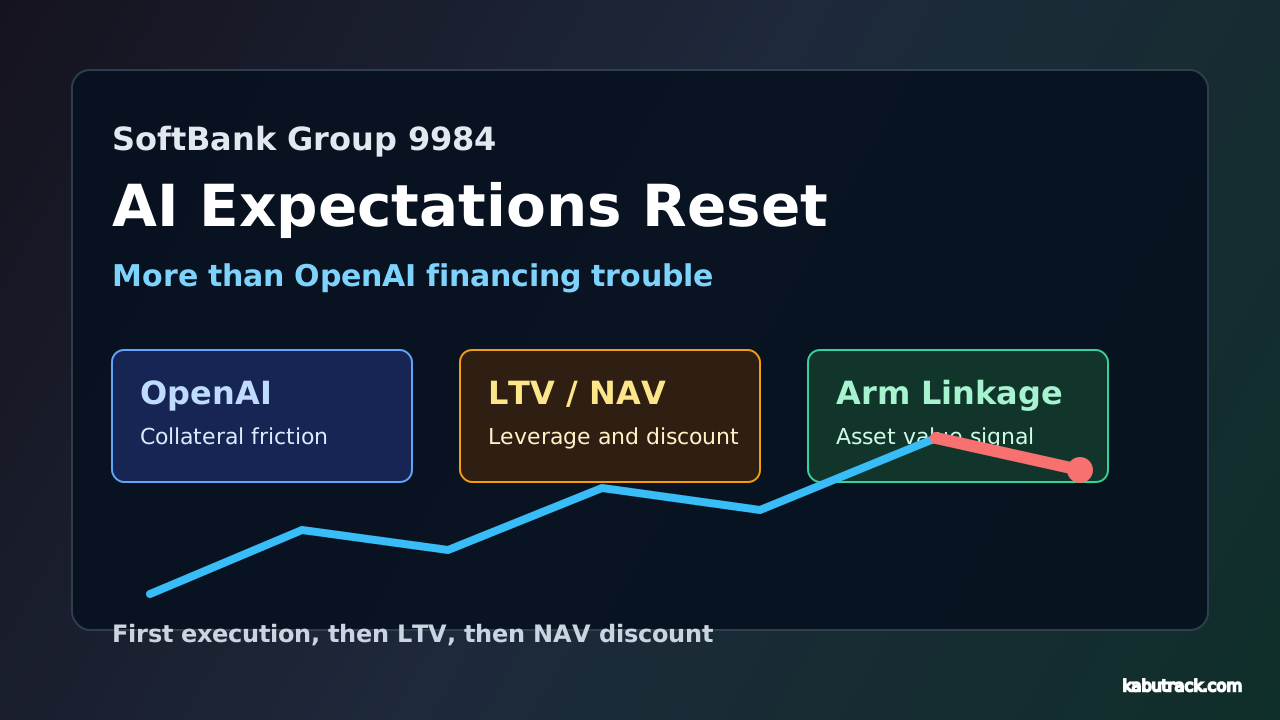
- Check LTV, then NAV discount, then dividend and buyback capacity, rather than price alone.
- Immediately after June 11, volatility is high, so position size should stay moderate until structural catalysts appear.
What Will Drive the Stock Price?
The current sequence is as follows.
Reappraisal of AI expectations
↓
LTV trend
↓
Confirmation of Arm linkage
↓
Narrowing of the NAV discount
This is the order in which the market's interpretation of new material is likely to flow into price.
Overall Assessment
As of June 11, SoftBank Group looks closer to a phase of lowering overheated expectations than a phase of fearing crisis.
- The long-term investment theme itself has not disappeared
- The near-term phase is about converting execution capability into numbers
- In the short term, high volatility should be assumed, and KPI confirmation should come first
Therefore, the appropriate judgment is not "buy unconditionally." It is more reasonable to treat the stock as conditionally range-bound until execution evidence appears.
Sources and Caution
This article is a strategy note based on SoftBank Group disclosures, major reporting, and major market data. Figures change over time, so investors should confirm the latest disclosures before trading.
- SoftBank Group disclosures, including earnings releases and press materials
- AI-related financial reporting as of June 10 to June 11
- Market data: Tokyo Stock Exchange and major financial information terminals for the relevant date