
There is one extreme view that taking out a scholarship loan will ruin your life. There is another, equally loose view that if it is for college, borrowing is simply the obvious thing to do.
Both are missing something.
A scholarship loan is not just a welfare program, nor is it simply kind money for students. It is a system in which a young person around age 18 uses future income as collateral, in effect, to bring forward several million yen of funding.
In other words, it is the first serious leverage most people ever touch.
This article looks at scholarships not through the emotional frame of "debt is scary" or "education is always right," but as an investment in human capital. The detailed rules must always be checked against the latest official information, but the thinking framework is fairly clear.
This article is an education-funding and household-finance analysis note based on general information as of June 2026. It does not recommend any specific school, borrowing decision, or repayment method. Scholarship conditions, household income criteria, interest rates, repayment deferment, reduced repayment, tax and social-insurance treatment, and expected career income differ by household. For actual decisions, check with JASSO, your school's scholarship office, local governments, and relevant professionals.
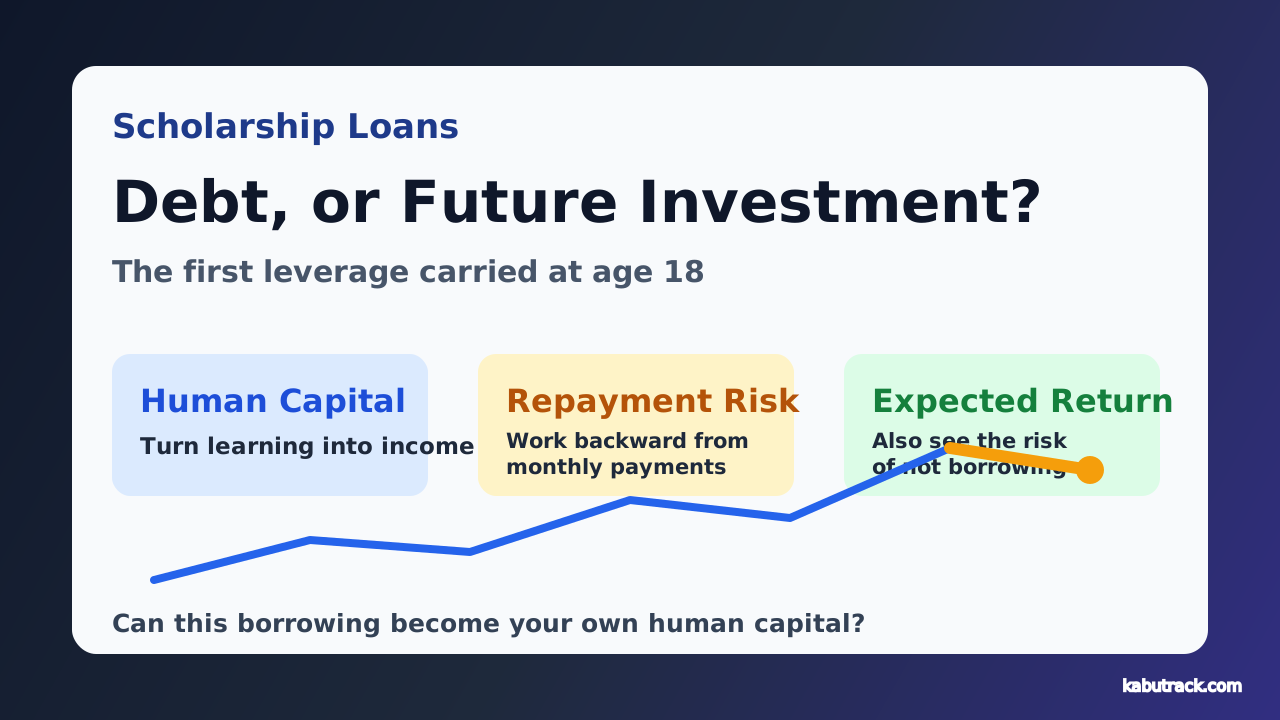
A Scholarship Loan Is the First Leverage in Life
Leverage means using borrowed money to access something that your own funds alone cannot reach.
With a mortgage, you buy a home based on future income. With a business loan, you invest in equipment or people based on future sales. A scholarship loan has a similar structure.
Higher education may be out of reach with current savings or parental support alone. A scholarship loan brings forward the cash flow that your future self is expected to earn and puts it into your present self. That is the financial shape of the system.
If it works, it raises the expected value of the jobs you can choose, the qualifications you can obtain, the environment you can enter, your starting salary, and lifetime earnings. If it fails, only the monthly repayment remains as a fixed cost.
This is where it gets important.
Whether a scholarship loan is good or bad is not determined by the amount borrowed alone. It depends on what the borrowed money becomes.
| Use of Borrowing | Investment View |
|---|---|
| Paths that tend to connect directly to qualifications or specialized skills | Relatively easier to design an income route that becomes the repayment source |
| Language, IT, accounting, research, internships, and other activities that can turn into market value | The expected value can rise depending on the student's own actions |
| Aimless enrollment, excessive living expenses, or leisure spending | Risky because it does not create a repayment source |
| Enrollment that broadens room for later career changes | Can be an investment in optionality if the purpose is clear |
"Scholarship loan equals debt, therefore bad" is too crude. So is "if it is for college, borrowing is fine."
The real question is whether the investment target remains as human capital.
Human Capital Investment Carries Risk
Going to a university or vocational school does not guarantee higher income.
Human capital investment has uncertainty, just like stock investing. The payback profile differs between paths close to professional qualifications, such as medicine, pharmacy, nursing, engineering, information technology, accounting, and teaching, and paths where the exit depends heavily on the individual's own actions.
Even at the same university and in the same department, a student who simply drifts through four years and a student who uses those years for qualifications, research, portfolio work, language skills, internships, networks, and job-search preparation will graduate with very different human capital.
In other words, the expected value of a scholarship loan is not determined by the school name alone.
Expected value = Future income and options gained through enrollment
               - Tuition, living expenses, interest, and repayment burden
               - Time cost during school
               - Risk of career mismatch
Once you look at the formula calmly, the decision becomes quite practical.
For example, if you borrow 3 million to 5 million yen, is there a realistic income route after graduation that can repay that amount? If you choose an industry with low starting pay, how low does the monthly repayment need to be? If graduate school or time spent preparing for a qualification exam is possible, how should you think about in-school deferment and household liquidity?
Borrowing on the assumption that "it will work out somehow" is not investment. It is wishful thinking.
There Is Also a Risk in Not Borrowing
Scholarship discussions often focus almost entirely on the risk of being unable to repay.
That risk matters. If repayment becomes delinquent, it can affect credit information. If monthly repayment is heavy, it can affect living alone, changing jobs, marriage, childbirth, starting a business, and supporting parents.
But there is another risk that should not be missed.
It is the risk of not borrowing and thereby losing access to higher education, qualifications, specialized skills, the entry point to new-graduate hiring, networks, and environment. As opportunity cost, that can be quite large.
According to lifetime wage estimates from the Japan Institute for Labour Policy and Training, when people continue as full-time regular employees after leaving school, lifetime wages through age 60 differ by educational background. Of course, these are averages and do not guarantee individual outcomes. Even so, the human-capital gap created by further education can often exceed several million yen of borrowing.
The important thing is to put the risk of borrowing and the risk of not borrowing on the same table.
| Choice | Main Risks |
|---|---|
| Borrow and enroll | Repayment burden, career mismatch, low income after graduation, delinquency, psychological burden |
| Do not borrow and give up enrollment | Unable to meet qualification or degree requirements, narrower employment entry points, lost opportunity to build human capital |
| Borrow less and enroll | Too much part-time work, less study time, unstable living conditions |
| Search for grants and school scholarships | Application burden, but potential access to funds that do not need to be repaid |
A choice that looks safe is not always truly safe.
If not enrolling narrows future options, that is also a risk.
Four Behaviors That Can Turn Scholarship Borrowing Into Bad Debt
People who struggle with scholarship loans tend to share several patterns.
1. They Do Not Look at the Total Borrowed Amount
If you look only at monthly deposits of 50,000 yen or 80,000 yen, the weight of the liability is hard to feel.
But borrowing 80,000 yen per month for four years creates 3.84 million yen of principal alone. With a Type 2 scholarship loan, interest is added. If an institutional guarantee is used, guarantee fees also matter.
The number to watch is not the monthly deposit.
It is the amount owed at graduation, the monthly repayment, and the repayment period.
2. They Do Not Work Backward From First-Year Take-Home Pay
Assuming "once I get a job, I can probably repay around 20,000 yen per month" is dangerous.
After subtracting rent, utilities, communication costs, food, transportation, insurance, taxes and social insurance, trips home, and social expenses from first-year take-home pay, the amount of free cash is often smaller than expected.
A 20,000-yen monthly repayment may look small as a number. But for a household with take-home pay in the low 200,000-yen range, it becomes a fairly heavy fixed cost.
Before enrolling, it is worth laying out at least three scenarios.
| Scenario | What to Check |
|---|---|
| Standard case | Can repayment be made comfortably on the expected first salary? |
| Low-income case | Can repayment be handled if starting pay is lower than expected, employment is non-regular, or the person has just changed jobs? |
| Trouble case | If illness, job loss, or leave occurs, can deferment programs or family support be used? |
3. They Borrow the Maximum Type 2 Amount to Fill Living-Expense Gaps
JASSO's Type 2 scholarship loan bears interest. Under JASSO's system, the interest-rate method can be either a fixed-rate method or a rate-review method, and both are capped at 3.0% per year. The actual rate varies by factors such as the month the loan period ends.
Compared with ordinary unsecured loans, the interest rate is often low. But low interest does not mean borrowing can be handled casually.
Borrowing for tuition, materials, commuting, qualifications, and the minimum living costs needed to study can still turn into human capital. But if the excess is spent on consumption, it is simply pulling future income into the present.
A scholarship loan should be seen not as "cheap debt," but as an invoice against your younger self's future cash flow.
4. They Do Not Check Grants and School Programs
There is an order to funding.
First, check grants that do not need to be repaid, tuition reductions, local-government support, university-specific scholarships, and corporate or foundation scholarships. Then think about the remaining gap in the order of non-repayable funds, interest-free borrowing, low-cost borrowing, and interest-bearing borrowing.
Not checking because it is a hassle, missing deadlines, or failing to ask the school office is a real waste.
Grants are not available to everyone, and they often have income, asset, and academic conditions. Still, borrowing with interest without first checking the possibility of non-repayable funds is rough household finance.
The Parent's Role Is Not Prediction, but Insurance
It is unreasonable to ask an 18-year-old to accurately read income, the job market, health, and family circumstances 20 years into the future.
That is why parents and guardians should not focus on predicting the correct career path. Their role is to design the defense line if assumptions fail.
Before taking out a scholarship loan, parents and children should discuss at least the following points.
| Item to Check | Why It Matters |
|---|---|
| Total borrowing at graduation | To share the full picture of the liability |
| Monthly repayment and repayment period | To understand the fixed cost in the first working year |
| What the student will gain from the school | To see whether the borrowing can turn into human capital |
| Expected employer type and starting salary | To view the repayment source realistically |
| Steps if repayment becomes difficult | To use reduced repayment, repayment deferment, or family support early |
JASSO has programs such as reduced repayment and repayment deferment for borrowers who find repayment difficult. Repayment begins in the seventh month counting from the month after the loan period ends. If delinquency continues, there is also a risk of information being registered with credit information agencies.
In other words, waiting until things become difficult is too late.
Know the escape routes before borrowing. That is not weakness. It is risk management.
Look at the System as Funding Terms
As of June 2026, JASSO scholarships can broadly be divided into non-repayable grants, interest-free Type 1 scholarship loans, and interest-bearing Type 2 scholarship loans.
| Type | Repayment Obligation | Interest and Cost View | Notes |
|---|---|---|---|
| Grant-type scholarship | None | Funds that do not need to be repaid | Household income, assets, academic criteria, and other conditions apply |
| Type 1 scholarship loan | Yes | Interest-free | Household and academic criteria apply, and monthly amounts may be adjusted when combined with grant-type support |
| Type 2 scholarship loan | Yes | Interest-bearing. Annual cap is 3.0% | Check the interest-rate method, loan amount, repayment period, guarantee fees, and impact of delinquency |
The details of the system change every year. In particular, household income criteria, support categories, guarantee fees, interest rates, application periods, and school-specific procedures should always be checked with the latest JASSO information and the school's office.
In investment terms, scholarships are capital with different funding conditions.
If non-repayable funds are available, start there. If interest-free borrowing is enough, reduce interest-bearing borrowing. If interest-bearing borrowing is unavoidable, align the loan amount with post-graduation cash flow.
Just following that order can meaningfully reduce the probability of scholarship-loan failure.
Final Judgment
A scholarship loan should not only be feared. It should not only be hoped for either.
It is a decision to put capital upfront into your future self, an asset that is still uncertain.
So the order of questions should be this.
1. What human capital will enrollment create?
2. How will that connect to income and options after graduation?
3. What is the total amount borrowed?
4. Can the monthly repayment survive on first-year take-home pay?
5. What insurance exists if assumptions fail?
If you can answer these five questions, a scholarship loan can become a rational education investment.
If you cannot answer them, it is better to pause before borrowing. That does not mean giving up on higher education. It means redesigning the loan amount, school choice, living arrangement, grants, part-time work, parental support, and post-graduation path.
When thinking about a scholarship loan, the final question is not "borrow or do not borrow."
It is this: "Can I turn this leverage into my own human capital?"
Sources and Notes
This article is a general education-funding note based on official information from JASSO (Japan Student Services Organization) on scholarship and repayment systems, wage statistics from Japan's Ministry of Health, Labour and Welfare, and lifetime wage statistics from the Japan Institute for Labour Policy and Training. It does not advise any individual household on enrollment, borrowing, repayment, taxes, social insurance, or career choice.
- JASSO, "Scholarships": https://www.jasso.go.jp/shogakukin/
- JASSO, "Interest and Interest Rate Calculation Method for Type 2 Scholarship Loans": https://www.jasso.go.jp/shogakukin/about/taiyo/taiyo_2shu/riritsu_santei.html
- JASSO, "For Those Beginning Repayment": https://www.jasso.go.jp/shogakukin/henkan/houhou/flow/index.html
- JASSO, "Will Delinquency Information Be Registered With a Personal Credit Information Agency?": https://www.jasso.go.jp/faq/shogakukin/entai/kojinjoho/1190679_2736.html
- Ministry of Health, Labour and Welfare, "Summary of the 2024 Basic Survey on Wage Structure": https://www.mhlw.go.jp/toukei/itiran/roudou/chingin/kouzou/z2024/index.html
- Japan Institute for Labour Policy and Training, "Useful Labour Statistics 2024": https://www.jil.go.jp/kokunai/statistics/kako/2024/index.html