
More households are starting to invest for their children.
From 2027 onward, a NISA quota for minors, commonly called Child NISA, is also expected to begin. As a system, this is a tailwind. We are moving from an era in which parents built education funds only through their own NISA accounts to an era in which long-term tax-free investing can be considered in the child's own name.
But there is one important issue here.
Even if parents build assets, if the child does not know how to handle money, the risk begins the moment those assets are handed over.
Investment education is not about making children buy stocks. It is not about teaching them how to make money. It is about practicing, little by little at home, how to use, save, separate, wait, question, research, and say no with money.
This article organizes parent-child investing in the Child NISA era not as a "system" issue, but as an "education" issue. The previous system-focused article built the container. This article looks at how to use that container through household conversations and allowance rules. Minor accounts and NISA are only teaching tools. The main character is the child's judgment.
This article is a general financial-education and household-finance memo based on public information available as of June 18, 2026. It does not recommend any specific product purchase, investment decision, or educational method. NISA rules and minor-account conditions may change, so actual procedures should be checked through the latest information from the Financial Services Agency, J-FLEC, securities companies, and tax professionals.
First, The Conclusion
The first step in teaching children about investing is not NISA.
Home financial education is less likely to go wrong if it is organized into the following four stages.
| Stage | Purpose | What can be done at home |
|---|---|---|
| Use | Learn that money is something you choose how to use | Allowance, shopping, budgeting |
| Save | Practice waiting for something you want | Piggy banks, purpose-based envelopes, target amounts |
| Separate | Separate money to use from money to keep | Three buckets: use, save, donate |
| Grow | Learn risk and time | Mutual-fund price movements, company observation, small experiments |
Child NISA and minor accounts can become teaching tools for the final "grow" stage.
However, before opening an account, parents should check whether the child understands the basics: prices can go down, money needed soon should not be invested, and unfamiliar products should not be bought.
Why Financial Education Is Needed Now
Children are encountering money at much younger ages.
In-app game purchases, cashless payments, subscriptions, flea-market apps, online advertising, and investment information on social media. In many households, money starts moving on screens before children even take cash out of a wallet.
In addition, Japan lowered the age of majority to 18 on April 1, 2022. The Ministry of Justice explains that the legal age of majority under the Civil Code includes the meaning of "the age at which a person can enter into a valid contract alone."
In other words, waiting until age 18 to suddenly face credit cards, loans, rental contracts, smartphone contracts, investment apps, and high-yield stories on social media is too late.
Financial education at home is not about teaching difficult investment theory. As allowance education, money education for children, and the foundation of money literacy, it means practicing in daily life how to avoid deciding immediately, question things you do not understand, and separate needs from wants.
Why School Alone Is Not Enough
Financial and economic education is also being strengthened publicly.
The Financial Services Agency explains that the Japan Financial Literacy and Education Corporation, or J-FLEC, is an authorized corporation established in April 2024 to deliver opportunities for financial and economic education to a wide range of age groups. J-FLEC itself states that it is a public organization that promotes financial and economic education from a neutral and fair position and does not solicit specific financial products.
In addition, financial and economic education materials for high school students related to the Ministry of Education cover household management, life planning, preparing for risk, saving and growing money, borrowing, and financial trouble.
So the trend of learning about money at school is certainly growing stronger.
But school education also has limits. Classes cannot fully cover each family's income, the parents' retirement funds, scholarships, gifts from grandparents, smartphone spending, lending and borrowing money between friends, or parent-child values.
Financial education differs greatly by household.
That is why parents need to put into words how their family thinks about money.
Age-Based Roadmap
Investment education is not something that automatically gets better the earlier it starts.
If the conversation does not fit the child's age, the child may receive the message that money is scary, investing is a game, or increasing money is the only victory. The order matters.
| Approximate age | Theme to teach | Examples |
|---|---|---|
| 0-6 | Money is a tool for exchange | Playing store, watching payment at the register |
| 7-12 | Things you want have priorities | Allowance, four jars, home bank |
| 13-15 | Separate price, value, advertising, and companies | Sales, subscriptions, game spending, familiar companies |
| 16-18 | Understand risk and contracts | Brokerage accounts, NISA, scholarships, credit basics |
Elementary-school children do not need to learn PER or index investing.
It is more effective to think together about questions such as: "Will you spend all of it today or keep some?" "Did the ad just make you want it, or do you really need it?" "Are you buying it because it is cheap, or because you will use it?"
Before investing practice, there is consumption practice.
Start Elementary-School Children With Four Jars
For elementary-school children, allowance can be an excellent teaching tool.
However, if money is handed over every month and that is all, it can easily become simple consumption money. If it is used for education at home, it is easier to separate it by purpose from the beginning.
Prepare four transparent jars or envelopes. The names do not need to be difficult.
| Jar | Purpose | Examples |
|---|---|---|
| Use | Spend on something wanted now | Snacks, stationery, capsule toys |
| Save | Keep for a slightly later goal | Games, stuffed toys, books |
| For someone else | Experience using money for others | Birthday gifts, donations |
| Grow | Practice not using immediately and waiting | Home bank, simulated interest |
The important point is not to make only the "grow" jar look superior.
Money to use is necessary, and money for others is also important. The goal is not to raise a child who saves everything. The goal is to build the feeling of separating money and choosing for oneself.
A Home Bank Teaches Waiting More Than Compound Interest
Money placed in the "grow" jar is temporarily held by the parent.
For example, if 100 yen is left unused for three months, the parent adds 5 yen and returns 105 yen. Or if 500 yen is left for six months, 25 yen is added. The amount can be set by each household.
Use 100 yen now -> 100 yen of shopping
Wait three months with 100 yen -> It becomes 105 yen under a home rule
This is not a real bank interest rate. It is an educational household rule.
To avoid confusing it with real interest rates or investment returns, parents should add one sentence.
"Real banks and real investments do not increase this neatly. They can go down too. But when you do not use money immediately and wait, your future choices can sometimes increase."
With that one sentence, the home bank becomes more than a reward. It becomes a lesson about time and money.
If the interest is set too high, it loses realism. The purpose is not to make the child earn money. It is to build the sense that being able to wait can increase future choices.
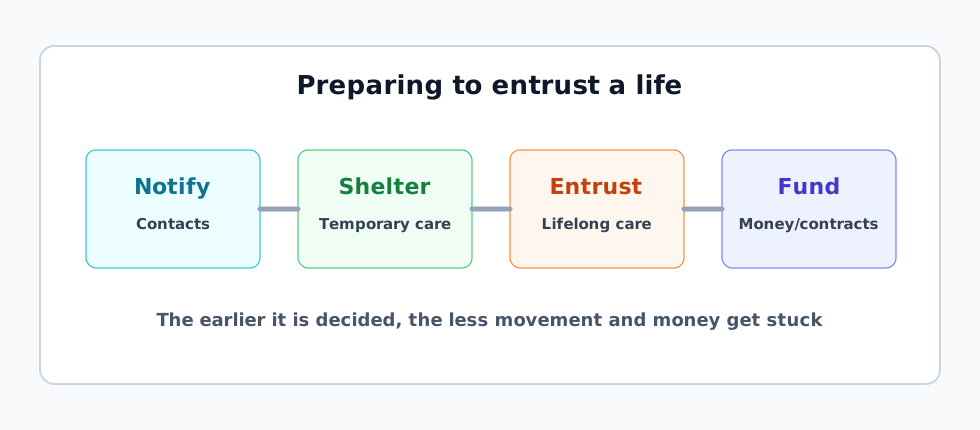
Diagram: Parent-Child Investing Is About Order Before Accounts
Mistakes Parents Often Make
The dangerous part of parent-child investing is often not investing itself, but how parents talk about it.
The following five mistakes are especially worth avoiding.
| Mistake | What happens |
|---|---|
| Showing only when money has increased | The child misunderstands investing as an easy way to make money |
| Hiding declines | The chance to learn risk disappears |
| Teaching only ticker or company names | The child stops looking at companies, profits, fees, and diversification |
| Pushing the parent's success story | The child stops practicing independent judgment |
| Mixing education funding with investment education | Necessary tuition may be pushed too far into risk assets |
The important teaching material in investment education is not the moment prices rise, but the moment they fall.
There is no need to fully explain why prices fell. In fact, it is more honest to say that there are things no one knows.
Markets are not always understandable. That is why we do not put everything into one product. We do not invest money needed soon. We invest only within a range that can be held for a long time.
That level of conversation is enough.
Financial Education Through Companies
If you teach children about investing, it is more natural to start from familiar companies than from financial products.
McDonald's, Nintendo, Uniqlo, convenience stores, railway companies, smartphone payments, video streaming services. Things children actually use are entrances to the economy.
The points for parent and child to look at do not need to be difficult financial indicators.
Why do people gather at this store?
How does it make sales?
Who are its competitors?
Will people still buy if prices rise?
Even if I like it, is the company profitable?
For example, you can start with games or hamburgers.
Parent: "This game sells all over the world. Who is happy when it sells?"
Child: "The company that made it?"
Parent: "That's right. The people who work there are involved, and so are shareholders who support the company with money."
That much conversation is enough.
For a child, the important thing is not memorizing the word "shareholder." It is learning that the viewpoint of the person buying the product and the viewpoint of the person supporting the company are different. It becomes practice in seeing not only the consumer side, but also how a company makes sales, keeps profit, and is supported by others.
The important point here is to teach that "a company I like" does not equal "a stock I should buy."
Liking a product and whether it is suitable as an investment are separate issues. A stock price includes expectations, profits, competition, foreign exchange, interest rates, and supply-demand factors. There is no need to explain all of this to a child, but it is worth saying early that putting a large amount of money in just because you like something is dangerous.
Materials To Use At Home And Teaching Styles To Avoid
Financial education does not end when you buy teaching materials.
Still, some tools are useful as triggers for parent-child conversation.
| Material | How to use it | Note |
|---|---|---|
| Board games | Touch concepts such as budgeting, negotiation, assets, and income while playing | Do not focus only on winning or losing |
| Allowance logs and household-budget apps | Make spending visible | Check in-app purchases, advertising, and personal-data handling |
| Public materials such as J-FLEC | Parents and children can confirm neutral financial knowledge together | Make time to turn it into household rules |
| Receipts | See consumption tax, price increases, unit prices, and discounts with real examples | Do not make the child carry household anxiety |
At the same time, there are common NG approaches parents may fall into.
| Teaching style to avoid | Why it is risky |
|---|---|
| Making all money talk taboo | Children may learn only from ads and social media outside the home |
| Treating all investing as dangerous | They cannot learn the difference between long-term diversified installment investing and short-term trading |
| Showing only profits | Declines, fees, taxes, and time are left out |
| Forcing the parent's correct answer | The child does not practice making decisions |
| Speaking household anxiety as-is | The child may carry excessive responsibility or guilt |
The goal of financial education at home is not to make children copy the parent's investing behavior.
It is to help them pause and think in the future when they face advertising, social media, friends, financial institutions, job changes, marriage, scholarships, mortgages, and inheritance.
If Child NISA Is Used For Financial Education
Once Child NISA begins from 2027 onward, it should become easier to start long-term tax-free investing in a child's own name.
However, if parents contribute on their own and then suddenly say at age 18, "This is your money," that is weak as financial education.
If it is used, parents should create time to review it with the child even once a year.
| What to check | Words to tell the child |
|---|---|
| Principal | How much has been contributed |
| Valuation | How much it is worth now |
| Price movements | Some years it rises, some years it falls |
| Product | Which countries and companies it invests in |
| Purpose | What the money is for |
| Timing of use | It is not money to use immediately |
When showing numbers, look at principal before profit.
If "how much it increased" is emphasized too much, the child will focus on returns. It is more practical to say, for example, "We contributed 1.2 million yen, and in some years it may be worth 1.1 million yen. But if the goal is more than 10 years away, one option is not to panic and sell."
Decide Before Handing It Over At 18
When a child turns 18, the stage approaches when they will handle their own NISA or brokerage account.
If nothing has been decided, parent-child expectations can easily diverge.
The parent thought it was education funding. The child thought it was freely spendable money. The grandparents thought it was wedding money. The larger the amount, the more these mismatches can cause conflict.
Before handing it over, parents should put the following three points into words.
| Issue | What to discuss |
|---|---|
| Ownership | Whose name it is in, and whose money it is treated as |
| Purpose | Education expenses, study abroad, future funds, or financial education |
| Rules | When it can be used, what it can be used for, and how far the parent is involved |
Letting a child take responsibility is different from abandoning the matter.
It is fine to decide that everything becomes free at age 18. But if that is the rule, then before that point, taxes, scams, debt, revolving credit, social-media investment information, crypto assets, and margin trading risks should also be taught.
Conversation Examples For Home
When parents talk about money with children, it can easily become a lecture.
The recommendation is to end with a question.
If you use this 1,000 yen today, what would you use it for?
If you wait one month, could you use it for something you want more?
What do you think this ad is trying to make you buy?
You like this company's product, but how does the company make profit?
If money you invested fell by 20%, how would you feel?
Should money you need soon and money you will not use for 10 years be kept in the same place?
There is no need to make the child give the correct answer.
The purpose is for the child to think in their own words.
Financial Education Checklist Before Age 18
Finally, here is a checklist to review at home.
There is no need to check every box. But before the child has more chances to handle contracts and money at age 18, it is worth seeing how much has been discussed together.
□ Understands that money is finite
□ Can distinguish wants from needs
□ Can separate money to use soon from money to keep long term
□ Does not swallow investment information on social media whole
□ Can explain how credit cards work
□ Understands the danger of revolving credit
□ Knows that investments can fall below principal
□ Questions stories about high returns, principal guarantees, and referral rewards
□ Has the habit of checking taxes, fees, and contract terms
This checklist is not meant to make children anxious.
Rather than raising a child who never fails with money, the aim is to raise a child who can pause when money is involved. Over the long run, that is much stronger.
FAQ
At what age should investing be taught to children?
Investing itself can wait until junior high school or later. During elementary school, it is easier to start from everyday money such as shopping, allowance, saving, advertising, and game spending.
Does opening a minor account count as financial education?
Opening an account alone is not financial education. It becomes a teaching tool only when parent and child confirm the purpose, principal, price movements, risk, and timing of use.
Is it okay to let children buy individual stocks?
It depends on the household policy, but starting with individual stocks can make children focus too much on price movements and topical names. As financial education, it is easier to observe familiar companies while learning about small amounts, diversification, and investment trusts.
Should I show education funds invested through the parent's NISA?
There is no need to show everything. However, depending on the child's age, it is fine to share that parents are preparing education funds, that investments can go down, and that tuition needed soon is kept separately in cash.
Even if parents leave assets, those assets will not become future choices if judgment has not been developed.
On the other hand, if judgment has been developed, the child can learn to handle money well even without large assets.
Summary
What parents should truly leave through investing for children is not only an account balance.
It is judgment.
Money disappears when it is used. Waiting can increase choices. Advertising creates desire. A company you like and a good investment target are different. Investments can rise or fall. Money needed soon should not be invested.
These ideas should be discussed at home many times in small ways.
Child NISA can be a good trigger for showing children asset formation. But the system is not the main character. The parent's role is not to teach the child how to make money, but to raise the ability not to let money break judgment.
The system article creates the container. The education article develops how to use it.
Only when both are present does it finally become "investing for children."
Sources And Notes
This article is a general explanation based on public information available as of June 18, 2026. Financial education, the NISA system, minor accounts, gifts, tax treatment, and investment-product handling vary depending on household circumstances and system changes. Individual investment and tax decisions should be based on the latest official information and consultation with specialists.
- Financial Services Agency, "Financial and Economic Education": https://www.fsa.go.jp/teach/kyouiku.html
- Japan Financial Literacy and Education Corporation, J-FLEC: https://www.j-flec.go.jp/
- J-FLEC, "Materials For Learning Finance": https://www.j-flec.go.jp/materials/
- Ministry of Education, Culture, Sports, Science and Technology, "Financial and Economic Education Teaching Materials For High Schools": https://www.mext.go.jp/content/20231017-kyoiku01-100002611_1.pdf
- Financial Services Agency, "Learn About NISA: NISA Special Website": https://www.fsa.go.jp/policy/nisa2/know/
- Ministry of Justice, "Act Partially Amending The Civil Code (Age Of Majority)": https://www.moj.go.jp/MINJI/minji07_00218.html