
The phrase "pet end-of-life planning" feels heavy.
But in truth, it is less about preparing to die and more about preparing to entrust a life. If you are hospitalized, who will feed your pet? If dementia or admission to a care facility makes it impossible to keep caring for them, where will they go? If you die first, who will manage the money for that animal's life?
It is not an easy conversation to have while you are healthy.
Even so, if the owner decides nothing, the ones who struggle most are the dogs and cats left behind.
In the previous article, I organized how to prepare for pet medical costs by separating cash, insurance, and NISA. This time, I go beyond that: final-care costs, expenses during pet-loss grief, where the pet would go if something happens to the owner, and legal options such as pet trusts and bequests with obligations.
This article is a general explanation based on public information available as of June 18, 2026. It is not legal advice, tax advice, or investment advice. Wills, trusts, donations upon death, and contracts with senior dog or cat care homes differ depending on family structure, heirs, assets, the pet's age and health, and the conditions of the intended caregiver. If you actually prepare a contract or will, please confirm with specialists such as attorneys, judicial scriveners, administrative scriveners, and tax accountants.
First, The Conclusion
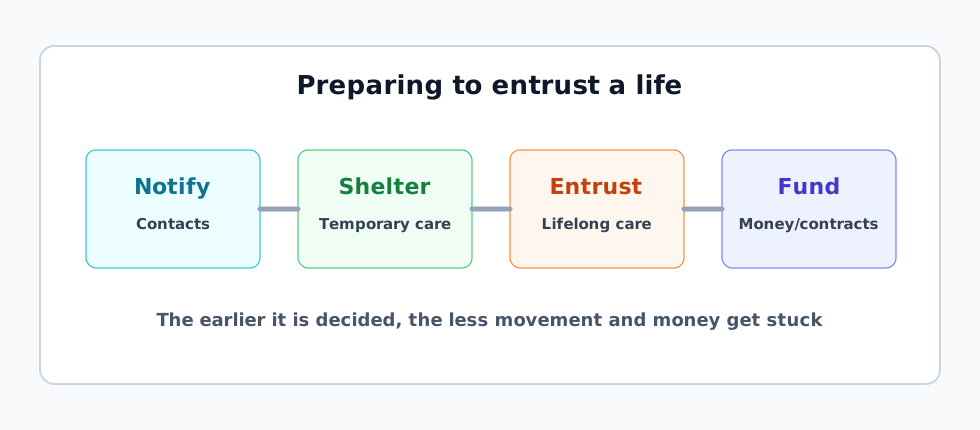
Pet end-of-life planning is not decided by emotion alone. It comes down to the following four decisions.
| What to decide | What is specifically needed |
|---|---|
| Who to notify | Emergency contacts and a card saying there is a pet at home |
| Who will provide temporary care | Family, friends, neighbors, pet hotels, regular clinic contacts |
| Who will take long-term responsibility | New owner, rescue organization, senior dog/cat care home, private service |
| How money will be delivered | Cash, dedicated account, will, bequest with obligations, donation upon death, pet trust |
A pet trust is one strong option, but it is not a cure-all. It costs money and effort, and its effectiveness changes depending on how the trustee, caregiver, and supervisor are designed.
The first thing to do is not rush into a trust agreement.
What can be done today is to summarize emergency contacts, care destinations, medical information, food, medication, the regular animal hospital, and the location of care funds on one page.
Costs Continue After Final Care
Immediately after a beloved dog or cat dies, the owner has to make several decisions while grieving.
What kind of cremation should be chosen? Should the ashes be returned? Should they be kept at home? Should a columbarium or cemetery be used? Many of these decisions are hard to make right away.
Costs vary by region, body weight, cremation method, whether ashes are returned, and the form of memorial care. Looking at published price lists from private providers, even small dogs and cats often cost tens of thousands of yen. Larger dogs, attended individual cremation, columbaria, and individual graves can raise the cost further.
Rough guideposts are as follows.
| Item | Cost perspective |
|---|---|
| Communal cremation | Around 10,000-30,000 yen is one rough guide. Ashes often are not returned |
| Individual cremation | Around 20,000-60,000 yen. Varies by body weight and return method |
| Attended individual cremation | Can be 30,000-80,000 yen or more |
| Home memorial care | Urns, altar items, and memorial goods from several thousand to tens of thousands of yen |
| Columbarium or cemetery | Initial cost plus possible annual management fees |
The important point is not to search for the cheapest option.
It is to avoid frantically searching during intense grief and choosing an expensive plan without understanding it. While the pet is healthy, simply checking nearby cremation providers, municipal options, whether ashes can be returned, and whether attendance is possible can make the final days a little calmer.
Pet loss can also lead the owner to need medical visits or counseling. Final-care costs are not only cremation fees. Including leave from work, travel, memorial care, and physical and mental support, it is worth setting aside several tens of thousands to over 100,000 yen of cash margin.
They May Live Longer Than You
The heaviest part of pet end-of-life planning is not only what happens after the pet dies.
The owner may collapse first.
Dogs and cats are living longer. Owners are also aging.
As a result, real cases now occur not only of "seeing a pet through to the end," but of "leaving a pet behind."
Sudden hospitalization, accidents, dementia, entry into a care facility, death. Even if no one is at fault, the dog or cat will be waiting from that day for water, food, a toilet, and medication.
The Tokyo Metropolitan Animal Care and Consultation Center explains that owners have a responsibility for "lifelong care" until the pet's life ends, and that even if the owner dies first, preparing an environment where the pet can live safely and securely is part of the owner's duty.
This is not only a problem for older people.
Single-person households, dual-income households, families living far away, and households whose relatives live only in pet-prohibited housing can face the same issue even when the owner is young.
"If something happens to me, where will this animal go?"
Can you answer that question with a name and phone number? Pet end-of-life planning starts there.
Diagram: Think About Pet End-Of-Life Planning In Four Stages
Under The Law, Pets Cannot Directly Inherit
This is where emotion needs to be separated from legal reality.
Under Japanese law, pets do not become human heirs. They are generally treated as movable property, meaning property. Therefore, arrangements such as "leave 1 million yen to my dog" or "leave the estate in my cat's name" cannot be made directly.
Does that mean nothing can be done?
No. The practical design is to transfer assets to a person or organization that will care for the pet, and have them take on the care obligation in return.
The main options are as follows.
| Method | Mechanism | Notes |
|---|---|---|
| Verbal promise or family memo | Ask family or friends | Weak legal force and vulnerable to changes in the other person's circumstances |
| Lifetime contract | Contract in advance with a senior dog/cat care home, rescue organization, pet hotel, etc. | Check costs, acceptance conditions, cancellation terms, and medical-decision handling |
| Bequest with obligations | Use a will to give assets on the condition that the pet is cared for | The recipient may renounce it. Prior agreement matters |
| Donation upon death with obligations | Contract to donate assets at death while imposing care obligations | Requires the other party's agreement. Monitoring performance is also an issue |
| Pet trust | Manage care funds as trust property and pay them according to the purpose | Design costs and selection of trustee, supervisor, and caregiver are necessary |
The phrase "pet trust" tends to spread by itself, but in practice multiple methods are often combined.
For example, short-term temporary care may be handled by family or friends, long-term care by a senior dog/cat care home, and care expenses by a will or trust. Thinking in this separated way is more realistic.
What Must Be Decided In A Pet Trust
Roughly speaking, a pet trust is a structure in which assets prepared by the owner are managed and paid out as pet care costs.
However, it cannot be said that "creating a trust means everything is safe."
Many design points need to be decided.
| Issue | What to decide |
|---|---|
| Settlor | The owner who entrusts the property |
| Trustee | The person or entity that manages the property |
| Caregiver | The person or facility that actually cares for the pet |
| Trust supervisor, etc. | The person who checks whether money is used for the intended purpose |
| Trust property | Cash, deposits, etc., and how much to prepare |
| Payment conditions | Monthly amount, medical costs, funeral costs, limits, and evidence handling |
| After the pet's death | Who receives any remaining property |
One common source of conflict is whether the caregiver and the money manager should be the same person.
If they are the same, the structure is simple, but there remains a risk that property is received while care is insufficient. If they are separated, supervision is easier, but more people are involved and costs and effort increase.
That is why a pet trust should be thought of not as "a way to leave money," but as a design that separates money, care, and supervision.
How Much Should Be Prepared?
The necessary amount varies greatly depending on the pet's age, health, species, size, destination, and region.
Entrusting a young large dog for lifelong care and entrusting a senior cat for a few years require completely different amounts. The amount also changes depending on how much medical care is included, whether nursing care is needed, and whether cremation and memorial care are included.
If rough categories are used, the money can be separated as follows.
| Funds | How to think about it |
|---|---|
| Temporary care costs | Several days to several weeks of hotel, sitter, and transport costs |
| Medical reserve | Margin for chronic illness, medication, tests, emergency treatment |
| Lifelong care costs | Monthly care cost x expected number of years |
| Final-care costs | Cremation, return of ashes, memorial care, disposal of remaining items |
| Specialist costs | Will, contracts, trust design, consultation fees |
Private lifelong-care services may require a large initial fee or monthly fees depending on age and health. Some cases may be handled with several hundred thousand yen, while long-term care can reach several million yen.
It is faster to get estimates from candidate providers than to rely on online averages.
The goal is not to guess "how many more years this animal will live." It is to check whether, if you were hospitalized tomorrow, the immediate care destination and money would be stuck. That is the starting point.
NISA Is Only Part Of The "Life Carrying Fund"
As in the previous article, NISA can be a candidate if used correctly.
However, building all pet end-of-life funds through NISA is risky.
The owner's sudden hospitalization or death will not necessarily happen when markets are favorable. Money whose timing is unpredictable should have a higher cash ratio.
NISA is suitable only for the portion that can be prepared with a long time horizon.
Immediate temporary care costs: cash
Medical and final-care costs likely to be used within a few years: mainly cash
Future funds prepared over 10-year periods: NISA can be a partial candidate
Legal and contract costs: secure in cash
Investing is not the main character.
The main characters are the care destination, the contract, and the contact information. Money is the fuel that makes the structure move.
Pet End-Of-Life Planning Checklist You Can Start Today
Start with what can be done without spending money.
□ Put a card in your wallet or phone saying "I have a pet at home"
□ Decide at least two emergency contacts
□ Decide at least one temporary care destination
□ Write down food brand, amount, and frequency
□ Write down illnesses, medication, dosing times, and things the pet dislikes
□ Share the regular animal hospital card and contact information
□ Gather vaccine, microchip, and insurance policy information
□ Keep microchip registration information up to date
□ Make the location of the carrier, leash, toilet supplies, and medication clear
□ Tell family your wishes for final care, cremation, and return of ashes
□ Confirm acceptance and costs with candidate care destinations
□ Separate pet-only funds in cash
□ Consult a specialist about whether a will, donation upon death, or pet trust is needed
There is no need to fill in this list from the beginning.
The first step can simply be an emergency contact card. If an accident or sudden illness leaves you unable to speak, the fact that someone knows there is a pet at home can change the outcome significantly.
Example Memo To Share With Family
The most useful item in pet end-of-life planning is not a fancy ending notebook. It is a short memo that someone can actually read.
Name: Hana
Type/age: Cat, 12 years old
Personality: Timid. Hides when unfamiliar people come in
Food: XX food, 30g morning and evening
Medication: Kidney medication once each morning
Hospital: XX Animal Hospital, 03-xxxx-xxxx
Insurance: XX Insurance, policy number xxxx
Temporary care: My sister XX, phone xxx
Long-term care candidate: XX senior cat home, estimate obtained
Cremation preference: Individual cremation, ashes returned
Funds: Pet account at XX Bank
Even this much can greatly reduce the burden on the first person who finds the situation or on family members.
Legal design can come after that.
FAQ
Can I leave an inheritance to my pet?
In general, pets cannot be heirs. Instead of leaving assets directly to a pet, consider giving assets to a person or organization that will care for the pet and having them take on the care.
Does creating a pet trust make everything safe?
It can provide reassurance, but a trust alone does not necessarily complete the plan. The actual caregiver, the person managing the funds, the supervisor, and the handling of remaining assets all need to be decided.
What is the difference between a bequest with obligations and a donation upon death?
A bequest with obligations gives assets through a will and asks the recipient to bear certain obligations. The recipient may renounce it. A donation upon death is a gift contract that takes effect upon death and requires agreement with the other party. Both should be checked with a specialist.
What should I start with first?
Start with an emergency contact card, temporary care destination, and medical-information memo. Pet trusts and wills are important, but if you collapsed today, the first thing needed is a mechanism that tells someone "there is a pet at home."
Summary
Pet end-of-life planning is a sad topic.
But it is not only sad. Because the owner is healthy now, the destination of the life left behind can be decided.
Final-care costs, cremation, memorial care, and expenses during pet loss. Temporary care, lifelong care destination, and care funds if you can no longer keep the pet. Pet trusts, bequests with obligations, donations upon death, and lifetime contracts.
None of this needs to be completed all at once.
But the state of having decided nothing should be avoided.
In the first article, the money for medical costs was prepared.
In the second article, the place for that life after the owner is gone was prepared.
At their core, both are the same. The point is not to increase money. It is to preserve choices for a beloved family member.
Pet end-of-life planning is not preparing to die, but preparing to entrust a life. Precisely while your dog or cat is sleeping as usual, write one emergency contact. Separate a little dedicated money. Contact one candidate care destination.
Small preparations reduce large confusion in the future.
Sources And Notes
This article is a general explanation based on public information available as of June 18, 2026. Pet funeral costs, lifelong-care service costs, trust, will, and donation-upon-death design, and inheritance and gift tax treatment differ by individual circumstances. Actual contracts and will preparation should be based on confirmation with specialists and candidate providers.
- Ministry of the Environment, "Until The Day You Someday Say Goodbye To Your Pet": https://www.env.go.jp/nature/dobutsu/aigo/2_data/pamph/h2706f/pdf/full.pdf
- Ministry of the Environment, "Disaster Preparedness For Pets": https://www.env.go.jp/nature/dobutsu/aigo/1_law/disaster.html
- Ministry of the Environment, "Dog And Cat Microchip Information Registration": https://www.env.go.jp/nature/dobutsu/aigo/pickup/chip.html
- Pet Food Association, "2025 National Dog And Cat Ownership Survey: Key Indicator Summary": https://petfood.or.jp/pdf/data/2025/3.pdf
- Tokyo Metropolitan Animal Care and Consultation Center, "If It Becomes Difficult To Keep Caring For Your Pet": https://wannyan.metro.tokyo.lg.jp/konnan/
- Kumamoto Bar Association, "I Want To Leave Assets For My Pet": https://kumaben.or.jp/life/life_cat_4058/
- e-Gov Law Search, "Civil Code": https://laws.e-gov.go.jp/law/129AC0000000089
- Financial Services Agency, "Learn About NISA: NISA Special Website": https://www.fsa.go.jp/policy/nisa2/know/