
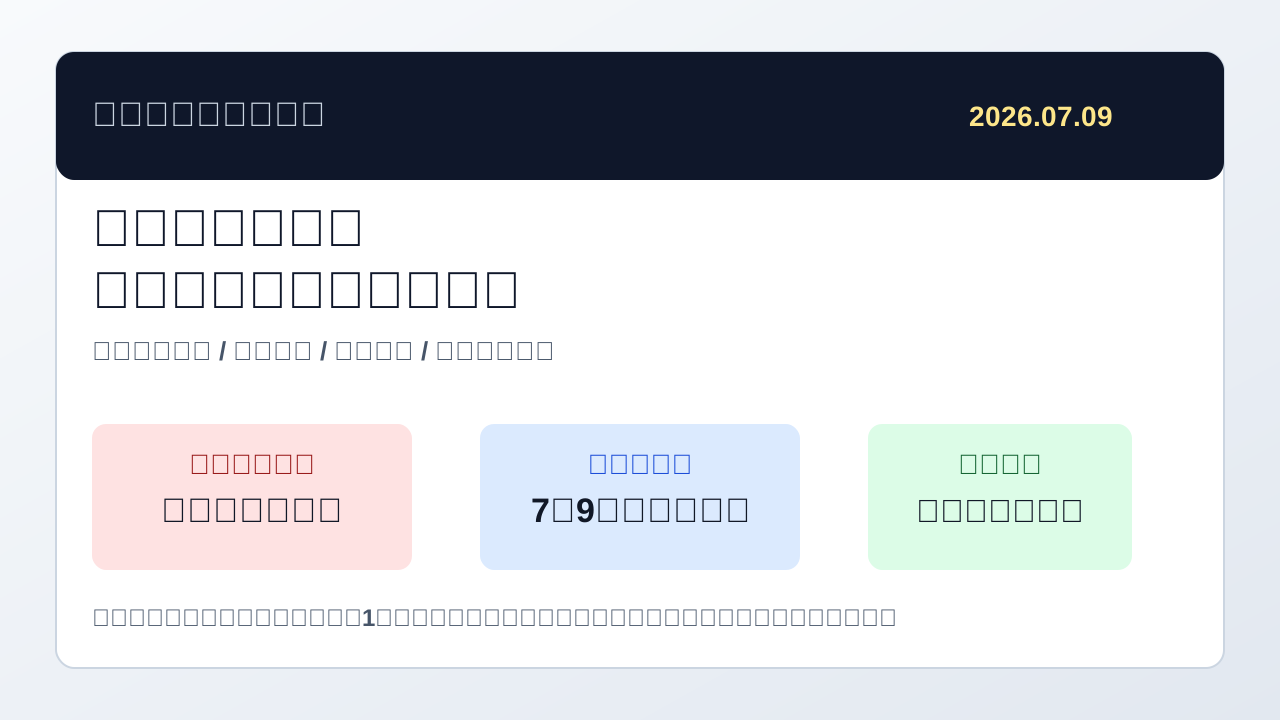
First, the conclusion
Sales exceeded 700 billion yen, a new record high. Still, the stock price reaction has been slow. It may seem strange at first glance, but the focus of evaluation has already shifted a little beyond sales.
How far will the profit structure improve after Fantasy Springs opens? Furthermore, will that profit absorb large-scale investments and ultimately lead to free cash flow? That's what investors are looking at.
In fact, in the fiscal year ending March 2026, operating cash flow was 181.281 billion yen, but free cash flow shrank to approximately 9.2 billion yen due to continued aggressive investment. Sales are strong. However, capital efficiency is still improving. This sentence can pretty much explain the reason why stock prices are so high.
Company profile
Oriental Land's profit structure is actually quite easy to understand. The theme park business generates most of the company's profits, and although the hotel business has become more prominent in recent years, it is still the park side that determines the direction of consolidated results.
The composition has not changed this season as well. Sales by segment for the fiscal year ending March 2026 were 568.345 billion yen for theme parks, 119.049 billion yen for hotels, and 17.144 billion yen for others. If you just look at sales, it's strong enough.
However, in terms of profits, we see a slightly different picture. Operating income for the theme park business was 130.488 billion yen, down 7.1% from the previous fiscal year. The hotel business performed well, increasing 20.9% year on year to 36.851 billion yen, but it was not enough to offset the decline in park profits. This is not to say that the brand has weakened, but rather that the profit margins of core businesses are not growing as easily as they used to. Let's start there.
most recent material
The first thing I would like to confirm as a fact is the financial results for the fiscal year ending March 2026, which were announced on April 28, 2026. Sales were 704.539 billion yen, an increase of 3.7% from the previous fiscal year, operating income was 168.413 billion yen, a decrease of 2.1% from the previous fiscal year, and net income attributable to owners of parent was 121.881 billion yen, a decrease of 1.8% from the previous fiscal year. The company's forecast for the fiscal year ending March 2027 is sales of 724.312 billion yen, operating income of 160.776 billion yen, and net income of 113.797 billion yen.
In terms of returns, the annual dividend is expected to be 15 yen for the fiscal year ending March 2026 and 16 yen for the fiscal year ending March 2027. In addition, it has been announced that shareholders holding 100 or more shares as of September 30, 2026 will receive an additional 1-day passport as a special shareholder benefit to commemorate the 30th anniversary of the company's listing.
As for growth investment, we have decided to establish a cruise business subsidiary in March 2026. The company positions Disney Cruises, which are scheduled to begin service in 2028, as a "pillar for further growth." However, this is not a theme where stock prices are driven solely by expectations. This material includes the weight of the total investment of approximately 330 billion yen.
How to view performance
Looking at the financial results, what is more concerning than the decline in operating income is the appearance of cash flow. Operating cash flow remains strong at 181.281 billion yen. However, most of this was absorbed into large-scale investments, resulting in a negative investment cash flow of 172.096 billion yen. Simple free cash flow is approximately 9.185 billion yen.
There is no need to be too pessimistic just looking at these numbers. This is because it was a special year in which large-scale investments such as those related to Fantasy Springs were concentrated. These numbers do not directly indicate the company's ability to generate cash in normal times.
However, this is not a number that can be ignored. This is because investors are trying to determine how much profit margins can be improved by accumulating this much investment, rather than ``discarding it because it is a special factor.'' Even if operating CF is large, the stock price will not decrease unless there is a clear outline of investment recovery.
Another point of concern is that the company's forecast for the fiscal year ending March 2027 is for sales to increase but profits to decrease. Although sales are expected to increase by 2.8% year on year, operating income is projected to decrease by 4.5%. If sales are increasing but it is difficult to see a return to profit margins, it is no wonder that stock prices do not move based on sales alone.
In short, the current issue is not the strength or weakness of the brand, but the reexamination of capital efficiency. You can also look at ROE, but here it is more important to see whether the return on invested capital (ROIC) improves to match the large investment. Profit over sales, cash over profit. That is the point that remains after reading the financial results.
Why are Oriental Land stocks falling?
The reason the stock price is heavy is not because of bad financial results. On the contrary, sales are strong. Even so, the reason why valuations are slow to grow is because more investors want to confirm the sustainability of profit margin improvement rather than the strength of sales.
Even if the high unit price strategy continues, if the number of park visitors slows down, the quality of growth will be questioned. Even if operating income is generated, if free cash flow is low due to large-scale investments, it will be difficult to make additional purchases. I have the impression that Oriental Land stock is currently being viewed in a fairly strict scoring mode.
Interpretation in the stock market
Oriental Land is no longer the unconditional premium stock it used to be. Of course, the brand power is strong. However, in order to support stock prices, it is not enough just to have a strong brand, and we are now at a stage where we are also asking how much the brand can recover the high invested capital.
The same goes for high unit price strategies. Ticket prices, Disney Premier Access, hotel unit prices, merchandise sales, and food and beverage sales certainly have an effect on sales. However, the heavier the household financial burden, the more they become concerned about the frequency of visits by young people and families, the inbound ratio, and the degree of dependence on events.
If the average price per customer increases, the durability of demand will be seen next. This is where things get a little confusing. This type of stock is prone to situations where the stock price reaction is slow even though the numbers are good.
In addition, while the cruise business has medium- to long-term dreams, in the short to medium term it tends to be seen as an upfront cost. Considering the timeframe of the planned launch of flights in 2028, it is still a long way from being bought as a source of immediate profit contribution. It is already well past the time when we can push through with just high expectations.
bullish scenario
The bullish scenario is a case where the high unit price strategy continues longer than expected and EBITDA, including hotel revenue and peripheral consumption, steadily accumulates. If the company's profit reduction plan for the fiscal year ending March 2027 is conservative and the operating profit margin picks up in the fiscal year ending March 2028, the market's outlook will likely improve considerably.
In this case, Fantasy Springs-related investments are not just a hot topic, but can be seen as an improvement in cash generation ability. Cruise investment will also become more likely to be factored in positively as a second growth axis, rather than as an upfront burden.
On the bullish side, we want to confirm sales per guest, hotel occupancy and unit price, operating profit margin, and maintenance of operating CF. Sales growth alone is not enough. In the end, the question here is whether it will come down to profits and cash.
bearish scenario
A bearish scenario is a case in which the room for price increases gradually diminishes, and the frequency of visits and demand begin to decline. If personnel costs, repair costs, depreciation costs, and new investment costs are added to this, the situation will continue for a long time, with profit margins not returning even if sales increase.
What is particularly disliked is a structure in which investment continues even if operating income does not increase. If free cash flow continues to be thin, it will become difficult to support the company's reputation solely through preferential treatment and positive brand impressions. The market may easily judge that the company is good, but lacks proof of capital efficiency.
In terms of external risks, major issues include fluctuations in inbound demand, a slowdown in the unit price of inbound tourists due to the strong yen, and restraints on leisure spending during the economic slowdown. Although theme park stocks appear to be domestic demand stocks, they are actually heavily influenced by exchange rates and travel demand.
Current location of valuation
Although the premium valuation is no longer as high as it was at its peak in 2023, Oriental Land is still valued at a higher level than general domestic demand stocks. Based on the closing price of 2,602 yen on July 8, 2026 and the company's forecast for net income per share of 69.40 yen, the expected PER is approximately 37 times.
Considering the brand power, it cannot be said that it is extremely expensive, but at this level, it is easier for investors to `wait and see until the profit margin returns'' to be more likely than investors to `buy with high expectations''. In fact, if the operating profit margin improves by just a few points, the outlook will change, but if sales and profits continue to increase, only the PER will tend to appear high.
This is where stock prices tend to lack a sense of direction. It's not that they're selling because the numbers are bad, it's that the profit margin doesn't have enough support for the valuation. Such a view is natural.
Featured KPIs
The first thing I would like to confirm is whether the operating profit margin has bottomed out. I would like to see whether the profit margin returns before looking at sales.
Next is the difference between operating CF and investment CF. If the free cash flow in a single year regains its strength, the market's evaluation is likely to change. On the other hand, if this ratio remains thin, stock prices will be difficult to rise even if sales increase.
In addition, we would like to confirm the balance between the number of guests and sales per guest, the balance of profits between theme parks and hotels, the room for raising the dividend payout ratio, and the progress of cruise-related investments. What the market wants more than new dreams is proof that existing businesses and growth investments can coexist.
summary
Oriental Land achieved record high sales in the fiscal year ending March 2026. Still, the reason why stock valuations are so heavy is because they look beyond the quality of sales to the profit margin and cash generation ability.
There are not many investors who doubt the Tokyo Disney Resort brand. Rather, the focus is on whether the brand can continue to generate returns that exceed the high investment.
Fantasy Springs, hotels, and Disney cruises. If the company's profit margin and cash generation ability improve after the large-scale investments are completed, there is room for the company's evaluation to be reconsidered. On the other hand, if sales continue to accumulate and profit margins remain sluggish, it will not be easy to justify the current P/E ratio.
What you want to check at the next financial results is not sales, but whether the profit margin has returned and whether investments have begun to enter the recovery phase. This is probably also the source of the stock price reaction.
Related pages
- オリエンタルランド(4661)銘柄分析
- オリエンタルランド株主優待とは?2026年特別優待と長期保有条件を解説
- オリエンタルランド(4661)は買いか?PER40倍・ROIC・2028年シナリオから株価の本質を分析
source
- 株式会社オリエンタルランド「2026年3月期 決算短信〔日本基準〕(連結)」 (disclosed on April 28, 2026, confirmed on July 9, 2026)
- 株式会社オリエンタルランド「配当金」 (confirmed on July 9, 2026)
- Stock price and valuation refer to market data based on closing price on July 8, 2026.
- Oriental Land Co., Ltd. “Notice regarding shareholder benefit system” (April 28, 2026)
- Oriental Land Co., Ltd. “Notice regarding establishment of subsidiary “Oriental Land Cruise Co., Ltd.”” (March 24, 2026)
- Oriental Land Co., Ltd. “Notice regarding the start of a new business: Expanding Disney cruises in Japan” (July 9, 2024, confirmed on July 9, 2026)