First, the conclusion
Orts and Wuhan Jinhuang are completely different cases if you just look at the surface. One is a Japanese AI startup and the other is a Chinese gold processing company. One side is digital sales and the other side is physical gold bullion.
Still, if we look at it as a market failure, we see the same pattern. Place the source of value in a location that is difficult to confirm, and then layer a ``plausible outline'' on top of it. Alts offers AI, SaaS, TSE listing, auditing, and lead underwriter securities. Wuhan Jinhuang has the title of gold bullion, insurance, trust products, and a NASDAQ listed company.
There is no need to roughly lump these two cases together as the same type of incident. The legal systems, accounting treatments, people involved, and ways of generating losses are different. However, the lessons investors should draw are quite close. When an asset that is difficult to verify has a strong narrative and a third-party sign attached to it, it is easy for the market to postpone the important verification of its existence.
Honestly, this point is relevant to AI stock investment, IPO investment, and credit analysis of financial stocks. The more flashy the theme, the more effective the final confirmation will be. Who is using it? Who paid? Did you get your cash back? Is the collateral real? What does insurance cover? The moment the market cares about this question, it will be forced to pay the price of the plated item as if it were genuine.
what is happening
Alts was listed on the Tokyo Stock Exchange Growth Market in October 2024 as an AI company that develops AI GIJIROKU, an AI meeting minutes service, etc. However, in early April 2025, suspicions surfaced that sales related to the service's paid accounts were not actually being used, and an investigation by a third-party committee began.
JPX has decided to delist Allts shares on July 30, 2025. JPX has announced that a third-party committee report has revealed that most of the sales, approximately 80% to 90%, from the December 2021 period to the December 2024 period were overstated, and that executives were involved and that from around June 2021 to March 2025, sales of AI GIJIROKU licenses were recorded without accounting for the actual issuance of accounts.
The company also filed a petition to start civil rehabilitation proceedings with the Tokyo District Court on July 30, 2025. On the special civil rehabilitation page for Orts, it is recognized that inappropriate accounting treatment has been revealed, and the company has fallen into a situation where it is difficult to rebuild on its own due to the damage to its business value and deterioration of its financial condition. In October 2025, it was reported that former executives of the company were arrested on suspicion of violating the Financial Instruments and Exchange Act, and on October 29, the company announced that the former executives and the company as a corporation had been indicted.
The Wuhan Jinhuang Jewel incident is more physical. The company was a Chinese gold products manufacturer that was listed on the US NASDAQ, and had received loans from financial institutions using gold bullion as collateral. However, in 2020, the problem came to light when it was reported that some of the gold bullion used as collateral was gold-plated copper alloy. According to a report from the Chinese side in May 2024, the company received a loan of approximately 20 billion yuan in the form of "gold pawning + pawn increase credit," and the corresponding pawning gold amounted to approximately 83.03 tons.
In August 2020, Kingold Jewelry announced its voluntary delisting from NASDAQ. The reasons include the cost of staying listed, financial condition, and delays in SEC filings. Although the company's announcement alone cannot determine the full picture of the fake gold incident, it was clear at this point that trust in the capital market had been destroyed.
structural change
What these two cases have in common is that the external form of the value was created before the content of the value.
In Wuhan Jinhuang, gold was on the surface of the copper alloy. If the inspection is shallow, it looks like gold. What's more, it comes with a financial form such as insurance and trust products. Lenders tend to think that they have money, insurance, and are a big company.
At Alts, sales related to AI GIJIROKU, which do not involve actual demand, take on the form of accounting: contracts, sales partners, nominal expenditures for advertising and R&D expenses, and collection of sales proceeds. If you just look at the accounts, contracts, invoices, and payment records on the screen, you can see the image of a growing company.
The difference is the plating material. Wuhan Jinhuang is physical gold plating. Orts is a digital sales plating. However, the mechanisms that affect investor psychology are similar. It costs money to confirm whether what is in front of you is real. Therefore, the market is inclined to believe in the third party who supposedly confirmed the confirmation, rather than the confirmation itself.
The scary thing here is that not all people who don't check are lazy. It takes time and expertise to inspect the actual product and track the actual usage of SaaS. Listing screening, auditing, insurance, and financial institution screening are essentially necessary mechanisms. However, when they begin to assume that the other person is watching, the last person to confirm disappears.
Physical plating and digital plating
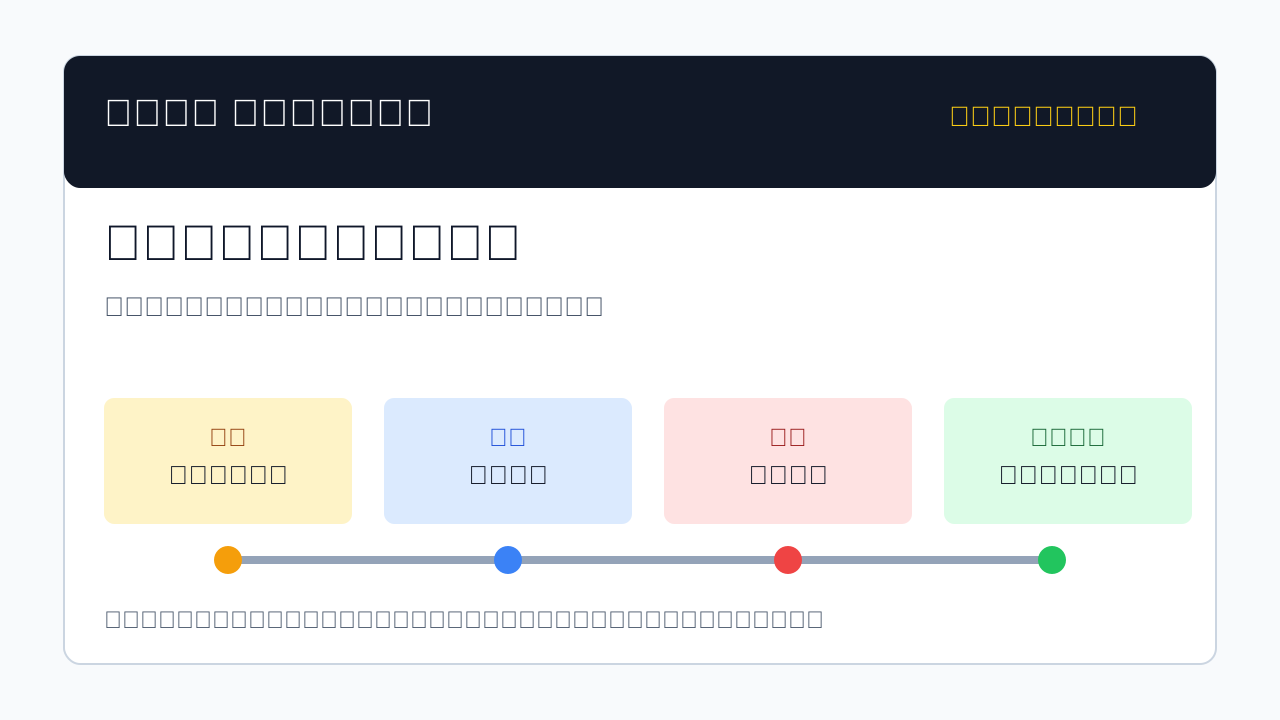
In comparison, the contours of the two cases are fairly easy to sort out.
| comparison axis | wuhan gold huang jewel | Orts |
|---|---|---|
| disguised value | A safe asset called gold bullion | AI/SaaS growth sales |
| form of plating | Collateral allegedly gold-plated copper alloy | Accounts/contracts/sales without actual status |
| expectations abused | Confidence that gold has high collateral value | Expectations for AI/DX/ARR growth |
| credit enhancement | Insurance, trust, listed company outline | Listed on TSE, Audit, Lead Underwriter, Sales Partner |
| Cause of bankruptcy | Collateral inspection after default | SESC Investigation, Third Party Committee, Disclosure |
| Points to check for investors | Collateral inspection, insurance exemption, custody control | Usage status, cash collection, related parties, auditor change |
The lesson of the Wuhan Jinhuang is that even visible assets cannot be trusted unless the contents are verified. Gold bullion appears to be an easy-to-understand physical asset, but unless you inspect the entire amount, you won't be able to tell just from the surface.
The lesson for Olts is that digital metrics are even trickier. The number of SaaS accounts and contracts is not stored in a physical warehouse. Is it being used, is it being continued, who is paying for it, and is the cash coming in from external customers? If this is not separated, both ARR and sales growth rate will be at risk.
The story the market believed
Fraud is unlikely to become large when it comes to mere document manipulation. When the market buys into a story that it wants, it inflates.
In the case of Wuhan Jinhuang, gold is strong as collateral. In times of economic and credit instability, just the word gold brings a sense of security. When lenders and investors hear that a loan is backed by gold and comes with insurance, it is easy for lenders and investors to underestimate the risk.
In the case of Orts, there was a story called AI. From 2024 to 2025, generative AI, business efficiency, SaaS, and DX will be the themes that the market desires. In the growth market, where high growth is valued even if the product is in the red, sales growth, number of companies introducing it, user accounts, and future market size are more likely to be bought than profits.
The market sees what it wants to see. I want the money to be real. I want AI sales to be real. Since the company passed the listing examination, it shouldn't be that strange. Since the insurance company is involved, the collateral should have been confirmed. The more this ``supposed'' accumulates, the less the discomfort will be treated.
This is where investment practice becomes important. The stronger the stock's narrative, the faster good news is factored into the stock. On the other hand, the moment there is doubt about the reality, the valuation will fall based on the credit multiple, not the profit multiple. If the quality of sales itself deteriorates, as it did with Orts, the denominator of sales will no longer be trusted, even before discussing PER and PSR.
Implications for AI stocks and SaaS evaluation
When looking at AI companies, the market tends to focus on "AI technical capabilities" and "market size." However, from a post-Orts incident perspective, that alone is not enough.
最初に見るべきは、売上の実在性です。 Is the customer external and independent?販売パートナー経由の場合、最終利用者は誰か。アカウントは発行されただけか、実際に使われているのか。無料利用、代理店在庫、PoC、社内利用、正式契約が混ざっていないか。 I want to separate this.
Next is cash collection. Accounts receivable are increasing even though sales are increasing, advertising expenses and research and development expenses are increasing unnaturally at the same time, deposits and withdrawals are cyclical with specific business partners, and there is a high dependence on related parties and sales agents. In this area, it is easier to look at the flow of funds than the appearance of the numbers.
The KPI for introducing AI is also weak, with just a large number of contracts. What you really need to look at are ARPU, retention rate, usage frequency, active account rate, churn rate, cost per customer acquisition, payback period, processing time reduction, inquiry reduction, employee productivity, audit logs, and permission management. It's not so much about the word AI as it is about how much it's embedded in work.
The market will likely view AI stocks with suspicion for some time. Even if sales growth is good, if the customer base is weak, it will be difficult to buy. On the other hand, even if there is no flashy theme, companies that can confirm cash collection and continued usage are more likely to be evaluated in a simple manner. This is a fairly significant temperature change when looking at growth stocks from 2025 onwards.
Implications for finance/collateral evaluation
The Wuhan Jinhuang incident is a yardstick that can be used when looking at financial stocks, non-banks, leasing, trading companies, and inventory finance.
There is collateral, there is insurance, there is guarantee. These are safety factors, but stopping there can be dangerous. It is necessary to look at the frequency of collateral evaluation, inspection method, storage location, storage control, third-party appraisal, prevention of replacement, double collateral, insurance exemption, and the creditworthiness of the guarantor.
Especially for financial institutions, when interest income looks good, the quality of credit becomes an issue later on. Are loans being increased by making collateral requirements too loose? Are delinquency rates and loan loss provisions delayed? Are high-yield products being sold as "secure collateralized" products? Even if the numbers are good, if the market begins to doubt the cost of credit, the stock price will be less responsive.
What is scary about the Wuhan Jinhuang situation is not the collateral itself, but the chain of credit enhancement. Financial institutions feel reassured when they see insurance, insurance parties rely on the financial institution's screening, and investors feel reassured when they see the names of both parties. Even if everyone makes decisions that appear to be somewhat rational, the overall verification may be hollow.
This is not someone else's problem even in the Japanese market. Real estate, inventory, accounts receivable, intellectual property, data centers, renewable energy equipment, semiconductor equipment, unlisted stocks. The more specialized the collateral and asset value, the higher the confirmation cost. The higher the confirmation cost, the stronger the dependence on the external shape. The market should take this with a grain of salt.
KPIs that investors should look at
The KPIs you get from these types of incidents aren't flashy. Rather boring. However, boring KPIs are more effective against fraud.
For AI/SaaS companies, they want to see not only the sales growth rate, but also the external customer ratio, active account rate, login frequency, paid retention rate, cancellation rate, ARPU, accounts receivable turnover period, correlation between advertising expenses and sales, sales partner concentration, related party transactions, changes in auditors, corrective disclosures, and whistleblowing responses.
For secured loans and financial products, you want to check the collateral appraisal value, collateral weight, revaluation frequency, independence of third-party appraisal, storage location, pledge setting, insurance coverage, disclaimer clause, delinquency rate, allowance for loan losses, guarantor's finances, and yield and risk explanation in product explanatory materials.
On the side of reading news, it is about separating the layers of information. Company announcements, exchange announcements, courts/regulatory authorities, third-party committees, press coverage, anonymous parties, SNS summaries. If you treat everything with the same weight, your writing may be clean, but your judgment will be sloppy.
This is the most practical question. "Who checked these numbers, what steps did they take, and to what extent?" Whether it's AI or money, I have no choice but to return here.
risk scenario
The first risk is to look too strongly at the similarities between the cases. Olts and Wuhan Jinhuang are not the same fraud. Jurisdictions, financing methods, and scope of victims are different. Comparison is an auxiliary line for understanding the structure, and is not intended to mix fact-finding.
The second is a crude generalization to AI companies as a whole and Chinese companies as a whole. It is too crude to read that all AI companies are in danger because of the Orts incident, or that all Chinese finance is in danger because of the Wuhan Jinhuang incident. We need to look not at country names or topic names, but at the quality of verification procedures, capital flows, governance, and disclosures.
The third is to use past events as material for current buying. The Wuhan Jinhuang issue surfaced in 2020, and the first instance judgment was reported in 2024. It is not a new material that will directly move Japanese stocks as of July 2026. Alts has already been delisted, so this is not a discussion about existing stocks as investment targets, but rather material for thinking about the market system and investor confirmation process.
The fourth is over-reliance on verification. No matter how much you check, you can't completely avoid fraud. Investors can lower their expectations when warning signs pile up, don't evaluate based on theme or signage alone, and avoid paying high valuations for things they can't confirm.
Related pages
- オルツ(260A)粉飾決算事件|AIブームとSaaS評価の盲点を検証する
- 循環取引2.0とは何か|オルツ・MTU・KDDI子会社問題にみる無形資産時代の投資リスク
- 中国・武漢金凰の偽ゴールド事件に見る確認の外注化リスク 金融とニュース検証の本質
summary
The lesson left by Ortu and Wuhan Jinhuang is simple. However, it is difficult to implement.
The more something seems to have value, the more it returns to the source of its value. If it's gold, check what's inside. For AI sales, look at actual usage and cash collection. Insurance, audits, and listing examinations are important, but they are not substitutes for verification.
Markets are good at pricing fast-moving stories. AI, gold, safe assets, listing approval, third party guarantees. These are all strong words. However, determining losses after the fact usually lies in a humble place. Contract parties, return routes for funds, inspection of collateral, insurance disclaimers, change of auditors, delays in disclosure.
The surface of both physical and digital plating is clean. What investors should look at is below.