
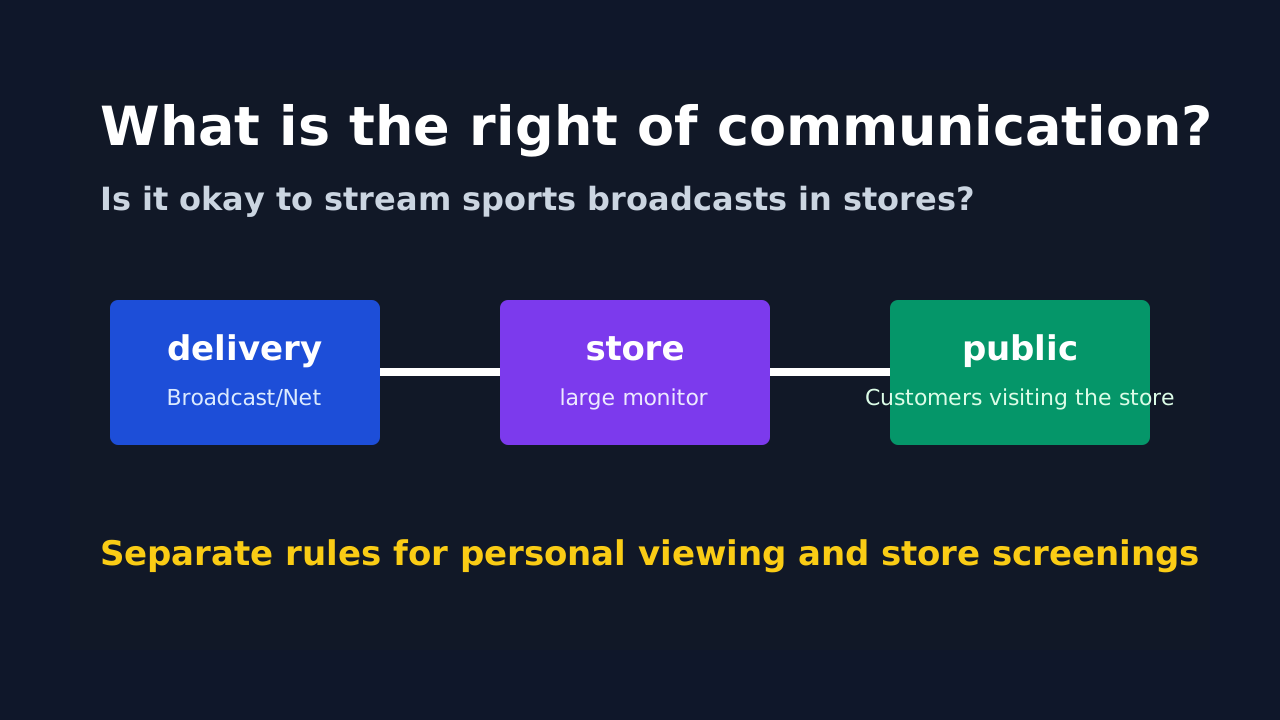
What is the right of communication?
Article 23 of the Copyright Act provides for the right of public transmission and the right of public communication.
The right of public transmission is the right to transmit copyrighted works to the public through Internet distribution, broadcasting, wire transmission, etc.
The right of conveyance concerns the next step.
Distribution company/broadcasting station
        ↓
Internet distribution/broadcasting
        ↓
Receiving device such as PC, smartphone, TV, etc.
        ↓
Store monitors and screens
        ↓
Viewed by customers
This last part of ``showing to customers'' can become an issue of communication rights.
In legal terms, it is the act of "publicly transmitting a work that is to be transmitted to the public using a receiving device."
Although this is a rather rigid expression, in practice it is easier to understand if you think of it as follows.
| Usage scene | Relationship with the right of communication |
|---|---|
| watch alone at home | usually private viewing |
| Watch with family | Usually for private viewing |
| Show it to customers at the store | can be communicated to the public |
| Show at event venue | Communication to the public, screening, and contract conditions tend to be problematic. |
When playing the World Cup in-store
Large-scale sporting events such as the World Cup are highly valuable content for broadcasting and distribution rights.
If you only watch official distribution or TV broadcasts at home, this is usually not a problem.
However, you need to be careful when using it in the following ways at restaurants and sports bars.
Personal contract distribution service
        ↓
Large store monitor
        ↓
Customers watching the game
        ↓
Leads to food sales and customer attraction
In this case, it is easy to see that the video is being used as part of store operations, rather than just for personal viewing.
In particular, the following conditions increase the risk:
- It is advertised as a spectator event.
- Charges admission and seat fees
- Using large screens and sound equipment
- I am using a distribution contract for individuals for business purposes.
- Using match footage to attract customers to stores
What's important here is not just "are you taking money?"
Even if there is no admission fee, if you use it for store operations or attracting customers, you may be subject to distribution contracts and rights holder rules.
What if I want to stream terrestrial broadcasts on a regular TV?
This is where things get a little tricky.
Article 38 of the Copyright Act provides an exception that allows broadcasts to be publicly transmitted using a receiving device if the purpose is not for profit and no fee is charged. In addition, certain handling is stipulated even when using ordinary home receiving equipment.
Therefore, in cases where terrestrial TV broadcasts are broadcast directly on regular TVs placed in stores, this may fall under an exception under copyright law.
However, it is safer to consider the following cases separately.
| case | Points to note |
|---|---|
| Use paid distribution services at stores | Terms of use may be for personal use only |
| Event screening on large screen | It is difficult to call it a normal home receiving device. |
| Charge admission/viewing fees | Easily excluded from non-profit/free exceptions |
| Use for store customer attraction campaigns | Easy to see as commercial use |
| The organizer has established public viewing regulations. | Separate permission or application may be required. |
In other words,
It's the same feeling as your home TV, and you don't have the freedom to stream or show large events.
That's what it means.
For professional baseball broadcasts
The same idea applies to professional baseball broadcasts.
The game itself, or facts such as `which team scored how many points'' or `who hit a home run,'' are not usually copyrighted works in and of themselves.
However, various rights overlap with footage broadcast on television or distributed online.
- camera work
- Live commentary/commentary
- Score display and CG
- Program composition
- BGM and jingles
- Broadcasting station/distributor contract conditions
Therefore, if you want to stream a privately contracted professional baseball streaming service at a store, you should first check the terms of use.
There is a difference between `having a contract to view the video'' and `being allowed to show it to customers in the store''.
Many people stumble here.
Can YouTube live streaming be streamed freely?
Just because it's YouTube doesn't mean it's free.
YouTube's Terms of Service place restrictions on the use of its services and content, assuming personal, non-commercial use. Uses such as public screenings or in-store music streaming may not necessarily be possible without permission.
For example, be careful when using the following:
YouTube live
        ↓
store monitor
        ↓
Viewed by customers
Even if a video is available for free, it may not be possible to play it in stores.
There are at least three things to check:
| Check points | Content |
|---|---|
| YouTube Terms of Service | Is public screening/commercial use allowed? |
| Streamer's rights | Does the distributor allow store use? |
| Original content rights | Are there other rights to sports, music, and video materials? |
Even if a sports broadcast-style video is shown on YouTube Live, it does not necessarily mean that it is an official broadcast. If illegal uploads or unlicensed distribution are carried out at a store, the store may also get into trouble.
common misconceptions
It's okay as long as you don't take money
Not necessarily.
Even if you don't charge an admission fee, if you use it to attract customers or do business for your store, it may be considered commercial use.
Additionally, if the terms of service for a streaming service state that it is for "personal use only," even free events may violate the terms.
You can use it freely because it is distributed online.
This is also a misunderstanding.
There is a difference between what can be seen online and what can be shown to the public.
In particular, paid distribution services are often designed for personal/home viewing.
There is no copyright in sports broadcasts.
It is necessary to consider the game results and play facts separately from the broadcast footage.
Regardless of whether the sports matches themselves have copyrights, broadcast programs and distributed videos include rights to video production, commentary, editing, CG, music, etc.
In other words, it cannot be said that ``the match is a fact, so it is free.''
Anything is OK at the store as long as it's shown on TV.
There are some exceptions to normal TV reception.
However, when expanding to events, large screens, paid distribution, recorded screenings, redistribution on SNS, etc., different rights and contract conditions arise.
The most dangerous thing to do is to apply the same rules to online distribution and paid sports broadcasts, thinking that ``it's okay because we've been playing TV in stores for a long time.''
Checklist before shipping at store
If you actually want to stream World Cup or baseball broadcasts at your store, it is practical to check the following.
| Check items | Points to see |
|---|---|
| How to watch | Terrestrial broadcasting, paid distribution, YouTube? |
| Contract type | Is it an individual contract or a contract for corporations/stores? |
| Terms of use | Are store screenings, commercial use, and public screenings prohibited? |
| Screening environment | Home TV or large screen/sound equipment? |
| How to attract customers | Will it be announced as a spectator event? |
| Fee | Will there be an admission fee, seat fee, or viewing fee? |
| Recording/redistribution | Would you like to have a recorded screening or distribute it on SNS? |
| Organizer rules | Are there any public viewing conditions for sports organizations/broadcasting rights holders? |
If you're at a store, the quickest way to do this is to contact the distribution service's inquiry desk to see if it can be streamed at the store.
If you make a big announcement without being vague, it will be difficult to stop it later.
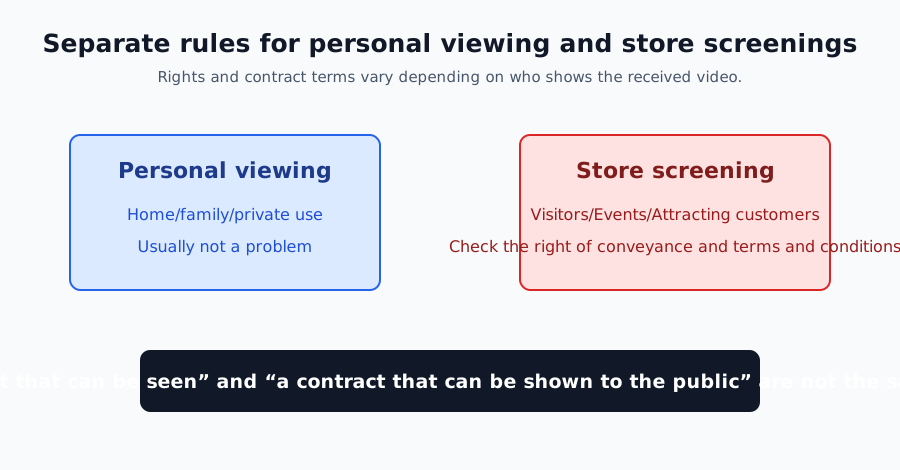
Illustration: Difference between personal viewing and store screening
Broadcasting rights business from an investor’s perspective
The reason sports broadcast rights are strictly controlled is because broadcasting and distribution rights are big business.
The value of sports content that can attract people live, such as the World Cup, the Olympics, professional baseball, overseas soccer, martial arts, and basketball, is increasing.
Distribution services and TV stations attract viewers by paying high rights fees.
Therefore, unauthorized in-store screenings and unauthorized live streaming are not just a violation of etiquette, but a problem that goes to the very foundation of the rights business.
From an investor's perspective, the structure is as follows.
| Company/Industry | Relationship with broadcasting rights |
|---|---|
| TV station | Aiming for advertising and viewership ratings with large-scale sports broadcasts |
| delivery service | Aim to acquire members through exclusive distribution |
| sports organizations | Broadcasting rights fees become a source of revenue |
| communication company | Increase lines and subscriptions with sports streaming |
| Restaurants/Sports bars | Demand for watching games is used to attract customers, but permission needs to be confirmed. |
In sports broadcasting, the content itself has become an investment theme.
That's why the rules for use are becoming stricter. This is where I would like to see the set.
Summary
The right of communication is the right to communicate publicly transmitted works to the public through receiving devices.
It is handled differently depending on whether you are viewing it privately at home or showing it to an unspecified number of people at a store or event venue.
In particular, if you want to stream the World Cup, professional baseball, the Olympics, YouTube Live, or paid streaming services at your store, you need to check the following points.
- Right of communication under copyright law
- Does it fall under the exception of Article 38 of the Copyright Act?
- Terms of use for distribution services
- Public viewing conditions for sports organizations and broadcast rights holders
- Relationship with store sales and customer attraction objectives
The most practical conclusion is simple.
If you want to play it at a store or event, make sure that the contract allows for commercial use and public screening, rather than using it as a personal contract.
If you play it in a store just as you would watch it at home, you may run into trouble later with the rights holder or distribution company.
Source/reference materials
- e-Gov Law Search “Copyright Law”
- Agency for Cultural Affairs “Copyright text 2020 edition”
- Agency for Cultural Affairs “Next Copyright”
- YouTube「Terms of Service」