
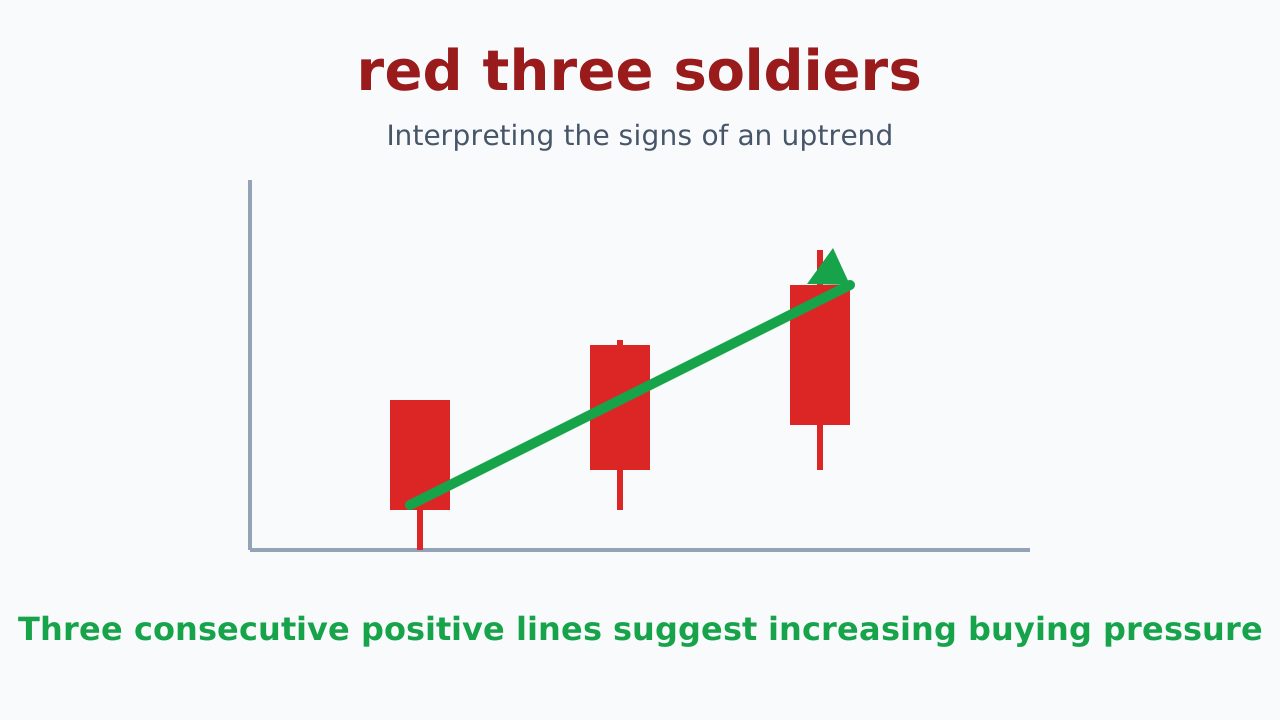
What is Red Sanhei?
Red Sanhei is a pattern in which three consecutive positive lines appear on a stock price chart.
A positive line indicates that the closing price was higher than the opening price.
In other words, the Red Sanhei indicates that buying has been dominant for three consecutive periods.
The image flow is as follows.
- 1st: Bought and rises
- 2nd one: more bought
- 3rd: Continue to rise
If the Three Crows is a pattern that indicates an advantage in selling, the Red Sanhei is a typical pattern that indicates an advantage in buying.
Characteristics of the Red Sanhei
The shape that is easily regarded as the Red Sanhei has the following characteristics.
| Points to see | meaning |
|---|---|
| 3 consecutive positive lines | buying continues |
| closing price goes up | There is a rising momentum |
| body is relatively large | strong buying pressure |
| Upper beard not too long | Profit-taking selling is limited |
A simple image is as follows.
1st 2nd 3rd
  │
  █      │
  █      █      │
  █      █      █
  │      █      █
         │      █
                │
What I want to check is whether three stocks have been bought in a row and the price has gone up. If only the third line is extremely long, I also suspect short-term overheating.
Why is the Red Sanhei attracting attention?
The red three soldiers are likely to appear when investor sentiment begins to change from bearish to bullish.
After a down market or sideways market, the market starts to look like this:
The sell-off may have come to an end.
There is a buyback
New purchases are increasing
The tide has begun to change
Therefore, the Red Sanbei can be seen as an early sign of an uptrend. In particular, if the market continues to decline for a long period of time and is accompanied by high trading volume, there is a view that the momentum of sellers has weakened.
How to use the Red Sanhei
1. Used to confirm trend reversal
If the red three soldiers appear after a falling market or bottom area, it may indicate a change to an uptrend.
In particular, if the price is rising along with the volume, it will be easier to confirm the seriousness of the purchase. If there are only 3 lines in a row with low sales, there are situations where it is better not to trust it as much as it looks.
2. Search for potential buys
There is no need to jump immediately after Red Sanhei appears.
If the price is rising too much in the short term, it may be safer to wait for a push.
I would like to confirm the following points.
- Is it above the moving average?
- Is trading volume increasing?
- Are financial statements and materials included?
- Are you grabbing high prices?
3. Don't be overconfident when prices are high
Red Sanhei is a strong form, but you need to be careful if it appears in the high price range.
If many investors have already bought, there may be profit-taking selling after the Red Sanhei.
Instead of "buying because it's strong," look at "where it's selling." If you skip this point, you will use rising signs as a gateway to grabbing high prices.
Mistakes that beginners often make
I think the red three soldiers are a surefire sign of victory.
The Red Three Soldiers is a pattern that indicates the possibility of an increase, but it does not confirm the future.
When the market as a whole is weak or there are bad news, stocks may stall after the Red Sanhei.
don't look at volume
If the trading volume continues to rise while remaining low, buying power may be weak.
When looking at the Red Sanhei, check not only the shape of the candlesticks, but also the trading volume.
Seize the high price
After three consecutive gains, it may be overheating in the short term.
Beginners tend to panic and buy stocks when they see them going up. The more neatly the candlesticks line up, the stronger the feeling of being left behind.
Before you buy, decide on your stop loss line and investment period. If you're going to watch Red Sanhei before you buy it, you'll want to decide first how far it's going to collapse before you change your mind.
practice framework
Once you find the Red Sanhei, check them in the following order.
- Is it occurring after hitting the bottom or leveling off?
- Is trading volume increasing?
- Is it accompanied by achievements and materials?
- Is it above the moving average?
- Is it overheating in the high price range?
- Does it match my trading rules?
Summary
The Red Sanhei is a typical candlestick pattern that indicates increasing buying pressure.
- Consists of three consecutive positive lines
- May signal a change to an uptrend
- Check with output and materials
- Don't be overconfident when prices are high
- Don't rush to buy, decide on risk management first
Red Sanhei is not a "sign that will definitely go up if you buy it".
It is realistic to use it as a confirmation that the market trend may have started to change. The stronger the shape, the more you look at the position and volume.