
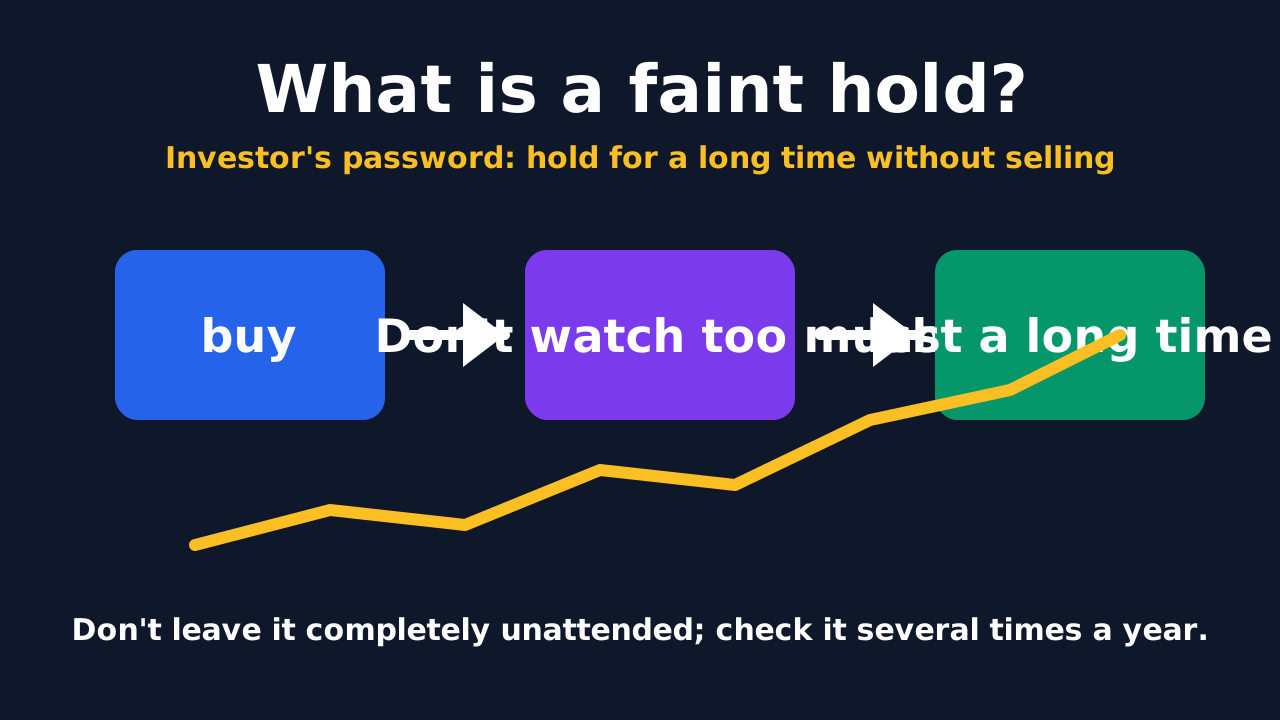
What is a faint hold?
Among investors, the following style is sometimes referred to as a "stunned hold."
buy
↓
Don't look at the charts too much
↓
Don't sell due to short-term declines
↓
Last until several years or even decades later
This is a slang term used on social media and the investment community.
It's close to the meaning of ``If you buy it and forget about it, it's just right.''
However, that doesn't mean you can forget it completely.
It's dangerous if you get this wrong.
Why is the term faint hold used?
When people start investing, many people look too much at stock prices.
stock price goes up
↓
I'm happy

stock prices fall
↓
I feel anxious
This is repeated.
The problem is that the more you watch price movements, the more likely you are to buy and sell emotionally.
Common mistakes include:
| emotion | action | likely outcome |
|---|---|---|
| impatience | buy after a spike | Grasping high prices |
| anxiety | sell when down | low price sale |
| greed | try to increase more | concentrated investment |
| boredom | make unnecessary purchases | Increased fees and taxes |
So,
choose good assets
↓
last a long time
↓
Don't overreact to short-term price movements
This is the idea that comes to mind.
A very rough expression of this is a stun hold.
Stun hold example
S&P500 reserve investment
For example, you might invest in a mutual fund that tracks the S&P 500 every month.
Reserve every month
↓
Don't worry too much about short-term ups and downs
↓
Hold for 10 or 20 years
Even if there is a downturn along the way, you can continue to save money after securing a living fund.
This idea is similar to a faint hold.
Long-term holding of global stocks
A typical example is buying a global stock index and holding it for a long time.
buy stocks all over the world
↓
Riding the growth of the global economy as a whole
↓
Don't be swayed by short-term national results
Rather than focusing on specific countries or regions, the idea is to disperse widely throughout the world and maintain it for a long time.
Savings with new NISA
With the new NISA, you can hold tax-free products that are compatible with long-term, savings, and diversified investments.
The term "stun hold" is a bit light, but it is a very realistic way to use the new NISA.
However, just because it's tax-free doesn't mean you can buy anything.
The first thing to consider is whether the product will last for a long time.
Advantages of Stun Hold
Not easily influenced by emotions
Investment failures can often come from your own actions rather than the product itself.
I got scared and sold because of the sudden drop. I panicked and bought it because of the sudden rise. I watch the news and switch over and over again.
Stun holds tend to reduce this behavior.
saves time
Looking at charts every day is more tiring than I thought.
When it comes to long-term investing, even if you follow every daily price movement, it doesn't necessarily make your decisions better.
Sometimes work, finances, studying, and sleep are more important.
Good for long-term investment
The stock market goes up and down significantly in the short term.
It is common for it to be negative on a one-year basis.
Still, a widely diversified stock investment is an idea that captures corporate profits and economic growth in the long term.
The Financial Services Agency also introduces the concepts of long-term, savings, and diversified investments for asset formation.
Stun hold can be said to be a rather informal version of that idea.
Disadvantages of faint hold
It's dangerous to not really see anything
Stunning hold is different from complete neglect.
Unless you really look at something, you won't notice the following changes.
- Asset allocation will be severely disrupted
- life situation changes
- taking too much risk
- Problems arise with product trust fees and management policies.
- Systems and tax systems will change
It is more realistic to check your entire assets once to several times a year.
Individual stocks are risky
Stunning holds are much more difficult with individual stocks.
buy popular companies
↓
business performance deteriorates
↓
I still don't watch it
↓
Stock prices fall significantly
This kind of thing usually happens.
For individual stocks, a company's competitiveness, performance, finances, management policy, and industry environment change.
If you completely ignore it in the same way as index investing, it is easy to overlook the risks.
Not suitable for leveraged products
Some leveraged ETFs and bull/bear type products are not designed for long-term holding.
Price movements are large, and the damage caused when the market moves in the opposite direction is also large.
It is dangerous to think that if you faint, you will return someday.
Investments suitable and unsuitable for fainting hold
Products that are easy to invest in are widely diversified and easy to hold for the long term.
| Easy investment | reason |
|---|---|
| World stock index | Easy to disperse regionally |
| S&P500 linked products | You can invest in a wide range of US large-cap stocks |
| balanced fund | Easy to combine stocks and bonds |
| Reserve every month | Easy to spread out timing |
| Long-term operation of the new NISA | Tax-free and easy to hold for a long time |
Some things are difficult to face.
| Unsuitable investment | reason |
|---|---|
| short term buying and selling | Not compatible with abandonment |
| leveraged products | Large price fluctuations, high long-term holding risk |
| Individual stocks with uncertain performance | Hard to notice deterioration |
| Concentrated investment only in theme stocks | Large drop at the end of the boom |
| Investment with living funds | Difficult to withstand when falling |
For fainting hold, select the product.
This is not to say that everything should last for a long time.
Difference with FOMO
FOMO is
Fear Of Missing Out
fear of missing out
It is.
The psychology behind investing is as follows.
stock price goes up
↓
Become a hot topic on SNS
↓
I feel like I'm the only one who doesn't have it
↓
Buy in a hurry
On the other hand, the stun hold is like this.
Buy with confidence
↓
Don't look too closely at short-term price movements
↓
last a long time
Although they appear to be opposites, they are actually connected.
When a product you buy with FOMO goes down, you immediately become anxious. The reason I bought it is because it's weak.
To perform a stun hold, you must first decide ``why you want to hold this for a long time.''
Common misconceptions for beginners
Stun hold is an investment without any consideration.
No.
The initial product selection is very important.
If you want it to last for a long time, you need to have enough dispersion, low cost, and a sense of satisfaction to last for a long time.
Even if it crashes, I will never reconsider.
This is also different.
There's a difference between not selling in a panic during a market crash and not checking your asset allocation.
If your investment objectives or living situation change, you will need to review your investment plan.
Individual stocks can be left alone in the same way.
Individual stocks are different.
If a company's business performance is deteriorating and you put it on a "stunning hold" and leave it alone, you are likely to suspend your judgment.
For individual stocks, it is necessary to regularly review financial results, financials, competitive environment, and stock price evaluation.
How much should I watch if I actually do it?
Even though it's called a stun hold, you don't have to completely forget about it.
If you are a beginner, the following are realistic.
| frequency | things to check |
|---|---|
| every month | Is the accumulation being carried out as planned? |
| Once every six months | Is your asset allocation significantly disrupted? |
| Once a year | Check your investment objectives, risk tolerance, and life defense funds |
| When needed | Life changes such as job change, marriage, home purchase, childbirth, retirement, etc. |
The important thing is not to look at stock prices every day and buy and sell.
Make sure that your investment policy suits your current lifestyle.
Illustration: Concept of fainting hold
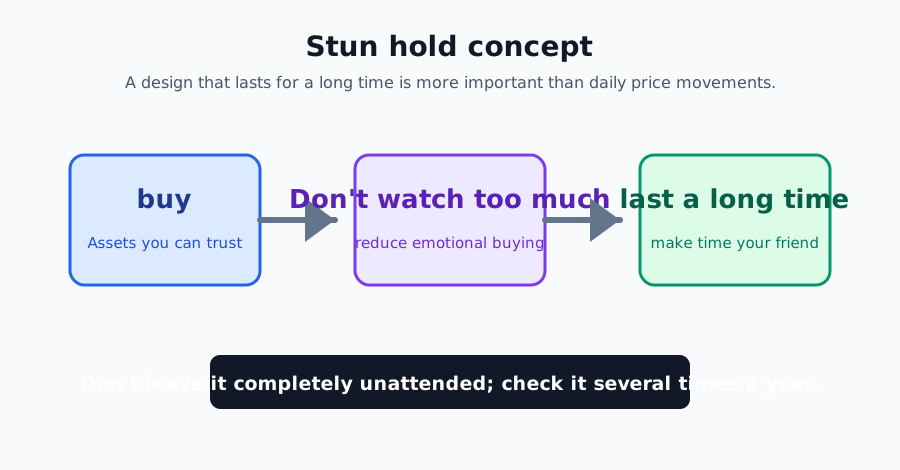
Summary
What is a faint hold?
Buy good assets and hold them for a long time without being influenced by short-term price movements
This is a humorous term used by investors to express this idea.
It is compatible with the new NISA, index investment, and long-term savings.
However, it is not really a blind investment.
It is assumed that the initial product selection, asset allocation, life defense fund, and risk tolerance match.
For individual stocks, leveraged products, and short-term theme stocks, a stunned hold can be just a suspension of judgment.
The important thing in long-term investing is not to buy and sell every day, but to create a system that allows you to continue investing.
Reduce the number of purchases and sales and use time on your side. A slightly interesting password for this is the stun hold.
Source/reference materials
- Financial Services Agency “Basics of Asset Formation”
- Investor.gov「Buy and Hold」
- Investor.gov「Asset Allocation」
- FINRA「Market Timing」