Core and satellite in new NISA
The new NISA has an accumulation investment limit and a growth investment limit.
Under the system as of May 2026, the annual investment limit is as follows.
| frame | Annual investment limit | Main usage |
|---|---|---|
| Fresh investment limit | 1.2 million yen | Investment trusts suitable for long-term, accumulation, and diversification |
| growth investment frame | 2.4 million yen | Listed stocks, ETFs, investment trusts, etc. |
These two frames are compatible with the core-satellite strategy.
For example, consider this.
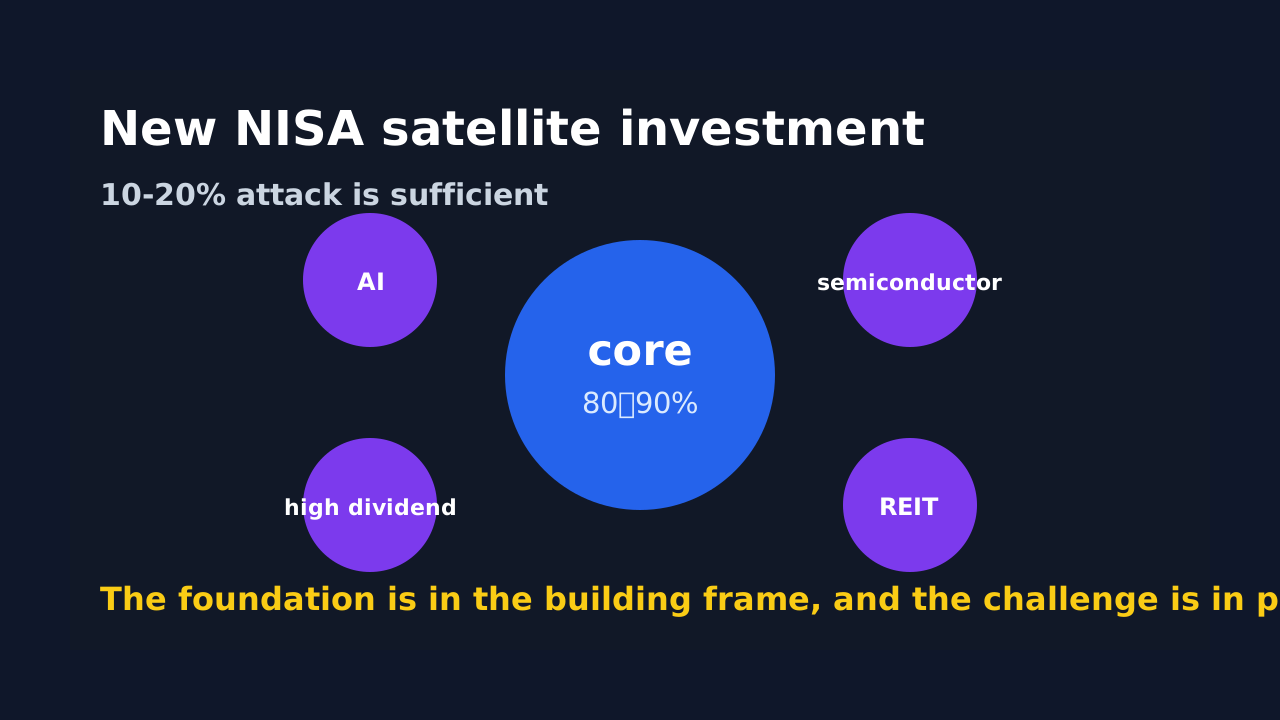
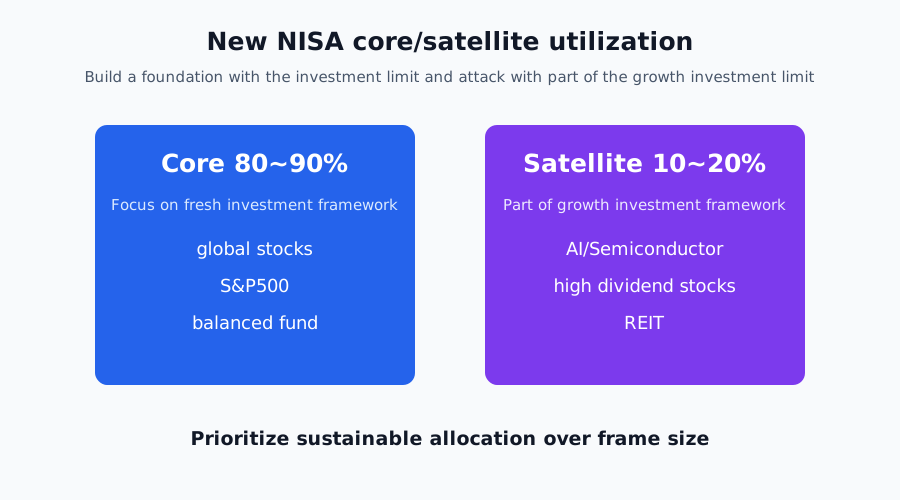
NewNisa

Core 80~90%
├ World stock index
└ S&P500 linked index

Satellite 10~20%
├ High dividend stocks/high dividend ETFs
├ AI related
├ Semiconductor related
└ REIT
The core is the accumulated investment limit. A portion of the growth investment quota will be made into satellites.
By doing this, you can participate a little in topics that interest you without compromising the foundation of asset building.
Assets for the core
Core assets are the central part of asset formation over the long term.
The goal is not to win big in the short term.
Our goal is to capture the growth of the global economy and corporate profits as widely and for as long as possible.
Representative examples are as follows.
- World stock index
- S&P500 index
- Developed country stock index
- balanced fund
- Investment trusts including bonds
The savings investment limit covers products for long-term, savings, and diversified investments that meet the standards of the Financial Services Agency.
Therefore, it is an easy-to-use frame for beginners to create cores.
If you create a core by making monthly savings, you will have a base to continue investing even if the market goes up or down.
Assets suitable for satellites
Satellite assets are an offensive framework to complement the core.
Typical examples are as follows.
AI related
This investment is expected to expand the AI market.
The scope is wide, including AI software, cloud, data centers, and semiconductors.
However, this is also an area where expectations tend to be factored into stock prices first.
Semiconductor related
Semiconductors are used in a wide range of fields, including AI servers, smartphones, automobiles, and industrial equipment.
Although they have growth potential, they are easily affected by the capital investment cycle and stock prices tend to fluctuate significantly.
High dividend stocks/high dividend ETFs
This is an investment that focuses on dividend income.
It is suitable for people who want to be aware of regular dividends as well as capital appreciation profits.
However, just because the dividend is high does not mean it is safe. Dividends may be reduced due to poor performance.
REIT
REIT is a product that invests in real estate.
You can diversify your investments in offices, logistics facilities, commercial facilities, housing, etc.
When interest rates rise, prices may tend to fall, so it may be easier to manage your holdings in a satellite frame.
Allocation example for beginners
Let's consider a case where you invest 1 million yen with a new NISA.
Pattern 1: Royal road type
Core 900,000 yen
└ World stock index

Satellite 100,000 yen
└ High dividend ETF
This is enough to start with.
If the satellite is 10%, even if the price goes down, the impact on the overall asset will be easily suppressed.
Pattern 2: Balanced type
Core 800,000 yen
├ Global stocks
└ S&P500

Satellite 200,000 yen
├ AI related
└ Semiconductor related
This is for people who want to include a little bit of theme investing.
However, the price movements of AI and semiconductors may be similar. In some cases, although they appear to be separate, they are actually taking the same risk.
Pattern 3: Dividend-oriented type
Core 800,000 yen
└ Index investment trust

Satellite 200,000 yen
└ High dividend stocks/high dividend ETFs
This is for people who want to be conscious of dividend income.
However, you cannot calculate profits and losses with a NISA account. It is important to note that even if you incur a loss by selling a high-dividend stock that has fallen in value, it cannot be offset against the profit in your taxable account.
common mistakes
Satellites take center stage
The most common mistake is making the satellite too large.
ideal
core 80%
Satellite 20%

Failure example
core 20%
Satellite 80%
This is no longer a core-satellite strategy.
It's almost like a competition between theme stocks and individual stocks.
It's fun when it's going up, but when it's going down, the whole asset swings a lot.
focus on one theme
Even if AI and semiconductors are doing well, it is dangerous to concentrate most of your assets on one theme.
When it comes to thematic investing, there may be high expectations for the stock price once it becomes a hot topic.
Even if good news comes out after you buy, the stock price may not increase because it has already been factored in.
change theme every year
Last year it was AI, this year it was defense, and next year it was space.
If you keep following the trends like this, you will buy and sell more.
The growth investment limit is convenient, but it is not a limit for increasing short-term buying and selling.
The new NISA has an unlimited tax-free holding period, so you'll want to think first about whether you can hold it for a long time.
Rules for making satellite investments with the new NISA
When making satellite investments, it will be easier to continue investing if you decide on the rules first.
1. Decide on the upper limit ratio
For beginners, 10-20% satellite is sufficient.
It's safer to think, "Even if the price goes up, don't increase it too much beyond a certain level," rather than "increase it if it goes up."
2. Be able to explain the reason for buying in one word
It is easy to fail if you buy something just because it is popular.
For example,
We believe that demand for semiconductor manufacturing equipment will increase due to demand for AI.
Owning a high-dividend ETF based on dividend yield and stability of performance
I want to capture some real estate income, so I'm going to invest in a REIT.
If you can explain this much, it will be easier to judge when the price goes down.
3. Check your ratio only once or twice a year
You don't need to see it every day.
Check your core to satellite ratio once or twice a year.
If the number of satellites increases too much, some will be returned to the core. On the other hand, even if there is a significant drop, think calmly about whether or not to add more.
This rebalancing is the basis for continuing satellite investment for a long time.
Diagram: Core/satellite utilization in new NISA
Summary
Satellite investments under the new NISA are aggressive investments that complement core assets.
The recommended idea is simple.
- First, make 80-90% of the core
- Keep satellites to 10-20%
- Don't use all of your growth investment allowance for attacks
- Don't concentrate too much on one theme investment
- Review the ratio once or twice a year
The new NISA is a system with a large tax-free allowance.
That's why it's more important to create an asset allocation that you can continue with, rather than rushing to fill the slots.
Build a base with the core and attack a little with the satellites. If you just follow this order, the new NISA will be much easier to use.
Source/reference materials
- Financial Services Agency, Learn about NISA: NISA special website (confirmed May 30, 2026)
- Financial Services Agency, Basics of asset formation: NISA special website (confirmed May 30, 2026)