What is the 40 million yen problem in retirement?
The 40 million yen problem after retirement, like the 20 million yen problem after retirement and the 30 million yen problem after retirement, is an expression used to explain the shortage of funds for retirement.
It's not like a public institution has decided that you need 40 million yen for retirement.
Rather, assuming the following household budget, a shortfall of around 40 million yen could occur.
- Pension alone is insufficient by around 100,000 yen per month.
- Looking at the retirement period of about 30 years
- There are also extraordinary expenses such as medical expenses and nursing care expenses.
- Housing and living costs are not going down much.
It's easier to understand if you think of it as a case where your expenses are larger than the 20 million yen problem, or your pension income is smaller.
Why is it 40 million yen?
Suppose your household finances after age 65 are as follows.
| Item | monthly fee |
|---|---|
| pension income | 220,000 yen |
| living expenses | 320,000 yen |
| Monthly shortfall | 100,000 yen |
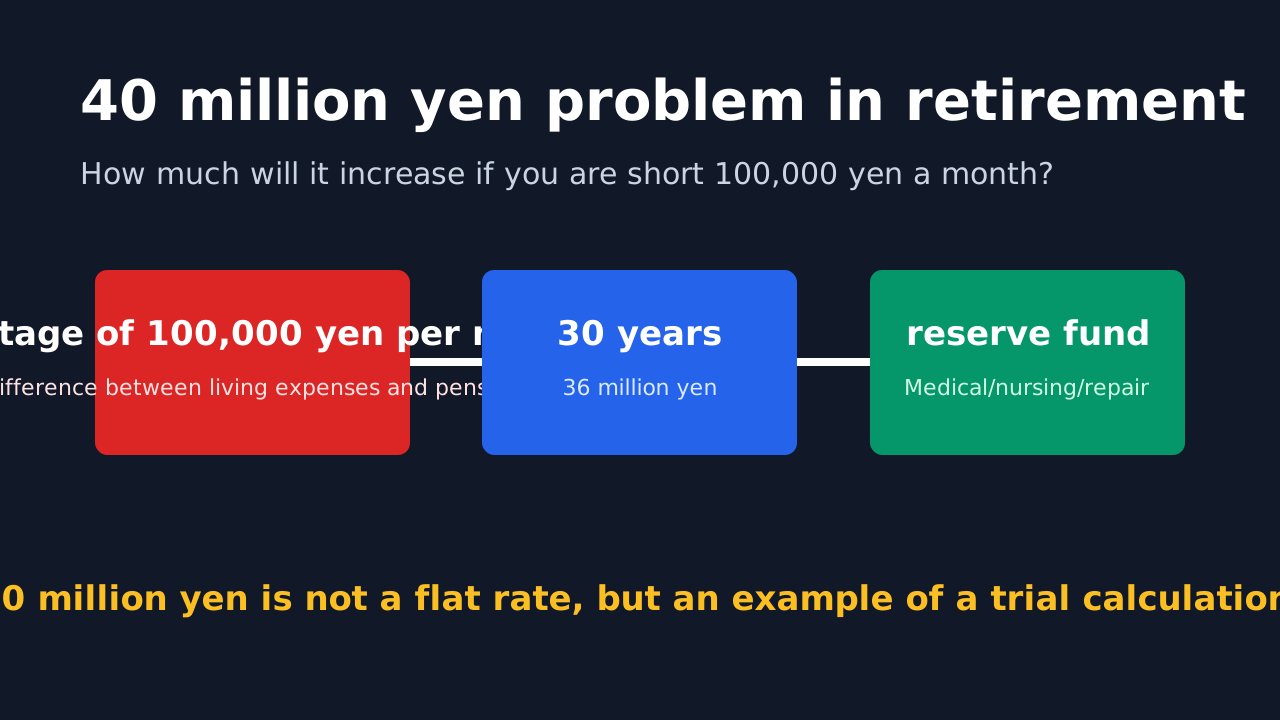
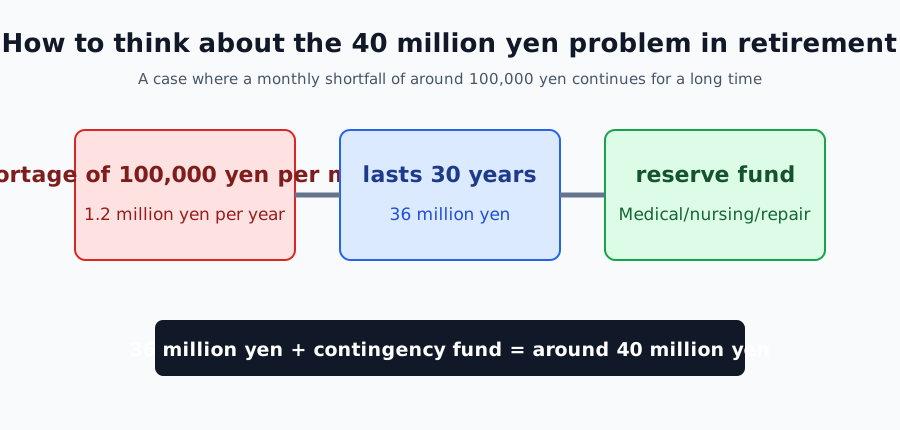
If this shortage continues for 30 years, it will be 36 million yen.
Shortage of 100,000 yen every month
×
12 months
×
30 years
=
36 million yen
Add extraordinary expenses here.
- medical expenses
- Nursing care costs
- home repair costs
- Replacement of home appliances
- car replacement
- Ceremonial expenses
- Support for children and grandchildren
If you estimate these expenses in millions of yen, it will be around 40 million yen.
In other words, the 40 million yen problem is a case where the monthly deficit of about 100,000 yen continues for a long time, and a contingency fund is added to it.
People who are likely to be realistically short of 40 million yen
If the following conditions are met, the figure of 40 million yen becomes quite realistic.
| conditions | reason |
|---|---|
| continue to live in rental housing | Rent remains a fixed expense even after retirement |
| Mainly self-employed | Employees' pension benefits are likely to decrease |
| I don't have much retirement money | Lack of sufficient capital |
| live in the city | Housing and living costs tend to be high |
| Expected to be over 95 to 100 years old | The withdrawal period will be longer |
| I want to enjoy hobbies and travel | Leisure costs increase |
| Take a closer look at medical and nursing care costs | reserve funds are required |
In particular, the combination of rent and pension amount is large.
If the rent is 100,000 yen a month, that's 1.2 million yen a year. 36 million yen in 30 years. Of course, rent will vary depending on the area and how you live, but people who continue to have housing costs even after retirement need to look very carefully.
People who don't need up to 40 million yen
On the other hand, the following people may not need up to 40 million yen.
| conditions | reason |
|---|---|
| Own your home and pay off your mortgage | Easily reduce housing costs |
| Both husband and wife receive welfare pension | Relatively large pension income |
| I have retirement benefits | There are funds available for withdrawal. |
| Working after age 65 | Shortfall can be reduced |
| Living with less expenses | monthly deficit becomes smaller |
| There are corporate pension plans and iDeCo. | Source of income other than public pension |
In this case, it may be around 10 million to 30 million yen.
When it comes to retirement funds, your fixed expenses are more important than the average value. Especially housing costs, car costs, insurance costs, communication costs, and medical costs. The required amount will vary considerably depending on how you design this area.
Differences between 20 million yen, 30 million yen, 40 million yen, and 50 million yen problems
In most cases, the difference in numbers is the difference between `how much money you will be shorting each month'' and `how many years' worth you are looking at.''
| How to be called | Image of expected shortfall |
|---|---|
| 20 million yen problem in retirement | Shortage of 50,000 to 60,000 yen per month × about 30 years |
| 30 million yen problem in retirement | Shortage of around 80,000 yen per month × about 30 years |
| 40 million yen problem in retirement | Shortage of 100,000 to 110,000 yen per month × about 30 years + reserve funds |
| 50 million yen problem in retirement | Shortage of 120,000 to 150,000 yen per month or 35 years or more of retirement |
In other words, the numbers are increasing primarily because they reflect the following factors:
- price rise
- Longevity
- Continuation of housing expenses such as rent
- Individual differences in pension amount
- Hope for a comfortable life
- Preparation for medical and nursing care costs
Rather than simply thinking, `20 million yen is not enough'' or `50 million yen is dangerous,'' it is more accurate to replace it with your own monthly shortfall.
numbers you really need to see
It is practical to think about retirement funds using the following formula.
Necessary assets
=
(Retirement expenses - pension income)
×
years of retirement
+
large extraordinary expenditure
-
Retirement allowance and existing assets
For example, if your monthly shortfall is 100,000 yen, but your retirement allowance is 15 million yen, the additional funds you need to prepare will change.
On the other hand, even if the monthly shortfall is 80,000 yen, if you continue to rent, have no retirement benefits, and want to take a more generous view of your nursing care expenses, it could exceed 30 million yen.
What is important about retirement funds is the breakdown, not the total amount.
Points to consider by age group
30s
There's still time. This is the age when it is easy to start long-term savings using NISA, corporate DC, iDeCo, etc., even if it is a small amount. Rather than the amount, it is more important to create a system that will not stop your savings.
40s
This is the age when mortgages, education costs, and retirement funds tend to overlap. If I can't see my household finances, I'll be in a panic in my 50s. I would like to start reviewing my fixed costs and confirming the estimated pension amount.
50s
Retirement allowances, mortgage balance, parental care, and how you work will become very specific. If you are thinking about the problem of 40 million yen in retirement, you can put it into a very realistic estimate for this age group.
60s
Rather than increasing it significantly through operation, the focus is on how to withdraw it and design the working period. It is important not to spend too much at once immediately after retirement, and to leave some reserve funds for medical and nursing care.
Illustration: The standard for the 40 million yen problem is “100,000 yen shortfall per month”
Summary
The issue of 40 million yen in retirement is not an amount that is necessary for all citizens.
This is an estimate of the amount of shortfall that may occur assuming a certain standard of living, a shortfall of around 100,000 yen per month, retirement for around 30 years, and contingency funds for medical care, nursing care, home repairs, etc.
What you should really be looking at isn't the 40 million yen headline.
- What is your pension income?
- How much does it cost to live in retirement?
- Will housing costs continue?
- How much retirement money do you have?
- Until what age do you work?
- How much to expect for medical and nursing care costs
With these six factors, you can get a pretty good idea of the retirement funds you need.
The higher the number, the more anxious you will be about your retirement funds. However, if you break it down, it's just a household budget calculation. How much will I be short of? The most realistic way to start is from there.
Source/reference materials
- Financial Services Agency, Regarding the publication of the Financial Services Council “Market Working Group” report
- Financial Services Agency, Financial Services Council Market Working Group Report “Asset Creation and Management in an Aging Society”
- Life Insurance Culture Center, How much do you think you need for living expenses in retirement?
- Japan Pension Service, Estimated pension amount using “Nenkin Net”
- Related article: What is the 30 million yen problem in retirement? Explanation for beginners about how much money you need for retirement due to rising prices
- Related article: What is the 50 million yen problem in retirement? An explanation for beginners about who really needs it and how to think about the amount that is missing
- Confirmation date: 2026-05-30