
First, the conclusion
FCF is an indicator that measures a company's free cash reserves.
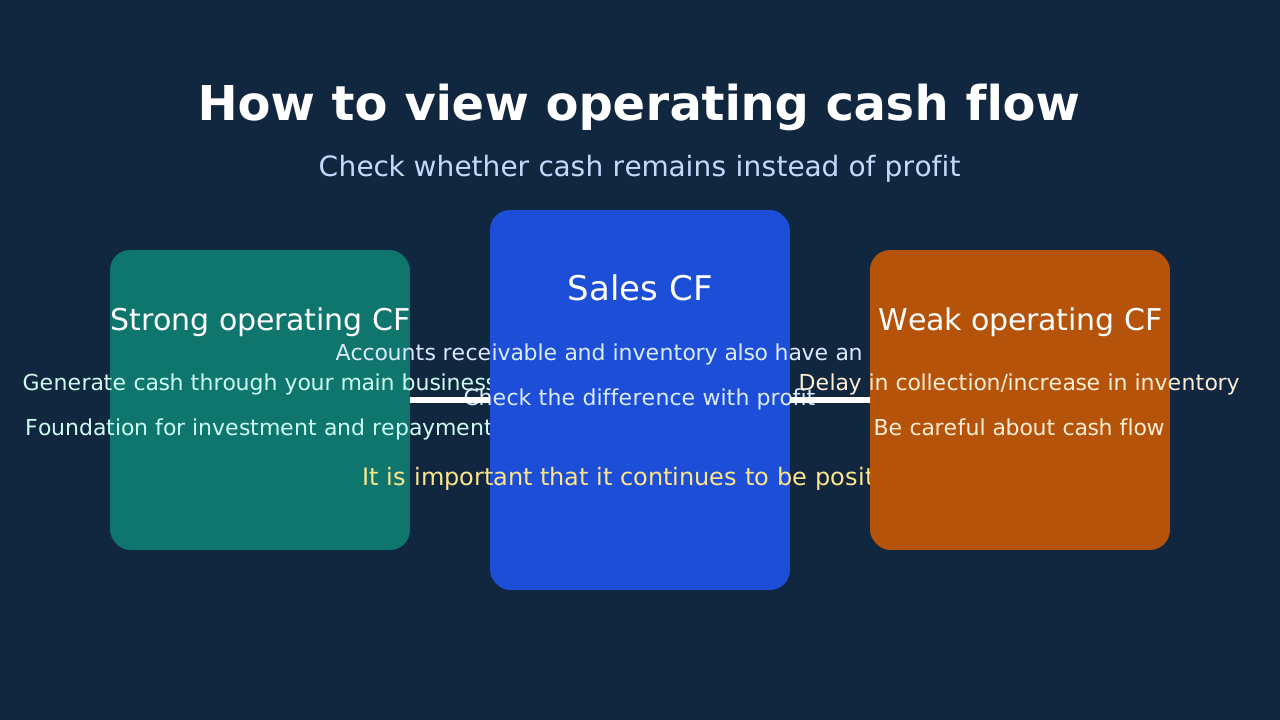
Even if you are making accounting profits, if there are delays in collecting sales proceeds, inventory builds up, or large capital investments are required, the amount of cash left on hand will decrease.
The reason investors look at FCF is simple.
This is because cash is harder to cheat than profit.
Of course, FCF alone does not determine the quality of a company. Companies with large growth investments may have a temporary negative FCF. The important thing is to look at why it's positive and why it's negative along with operating cash flow and investment details.
What is FCF?
FCF stands for Free Cash Flow.
It is generally explained as follows.
FCF = 営業キャッシュフロー - 設備投資Operating cash flow is cash generated from your core business. If you subtract investments in factories, stores, systems, machinery, etc. from this, you can see how much cash a company has that it can use relatively freely.
This surplus power is mainly used for the following purposes.
| Usage | Meaning |
|---|---|
| Dividend | Cash return to shareholders |
| Share buyback | Shareholder return and capital efficiency improvement |
| Loan repayment | Reducing financial burden |
| M&A | Business expansion and functional complementation |
| New investment | Investment in growth fields |
Points that are easy to stumble on with calculation formulas
When calculating FCF, beginners tend to get confused by the sign of investment cash flows.
Since capital investment is a cash expenditure, it is often shown as a negative amount on the cash flow statement.
Therefore, in practice, it will be easier to understand if you consider the following two separately.
| How to read | Calculation formula | Notes |
|---|---|---|
| When using capital investment amount | Operating CF - Capital investment amount | Capital investment amount is treated as a positive amount |
| Simple calculation using investment CF | Operating CF + Investment CF | If investment CF is negative, it is effectively subtracted |
For example, if operating CF is 100 billion yen and capital investment is 30 billion yen, FCF is 70 billion yen.
FCF = 1,000億円 - 300億円
    = 700億円
On the other hand, if the cash flow statement shows investment CF as "-30 billion yen," it can be viewed simply as follows.
FCF = 営業CF + 投資CF
    = 1,000億円 + (-300億円)
    = 700億円
If you calculate this mechanically as "Operating CF - Investment CF", you will end up subtracting the negative value twice, which may lead to a large misunderstanding of the numbers.
Case where FCF is weak even if there is profit
Even if a company is making a profit, if it does not have enough cash, it will have difficulty financing.
For example, consider a company that:
| Item | Amount |
|---|---|
| Sales | 10 billion yen |
| Profit | 1 billion yen |
| Accounts receivable before cash collection | 5 billion yen |
There is a profit on the income statement. However, if the collection of sales proceeds is delayed and accounts receivable is ballooning, the actual amount of cash may not be increasing as much as expected.
Furthermore, if capital investment is large, FCF will be small.
In other words, it is dangerous to judge a company as a ``good company'' based only on profits.
Characteristics of a good FCF
Positive for a long period of time
If your FCF is consistently positive every year, you may be able to earn cash through your main business and have some surplus left over after investing.
5年間連続でFCFプラスThese companies are more likely to be able to support themselves with dividends, debt repayments, and growth investments.
Along with sales growth, FCF is also increasing.
Even if sales are increasing, there are companies that have so much inventory and accounts receivable that they don't have any cash left.
On the other hand, it's easier to see the quality of growth in a company where sales growth and FCF growth line up.
Hard to collapse significantly even in times of economic downturn
Companies that can maintain FCF even in a recession may have strengths in price competitiveness, fixed cost control, customer base, and capital investment burden.
However, in economically sensitive industries and large manufacturing industries, investment cycles have a large effect, so it is safer not to make decisions based on a single year.
Points that beginners tend to misunderstand
Big profits don't necessarily mean a good company
For example, compare the following two companies:
| Company | Profit | FCF |
|---|---|---|
| Company A | 10 billion yen | -5 billion yen |
| Company B | 3 billion yen | +8 billion yen |
Company A appears to have large profits, but its FCF is negative. Cash may be flowing out due to an increase in accounts receivable, inventory buildup, or large investments.
Although Company B's profits are small, it has plenty of cash remaining. Which one is better depends on the industry and stage of growth, but at least you can understand that you should not make decisions based on profit alone.
Negative FCF is not always bad
When a growing company makes large investments in new factories, logistics bases, data centers, store networks, and R&D equipment, FCF may temporarily become negative.
The problem is not the negative itself.
The question is how much of your investment can be supported by your main business's operating CF, and whether that investment will lead to future sales and profits.
Even FCF plus is not always safe
Even if FCF is positive, there may be cases where cash is only temporarily increasing due to asset sales or investment restraints.
For example, if your FCF is increasing due to stopping growth investments, your short-term cash surplus may improve, but your future growth potential may be weakening.
Points that investors should look at
When looking at financial statements, it will be easier to understand if you check them in the following order.
| Order | Check items | Reason for viewing |
|---|---|---|
| 1 | Is the operating CF stable and positive? | Find out if you are earning cash from your main business |
| 2 | Is the amount of capital investment too large? | Understand how much earned cash is being used |
| 3 | Is FCF positive for multiple years | Continuity can be seen rather than temporary factors |
| 4 | Can the company support dividends and stock buybacks | Can confirm the sustainability of shareholder returns |
| 5 | Are you relying on borrowings or capital increases? | Easily detect problems with financing |
Especially when looking at dividend stocks, you want to check not only the dividend yield but also the FCF. Even if the dividend is high, a company with a long and weak FCF may have a higher risk of a future dividend cut.
Relationship with three cash flow brothers
FCF is easier to understand when viewed together with the three categories of the cash flow statement.
| Category | Role | Relationship with FCF |
|---|---|---|
| Operating cash flow | Ability to earn cash through core business | Starting point of FCF |
| Investment cash flow | Capital investment, M&A, and asset sales | Investment burden that increases or decreases FCF |
| Financial cash flow | Borrowings, repayments, dividends, share buybacks | How to use FCF and procuring shortfalls |
Beginners will find it easier to organize if they are viewed in the following order.
利益
↓
営業キャッシュフロー
↓
フリーキャッシュフロー
↓
財務キャッシュフロー
Are profits turned into cash? Do you have cash left over after investing? How are you using the remaining cash?
If you follow this flow, the way you read the financial statements will be quite stable.
Points to note
When looking at FCF, keep the following points in mind:
| Points to note | Contents |
|---|---|
| Definitions vary depending on company and analyst | There are multiple views such as operating CF - CapEx, operating CF + investment CF |
| Fluctuations due to M&A and securities sales | Temporary factors mix when using the entire investment CF |
| It is easy to have a negative result during the growth investment period | Don't judge just a negative result as bad |
| It is easy to misunderstand when looking at a single year | Look at trends over 3 to 5 years |
| There are large differences by industry | Manufacturing, communications, power, semiconductors, etc. have a large investment burden |
FCF is a useful metric, but it is not a panacea. It only makes sense when you look at it in conjunction with sales, profit margin, operating CF, investment content, financial CF, borrowing, and dividend policy.
summary
Free cash flow (FCF) is an important indicator that shows the amount of cash a company has left after deducting capital investments from cash earned through its core business.
There are three points to look at:
- Is FCF stable and positive?
- Is it increasing over the long term?
- Can you comfortably support dividends, share buybacks, debt repayments, and growth investments?
For beginners in investing, it will be easier to understand a company's true earning power if you get into the habit of looking in the order of "Profit → Operating CF → FCF" instead of making decisions based on profits alone.