
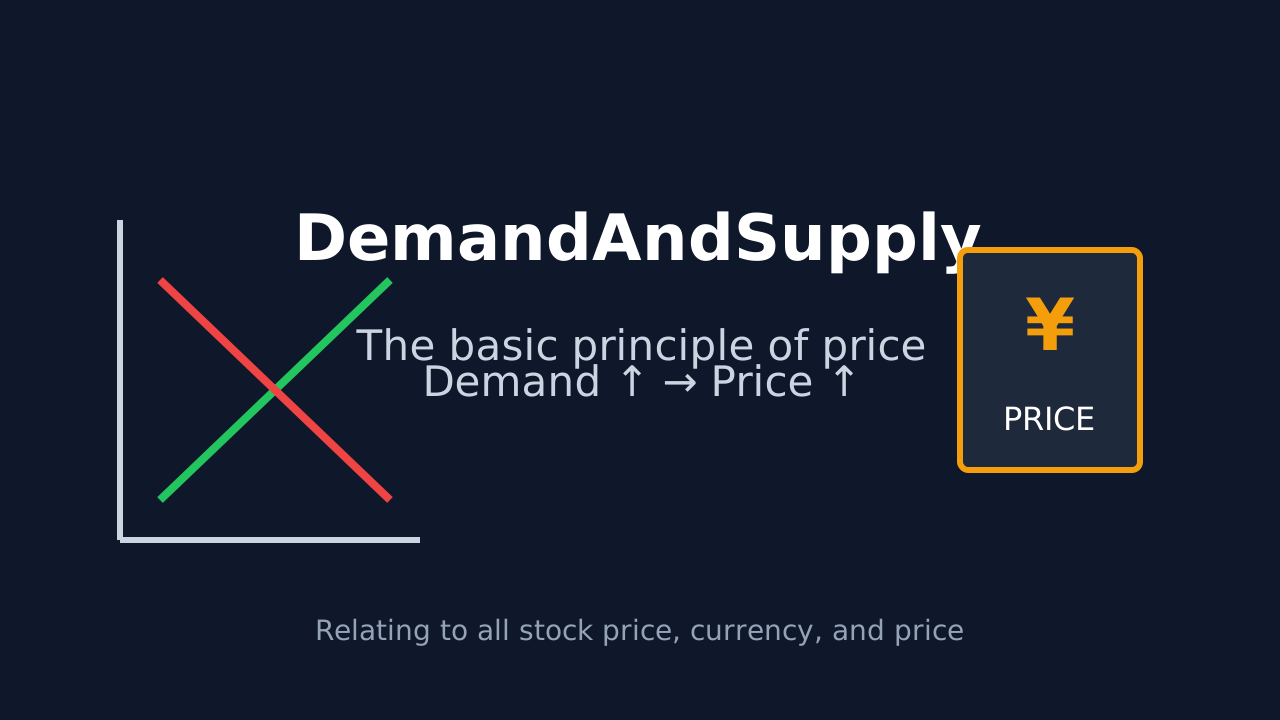
What is the total demand?
Total demand is the general economic demand.
English is called Ag。ate Demand.
Foods that individuals buy at supermarkets, machinery that companies put in factories, public constructions conducted by governments, and export demand from overseas are also part of total demand in a broad sense.
If you see only the household, it is "consumption", but if you look at the whole country, the demand is divided into several.
So the total demand will be the basis when looking at the strength of the economy.
Basic formula for total demand
Total demand is often expressed in the following formula:
AD = C + I + G + (X - M)Each meaning is as follows:
| Signs | 内容 | Example |
|---|---|---|
C | Individual consumption | Food, Food, Consumer Electronics, Travel |
I | Corporate investment | Factory, Machinery, IT Investment |
G | Government Exp s | Public works, administrative services, subsidies |
X - M | Export | Import from export |
It is simple to say that it is a bit hard to see only expressions.
If someone uses money, it will be someone’s sales.
It is a demand for the whole country.
Individual consumption (C)
Individual consumption accounts for a large part of total demand.
For example, the following enditure:
- Food
- Home
- Food
- Travel
- Clothing
- サブスク
If the salary increases or the is stable, the person becomes easy to use.
On the contrary, if you are worried about the future, the string of the wallet will become solid even if you have income.
This is a place close to the real sense.
Even in the same monthly income, the consumption behavior changes considerably, whether it seems to be stable in the future, or whether it is anxious next year.
Corporate Investment (I)
Corporate investment is the money that companies use for future sales and efficiency.
For example:
- Factory construction
- Machine introduction
- Shop Renovation
- System investment
- 研究開発
Businesses make it easier to increase investments if you are confident in the future.
On the other hand, in situations where demand is weak, interest rate is high, and foreign economic uncertainty, investment tends to be forward.
Corporate investments may move forward.
"It is hard now, but the demand will be back after next term."
So investment-related indicators are quite useful in looking at economics.
Government Exp s (G)
Government enditure is a part where governments and governments spend money.
Examples include:
- Infrastructure Development
- Public Works
- Medical and Education
- Disaster Prevention
- Subsidy
- Payment
In the event of a bad economic situation, there is a possibility that the demand is not enough only for the private sector.
When the government increases the政府enditure, the total demand can be lowered.
However, government spending is not free.
Issues of financial resources, national bonds and future burdens.
Short-term economics, but long-term financial見s are also seen.
Net Export (X - M)
Pure exports are imported from exports.
Net Export = Export - ImportWhen export is increased, demand for overseas to domestic companies is increased.
For example, automotive, semiconductor equipment, parts, food, tourism services, etc.
On the other hand, when importing increases, domestic money goes to overseas products and services.
It is easy to catch up with export companies when it comes to yen, but it can also overwhelm household and corporate costs by increasing import price.
Net export is an easy-to-understand part of foreign exchange and overseas economics.
Why is total demand important?
The sales of the company will not be affected if there is no demand.
When the total demand rises, the following flows are prone to occur:
Increased demand
↓
Increased corporate sales
↓
More
↓
Increased
↓
Income increase
↓
Increased consumption
This cycle is easy to rotate when the viewer is good.
On the other hand, if the total demand is weak, the company will remove inventory, refrain from investing, and be careful with.
The temperature of the scenery changes here.
Total demand and economic relationship
When the total demand is increased, the economy becomes easier to expand.
Inc ing corporate sales and increasing profits leads to and hiring.
In the stock market, the strength of total demand is assumption of corporate profit.
On the other hand, if the total demand is decreased, the economy is weak.
When consumption falls, corporate investment increases, and 雇用 worsens, consumption may decrease.
This reverse rotation is scary in the recession side.
Relationship with Inflation
The total demand increases itself.
However, too strong demand may cause inflation.
For example:
- Many people want
- No supply
- Wage rises due to labor shortage
- Increased raw materials and logistics costs
In this case, the company becomes easier to value.
Sales increase due to strong demand.
But the price is also rising.
This is a difficult place.
The central bank increases interest rate because it cools too strong demand.
Important Reasons for Investment
In investment, changes in total demand reflect corporate performance and stock price.
A common indicator is:
| 指標 | Reasons to See |
|---|---|
| GDP | Check the growth of the entire economy |
| Individual consumption | Check household demand |
| RECRUIT | See the foundation of income and consumption |
| Investment | See future expectations of companies |
| Tag | See how to cool or support demand |
For example, if personal consumption is strong, it will be windy for retail, food, travel, home appliances, etc.
With strong corporate investment, machinery, construction, IT, and semiconductors are easy to move.
However, if demand is too strong and leads to an increase in interest rate, the stock market may be inverted.
Total demand is good news and bad news.
Why governments increase政府endがres at depression
In the event of a recession, private demand becomes weak.
Household keep consumption and industry stop investment.
If you leave this condition, it is easy to lose sales, increase 。, and decrease consumption.
Therefore, the government aims to improve total demand in the following policies:
- Financial Exp s
- Tax reduction
- Payment
- Subsidy
- Public investment
The purpose is to make economic activity fall easier.
However, the effect of the policy depends on how it is used.
Does it end with temporary consumption or lead to future productivity?
This is quite different.
Easy to misunderstand for beginners
| misunderstanding | In fact |
|---|---|
| You can see only stock price | Need to see consumption, and investment |
| You can see only consumption | Total demand for corporate investment and government spending |
| More demand is always good | Overheating leads to inflation and interest |
| Government spend is always correct | Quality of financial resources and effects |
Total demand is not just a “more” story.
If it is too weak, it will be a depression.
If it is too strong, it becomes inflation.
How strong is demand for economic supply?
Practice
When you look at the news, you can easily understand the following order.
- Does the household use money
- Are companies increasing investments? Are governments increasing end res?
- Is export stretched? How does the price and interest rate react?
If you look at the 5 above, you will see a little “whether the current spect。 is moving in demand, or are you suffering from lack of supply.”
Even if you invest, it is better not to end with "good economics".
There are differences between industries with strong demand and industries that are suffering from increased costs.
Total demand is a way of thinking that represents the country’s demand.
Main components are personal consumption, corporate investment, government、enditure and net export.
As the total demand increases, the economy becomes stronger and it is easy to add to corporate performance.
However, if demand is too strong, it leads to inflation and gain.
If you are investing, you want to see not only the total demand itself, but also how the demand is strong, and how the price and interest rate are moving.
First, when you see economic news,
Is the demand strong or weak?If you have a habit of thinking, the understanding of the economy will be quite easy.