
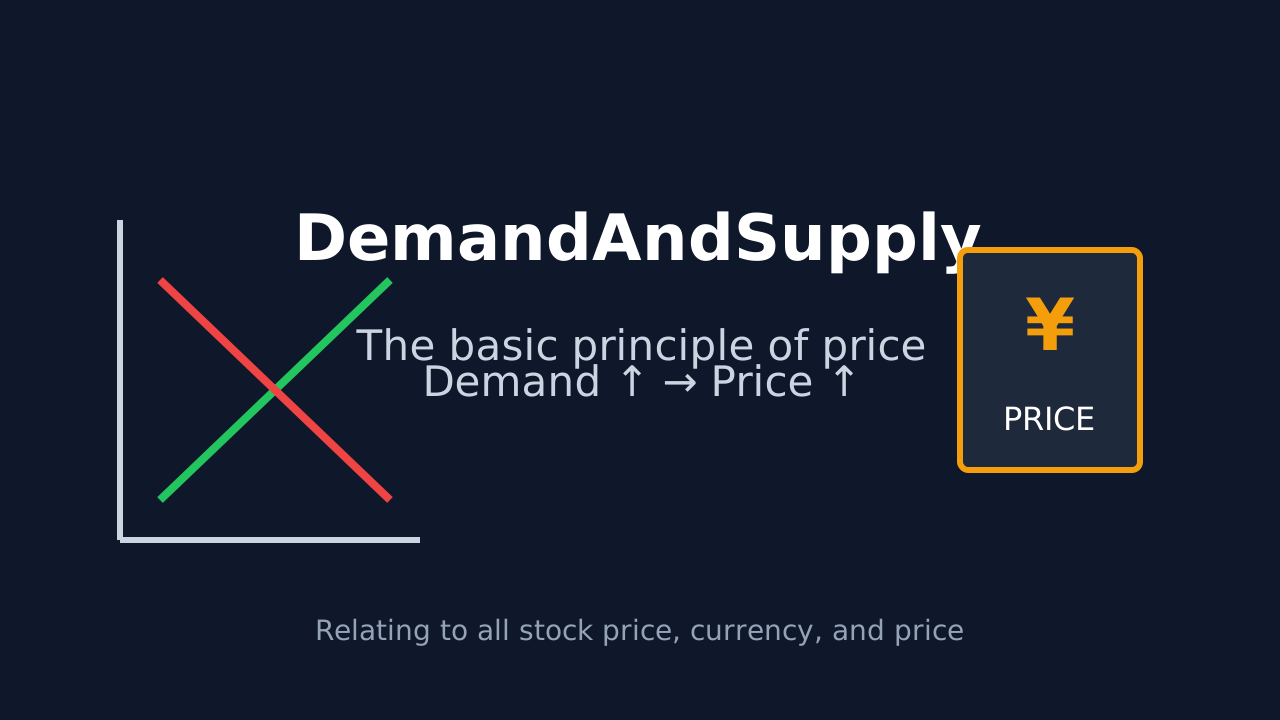
What is the demand curve?
Demand curve is a graph of the amount you want to buy per price.
Set the price on the vertical axis and the demand amount on the horizontal axis.
| 軸 | 意味 |
|---|---|
| Price | |
| 横軸 | 需要量 |
For example, if the price of the onigiri is 300 yen, it may be less.
If you buy 150 yen, you will be charged.
If it is 80 yen, you may buy more people.
In this way, it is a demand curve that connects "how much do you buy" by price.
Why right down
The demand curve may be lower right, because the price is cheaper, the more people you want to buy.
It is easy to understand if you think with the onigiri.
| Price | Quantity of Buyers |
|---|---|
| ¥300(税別) | Less |
| JPY150 | Close |
| 80g max | More |
If the price is lower, it will be easier for people who have not bought it before.
On the other hand, if the price rises, the number of people think that it is not the price.
This is the basis of the demand curve.
Demand Law
The Demand Law is the idea that if the other conditions are the same, the amount of demand increases when the price falls, and the amount of demand decreases when the price rises.
This is the part of "If other conditions are the same".
In the real market, there are many other factors in addition to the price.
- Popular
- Home
- Season
- Population
- Products
- News
- Substitute
So, when reading the demand curve, it is necessary to think about not only the price but also the other factors.
Move curves and move curves themselves
It is easy to get the best in the demand curve.
Is the price changed?
Or did you change the feelings of the buyer?
I think these two are separate.
1. Moving on curve
The movement on the curve is when the price changes only.
For example, it is assumed that the nigiri is reduced from 150 yen to 100 yen at the supermarket.
In this case, the number of buyers increases because it is cheaper.
The demand curve itself does not change.
It is an image that the price is low on the same curve.
Example
- Price reduced on sale
- Reduce the number of buyers
- More purchases at limited time
If the price is caused, the basic movement is on the curve.
2. Move the curve itself
The movement of the curve itself is when the demand changes due to reasons other than the price.
For example, even with the same 150 yen onigiri, the number of people who want to buy is likely to increase if the products that became popular on TV.
In this case, even the price is the same, the demand is increased.
This is the state where the demand curve itself moved to the right.
Example to move right
- Popularity
- Increased income
- More Population
- Seasonal demand increased
- Substitute increases
- SNS
Example to move left
- Popularity falls
- 景気が悪くなる
- Population decrease
- Less replacement
- Bad Reviews Spread
- Need falls
If you understand this, you can see the news.
“I sold it because it was lowered.”
“I sold the same price as the popularity has come out.”
This difference is quite large.
Examples in daily life
Super discount
When the side dish is lowered before closing, the number of buyers increases.
This is the movement on the curve due to the price drop.
However, if there are few customers on rainy days, it is said that the demand itself is weak due to reasons other than the price.
Old model of smartphone
When the new smartphone is released, the old model will be lowered.
If the price is lower, you can see the old model.
On the other hand, when more people want the latest model, the demand curve for the old model may move left.
Hotel Rates
Even if the hotel is busy, reservations are accepted.
This is a condition where the travel demand itself is strong and the demand curve is moving right.
It is the opposite season. Even if the price is lowered, the room may not be buried.
How to invest
In the stock market, you can use the idea of the demand curve.
The stock price動き of people who want to sell.
When stock price rises
- Increased performance expectations
- Increased sales and stock purchases will be announced
- Popular as a theme strain
- Buying foreign investors
- Less people want to sell
In this way, more people want to buy at the same price.
It is an image that the demand curve動く right.
When stock price falls
- Unexpected financial results
- The spect increases
- Interest rate rises
- Inc ing profit settlement
- Heavy credit residue
In this case, the number of people who want to buy is reduced.
The stock price is easy to down.
It’s important to see the price.
"What is the reason why people want to buy this stock?"
“Is that demand temporary or continued?”
See here
Points to note when looking at the demand curve
The demand curve is convenient, but it does not completely describe the real market.
There are three things to note.
1. Many other factors
The price does not move.
Trends, income, reviews, seasons, interest rates, exchanges, and regulations
2. It is not possible to sell if it is low
Even if it is cheap, it is not possible to sell the products you want.
Even if stock disposal items are largely discounted, it may be sold.
In addition to the price, it is necessary to see whether there is a demand for the product itself.
3. There are products that can be sold even if it is high
Brands, popular tickets, rare real estate, strong corporate products may be sold even if they are high.
This is because the demand is strong.
It is not possible to sell because it is high.
Easy to misunderstand for beginners
| misunderstanding | In fact |
|---|---|
| Demand is determined by the need | You also need the power to buy and pay |
| If it is cheap, you can always sell | It is difficult to sell if there is no demand in the product itself |
| Popular products are cheaper | Can be sold even if demand is strong |
| Demand is determined by price | It also affects income, trends, seasons and alternatives |
| Share price only works with corporate value | Also affects supply and demand and market requirements |
Demand does not mean "necessary".
There is a feeling that you want to buy and the money that you can actually buy. Both are related.
Demand Curves are graphs that represent the relationship between price and demand.
The following points are:
- Vertical axis is price, horizontal axis is demand
- Right down
- It is easy to understand if you want to buy when the price drops
- If price changes only, move on curve
- If the price is other than the price, the curve itself動く
- Find out why people want to buy shares in investment
First of all, think about this when the price changes.
"Is it bought by price reduction?"
“Is the popularity itself changed?”
The demand curve is quite easy to use, just by separating this two.