
This article is general investment educational content and does not recommend the purchase or sale of specific financial products or foreign exchange transactions. Assets denominated in foreign currencies are subject to price fluctuation risk, exchange rate fluctuation risk, fees, and tax considerations.
What is exchange rate?
An exchange rate is the price at which one currency is exchanged for another currency.
For Japanese yen and US dollar, the following is a common display.
1ドル = 150円This means that it takes 150 yen to buy 1 dollar.
For example, if you want to buy 100 dollars when 1 dollar = 100 yen, you need 10,000 yen.
100ドル × 100円 = 10,000円After that, when 1 dollar = 150 yen, the same 100 dollars converted to yen becomes 15,000 yen.
100ドル × 150円 = 15,000円Even if the quantity of dollars remains at $100, the value of the asset in yen will change. This is the basis of exchange rates, and is something that is often overlooked when investing overseas.
Yen appreciation and yen depreciation
Yen appreciation and yen depreciation are words that express whether the value of the yen has increased or decreased relative to foreign currencies.
The Bank of Japan also explains that the yen is stronger when the dollar becomes 80 yen compared to when the dollar was 100 yen, because more dollars can be bought with the same 10,000 yen.
When looking at dollar yen, the direction of the numbers tends to be a little counter-intuitive.
| Exchange rate changes | Status | Meaning |
|---|---|---|
| 1 dollar = 150 yen to 130 yen | Strong yen | You can buy 1 dollar with less yen |
| 1 dollar = 130 yen to 150 yen | Weak yen | It takes a lot of yen to buy 1 dollar |
In other words, it is easy to understand that when it comes to dollar-yen, `the smaller the number, the stronger the yen'' and `the larger the number, the weaker the yen.''
Advantages and disadvantages of strong yen
A strong yen is a condition in which the value of the yen increases relative to foreign currencies.
For example, when 1 dollar = 150 yen to 130 yen, fewer yen are needed to buy the same dollar.
The main effects of the strong yen are as follows.
| Perspective | Impact of strong yen |
|---|---|
| Imported goods | Easily cheaper |
| Traveling abroad | Easy to buy local currency |
| Foreign currency assets | The yen equivalent amount tends to decrease |
| Export companies | Potential headwinds for sales and profits when converted into yen |
| Long-term savings | You can also buy overseas assets cheaply in yen |
The appreciation of the yen is likely to be seen as negative for people who already own overseas assets. On the other hand, for people who are planning to accumulate US stocks or global stocks, it is possible to buy many foreign currency assets with the same yen.
Therefore, it is better not to simply label the strong yen as ``bad.''
Advantages and disadvantages of weak yen
A weak yen is a condition in which the value of the yen falls relative to foreign currencies.
For example, when 1 dollar = 130 yen to 150 yen, the amount of yen required to buy 1 dollar increases.
The main effects of the weaker yen are as follows.
| Perspective | Impact of weak yen |
|---|---|
| Imported goods | Can be expensive |
| Overseas travel | Expenses tend to increase |
| Foreign currency assets | Yen conversion amount tends to increase |
| Exporting companies | Easily a tailwind for sales and profits in yen terms |
| Household budget | Import costs for food, energy, etc. tend to be heavy |
A weaker yen can be seen as a positive for people who hold US stocks or foreign currency deposits. However, imports and energy prices tend to put a strain on household budgets.
In other words, whether a weak yen is good or bad differs from person to person.
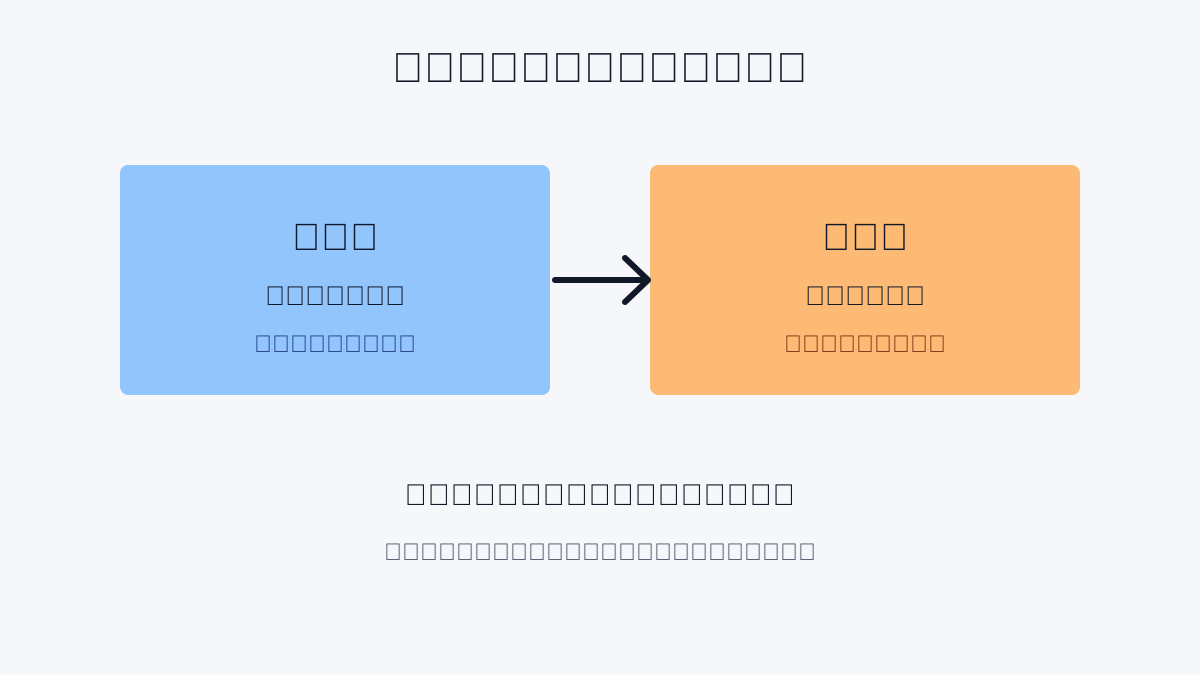
Illustration: Exchange ratio of USD and JPY
Exchange rates also affect returns when investing
When investing overseas, price fluctuations of the investment target and exchange rate fluctuations come into play at the same time.
For example, when investing in US stocks, the return in yen terms is roughly determined by the following two factors.
円換算リターン ≒ 米国株の値動き + 為替の影響Even if U.S. stocks rise by 10%, if the yen appreciates significantly during the same period, profits in yen terms may be smaller.
| US stock price movements | Currency movements | How it looks when converted to yen |
|---|---|---|
| +10% | Weak yen | Easy to add profits |
| +10% | Strong yen | Profits are likely to be cut |
| 0% | Weak yen | It may increase when converted into yen |
| 0% | Strong yen | It may decrease when converted into yen |
| -10% | Strong yen | Losses can easily appear large |
People who buy global stocks and S&P 500 investment trusts actually have a significant portion of foreign currency assets. The background to the movement of standard prices is not only stock prices but also foreign exchange rates.
What is currency hedging?
Currency hedging is a mechanism to reduce the impact of currency fluctuations.
Investment trusts and ETFs may be displayed as `currency hedged'' or `no currency hedged.''
| Type | Features | Notes |
|---|---|---|
| With currency hedging | Easily suppresses the effects of yen appreciation and yen depreciation | Hedging costs are high |
| No currency hedging | Easy to benefit from a weak yen | Easy to reduce the yen equivalent amount when the yen is strong |
Currency hedging is used when you want to keep the price movements of foreign currency assets as close to the local currency base as possible. However, hedging costs are incurred due to interest rate differences, etc.
Not having currency hedges is similar to holding foreign currency assets as is. If the yen is weak, the yen equivalent amount tends to increase, but if the yen is strong, it tends to decrease.
Neither one is always correct. Consider the investment period, purpose, and balance with yen assets.
Why exchange rates move
Exchange rates are driven by supply and demand for currencies.
The main factors are as follows.
| Factors | Impact on exchange rates |
|---|---|
| Interest rate difference | Funds tend to go toward currencies with higher interest rates |
| Economy | Currencies of countries with strong economies are more likely to be bought |
| Prices/Inflation | Differences in price increase rates affect currency values |
| Trade/Current Account | Exports, imports, and capital flows are related to currency demand |
| Politics/Geopolitics | Moved by elections, conflicts, sanctions, and policy instability |
| Central bank policy | Expected interest rate hikes/cuts, monetary easing, and foreign exchange intervention |
However, short-term foreign exchange forecasts are extremely difficult.
There are periods when it can be explained only by interest rate differences, and other times when it is driven by risk aversion, the stock market, resource prices, and political events. For beginners, it is more realistic to think about `what will happen to the entire asset if the exchange rate is wrong'' rather than `guess the exchange rate''.
Points that beginners tend to misunderstand
Common misconceptions about exchange rates are:
| Misconception | Actual |
|---|---|
| A weak yen is always good | Although it is positive for foreign currency assets, it can be a burden on imported goods and household budgets |
| A strong yen is always bad | The valuation of foreign currency assets tends to decrease, but it makes it easier to buy overseas assets |
| All you have to do is look at US stocks | Exchange rates also have an effect on yen conversion returns |
| Exchange rates are easy to predict | Short-term forecasts are quite difficult |
| Free and safe with hedging | Hedging costs apply and the impact cannot be completely eliminated |
Exchange fees are also important, especially for foreign currency deposits and bonds denominated in foreign currencies. The Japanese Bankers Association describes the rate at which yen is converted into foreign currency as TTS, and the rate at which foreign currency is converted into yen is TTB. For foreign currency products, profits and losses are affected not only by exchange rate fluctuations but also by the difference in buying and selling rates.
Checklist before investment
Before buying overseas assets, you should check at least these five things.
- How much will the yen equivalent amount decrease when the yen appreciates?
- With or without currency hedging
- What are the exchange fees and spreads?
- Do you plan to use the foreign currency as is or change it back to yen?
- Is the ratio of yen assets to foreign currency assets too biased?
Currency exchange is something to deal with rather than something to guess at.
When it comes to long-term investing, it is easier to maintain a plan that allows you to absorb exchange rate fluctuations through accumulation, diversification, and asset allocation, rather than relying on the yen to appreciate or depreciate every time.
summary
An exchange rate is the price at which currencies are exchanged.
The points to keep in mind are as follows.
- Exchange rate is the exchange ratio of different currencies
- In dollar-yen terms, the smaller the number, the stronger the yen, and the larger the number, the weaker the yen.
- When investing overseas, returns are affected not only by stock and bond prices but also by foreign exchange rates.
- Currency hedging makes it easier to reduce the impact of foreign exchange, but it is costly
- Without currency hedging, you will have the benefit of a weaker yen and the risk of a stronger yen.
- It is more important to think about asset allocation in the event of a deviation than short-term predictions of foreign exchange rates.
Beginners should first understand the difference between a strong yen and a weak yen, the conversion of overseas assets into yen, and the presence or absence of currency hedging.
Knowing exchange rates can significantly change the way you view U.S. stocks, global stocks, foreign currency deposits, and foreign currency-denominated bonds. I want to get into the habit of checking not only the investment target itself, but also the price movement in terms of yen.