
What is interest payment deferral?
Interest payment deferral is a clause that allows an issuer to defer the originally scheduled interest payment to a later date based on the contract.
The following products are commonly seen:
| Products | Why interest payment deferral is likely to be a problem |
|---|---|
| Subordinated bonds/subordinated corporate bonds | They have a lower payment priority than straight corporate bonds and are designed to have equity characteristics |
| Hybrid corporate bonds | They have characteristics intermediate between debt and equity, and the issuer may have the discretion to defer interest payments |
| AT1 bonds | Related to banks' capital regulations, they may have provisions for interest payment suspension or principal reduction |
| Subordinated equity loan | Although it is a loan, it may be treated like equity |
For ordinary corporate bonds, not paying interest on the interest payment date is a serious problem. However, for bonds with interest payment deferral clauses, payments may be deferred in accordance with the terms of the bond.
This is quite difficult for beginners to understand.
When we hear that ``interest will not be paid,'' we immediately think of default. However, if there is an interest payment deferral clause, the interest payment may be postponed as a contractual rule. While this is an adverse event for investors, it does not necessarily mean that it will be treated as a legal default at that point.
Why is there a mechanism to defer interest payments?
Interest payment deferrals are often designed to protect the issuer's finances.
Financial institutions in particular use equity instruments such as subordinated bonds and AT1 bonds to increase the appearance of their capital or to reduce capital outflows in times of crisis. If you continue to pay interest when your finances are in bad shape, your capital will further decrease. Therefore, a mechanism is introduced that allows interest payments to be stopped or postponed under certain conditions.
For the issuer, it provides a financial cushion.
For investors, there is a risk that they will not receive interest as planned.
Even though the mechanism is the same, the meaning changes depending on the perspective from which you look at it. If this is confused, it is easy to misunderstand the product's characteristics by looking only at the high yield.
Interest deferral is not the same as default, but it hurts investors
The point of interest deferral is that it may not be the same as default.
However, it is not painless for investors.
| Item | Ordinary corporate bonds | Bonds with interest payment deferral |
|---|---|---|
| Interest payment | Payment is basically on the payment date | It may be postponed based on the contract |
| Handling of non-payment | Can result in default | If the terms are met, it may not be treated as default |
| Impact on investors | Interest income stops | Interest income stops and prices are likely to fall |
| Documents to check | Prospectus, bond details | Interest payment deferral clause, cumulative/non-cumulative, triggering conditions |
When interest payments are actually deferred, the market becomes extremely cautious. I wonder if the issuer's capital is weak, if its rating will be lowered, and if the principal amount will be affected. Those suspicions suddenly become stronger.
Therefore, when interest payments are postponed, bond prices tend to fall. This affects not only interest income but also the mid-term sale price. It is best not to take this lightly and think that the interest is only slightly delayed.
Difference between cumulative and non-cumulative types
The most important thing about interest payment deferral is whether the deferred interest will be paid in the future or whether it will disappear.
Here, it is divided into cumulative type and non-cumulative type.
| Type | Structure | Impact on investors |
|---|---|---|
| Cumulative | Deferred interest is paid in the future | Payments are delayed but may be received at a later date |
| Non-cumulative | Deferred interest expires | You may not receive interest for the period |
With a cumulative loan, interest not paid this year may be paid in a lump sum later.
With non-cumulative loans, interest is not paid for the period and may not be recoverable in the future. A non-cumulative design can be seen in AT1 bonds, etc.
This difference is huge.
Even though the term ``interest payment deferral'' is written in the same terms, investors' sense of loss is quite different depending on whether it is cumulative or non-cumulative. Be sure to check this in the prospectus and bond guidelines.
Situations where interest payment deferral is likely to be triggered
Although the actual conditions differ depending on the product, interest payment deferrals tend to become a problem when there are concerns about the issuer's finances or capital.
For example, in the following situation:
| Scene | Why it matters |
|---|---|
| Deterioration of the issuer's performance | Sustainability to continue interest payments is questionable |
| Decline in capital adequacy ratio | Financial institutions are susceptible to capital regulations |
| Suspension of dividend | Financial situation appears to be severe enough to stop shareholder returns |
| Responding to authorities' orders and regulations | Prioritizing financial institutions' capital maintenance |
| Rating downgrade | Credit risk increases and bond prices tend to fall |
Please note that these conditions are not the same for all products. In some cases, issuers can voluntarily defer interest payments, and in others, they are required to defer interest payments if certain conditions are met.
That's why you shouldn't judge based on the product name alone.
If it says "with interest payment deferral clause," you need to read under what conditions, under whose judgment, which interest will be deferred, and for how long.
There is a reason for high yields.
Subordinated bonds with interest payment deferral provisions may appear to have higher interest rates than straight corporate bonds.
For example, suppose that the same issuer has the following differences:
| Product | Image of annual interest rate | Main reasons |
|---|---|---|
| Straight corporate bonds | 1.0% | Relatively high payment priority and simple product characteristics |
| Subordinated bonds | 3.0-5.0% | Subordination risk, interest payment deferral risk, long maturity, liquidity risk |
This difference is not a "good deal." It is compensation for the additional risk assumed by the investor.
Interest payment deferral is particularly easy to overlook for those who buy bonds for income purposes. Even though you bought it with the expectation of annual interest income, there is a possibility that the interest will stop. Furthermore, bond prices may have fallen by that time.
When looking at high yields, the first thing to think about is this.
Why is this yield necessary?
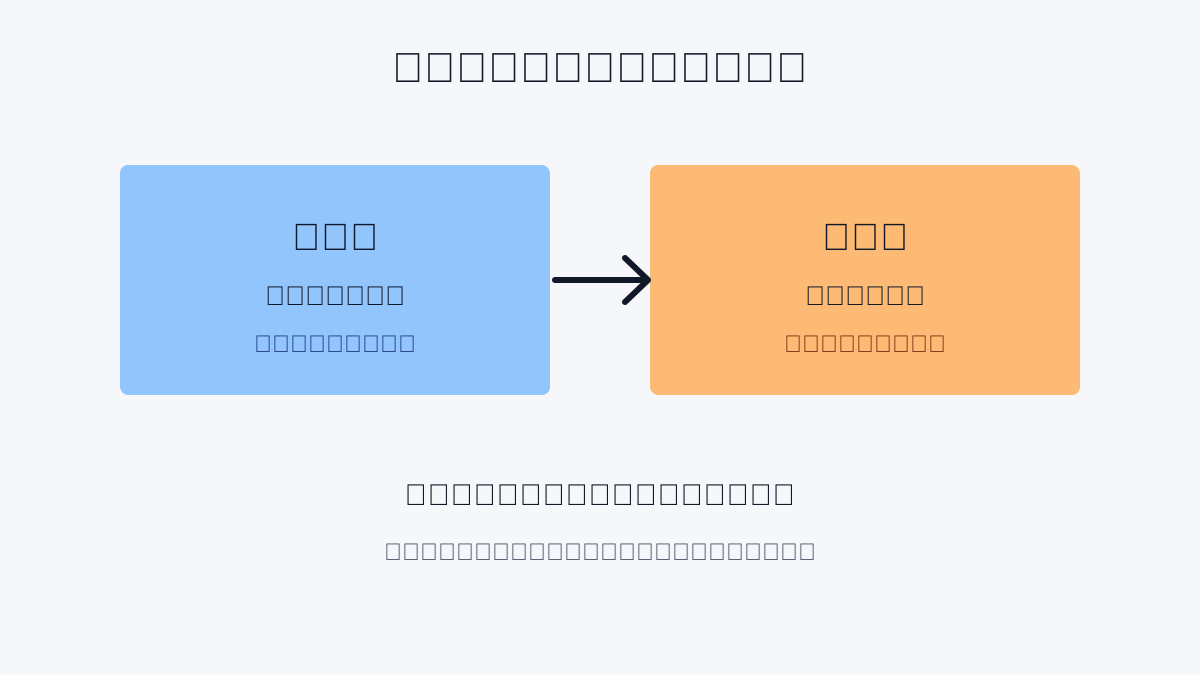
Illustration: Image of interest payment being deferred
What happens to investors when interest payment deferral occurs?
From an investor's perspective, the impact of interest payment deferral is not just on interest payments.
| Item | Effects that are likely to occur |
|---|---|
| Interest income | Decrease/stop |
| Bond prices | likely to fall due to credit instability |
| Mid-term sale | There are fewer buyers and the price is likely to be disadvantageous |
| Issuer evaluation | Ratings and market evaluations are likely to deteriorate |
| Principal risk | Interest payment suspension may lead to principal instability |
Interest payment deferral is not just an administrative postponement. It is easy for the market to interpret this as a sign that the issuer's finances have received a yellow flag.
Of course, not all interest payment deferrals mean bankruptcy. Still, it's dangerous to think of products that don't pay interest on schedule as regular regular income.
Points that beginners tend to overlook
There are three things that beginners tend to overlook when it comes to interest payment deferral:
| Misconception | Actual perspective |
|---|---|
| There is no problem if it is not a default | Interest income may stop and prices may fall |
| High yield is advantageous | High yield is compensation for interest payment deferral, subordination, and credit risk |
| No worries if it's a large company or bank | Even if the issuer is famous, the terms may be disadvantageous to investors |
In particular, it is dangerous to feel secure just based on the name of a bank or large company. In some cases, equity instruments issued by financial institutions are designed to allow investors to absorb losses in times of crisis.
`What kind of clauses are included'' is just as important as `who is issuing the document?''
Checklist to check before purchasing
When considering bonds with interest payment deferral clauses, you should at least check the following points:
- Is there an interest payment deferral clause?
- Will it be deferred at the issuer's discretion or will it be triggered under certain conditions?
- Is deferred interest cumulative or non-cumulative?
- What are the conditions under which an interest payment deferral will not be treated as a default?
- If there is an early redemption clause, is redemption the right of the issuer?
- Have you checked the issuer's rating, capital adequacy ratio, and financial condition?
- Can you accept the possibility that the price will drop significantly when selling mid-way?
- Are you investing your living funds or money that will be used soon?
If you feel bothered by reading this check, it may be too early to buy that product.
Bonds with interest payment deferral clauses are not products that are judged solely on yield. This is a product that requires you to read the terms and conditions.
summary
Interest payment deferral is a mechanism by which an issuer can contractually defer interest payments to a later date.
The points to keep in mind are as follows.
- Interest payment deferral is a postponement based on the contract and does not necessarily mean an immediate default. *However, investors may not receive interest as scheduled.
- The impact on investors is significantly different between cumulative and non-cumulative types.
- Particular attention should be paid to subordinated bonds, AT1 bonds, and hybrid corporate bonds.
- High yield is compensation for interest payment deferral, subordination, credit and liquidity risks
What's important when investing in bonds is not just looking at the yield numbers.
The key is to read how the yield represents the return on risk. The interest payment deferral clause is one of the first things to look at when checking.
Related articles
- What is a subordinated bond? Repayment order and risks behind high yield
- What is a subordination clause? Easy-to-understand explanation of contract clauses that postpone repayment order
source
- [Japan Securities Dealers Association "How to obtain information on characteristics, risks, and prices of corporate bonds for individuals"] (https://www.jsda.or.jp/about/hatten/risk/shasai/index.html)
- J-FLEC / Investment time "Subordinated bonds"
- SMBC Nikko Securities "Subordinated Bonds"
- Nomura Securities “Subordinated Bonds”