

What is margin buying balance?
Margin buying margin is the balance that an investor has borrowed from a securities company to buy stocks and has not yet repaid by selling or cashing back.
For example, for a certain brand,
- Buy on margin in hopes of stock price rise *Still held without payment
- More investors like you
In such a situation, the margin of credit purchases will increase.
At first glance, it looks like a ``popular stock that many people want to buy,'' but any remaining purchases will be repaid at some point in the future. In many cases, stocks are sold on the market as repayments, so if a large amount of unpurchased stock accumulates, it will be perceived as future selling pressure.
What is credit unsold?
Margin sales are the balance that investors have borrowed and sold short stocks and have not yet bought them back.
Short selling is
- Expect stock price to fall
- Hedging the risk of decline in stock holdings
- Aiming to worsen short-term supply and demand
It is used for such purposes.
Stocks with a large amount of unsold stock appear to have an increasing bearish outlook. On the other hand, short sellers will eventually need to be bought back, so if the stock price rises, there may be sudden demand for buybacks.
This can lead to what is called a bull run or short squeeze.
Illustration: How to view unbought and unsold items
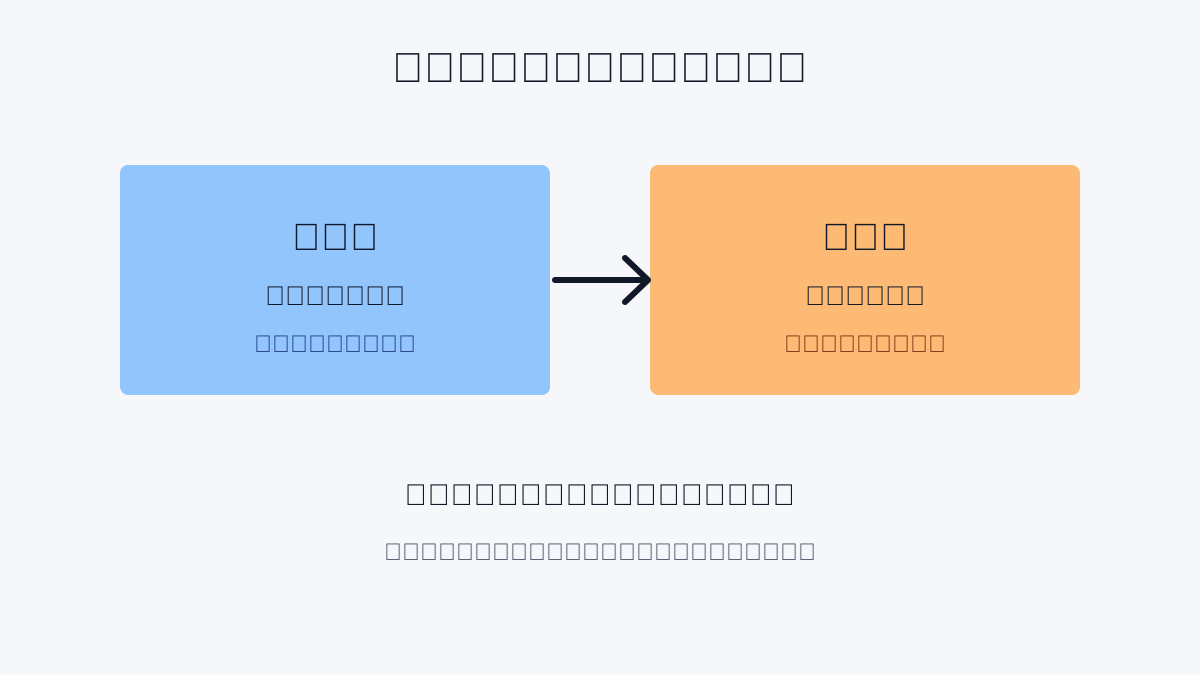
Basic reading of unbought and unsold terms
| Condition | General view | Notes |
|---|---|---|
| Increase in outstanding purchases | Bullish margin purchases are increasing | Possibility of future repayment sales increasing |
| Too much unbought stock | Expectations for upside are biased | Top price may be heavy |
| Unsold stock increases | Bearish and hedge selling is increasing | Buybacks are likely to occur due to favorable news |
| Too much unsold stock | Short sales are accumulating | Rising may occur |
Both unbought and unsold items cannot be judged simply as "good because there are a lot" or "bad because there are few."
The important thing is to look at which way the current supply and demand is biased, along with the stock price position, trading volume, materials, and financial results.
What is credit multiplier?
The credit multiple is an indicator of margin buying balance divided by margin selling balance.
信用倍率 = 信用買い残 ÷ 信用売り残for example,
- Margin buying balance: 1 million shares
- Unsold margin: 200,000 shares
If so,
100万株 ÷ 20万株 = 5倍It becomes.
The higher the credit ratio, the more unsold versus unsold. Conversely, the lower the credit ratio, the greater the proportion of unsold stock.
Approximate credit ratio
| Credit multiplier | General view |
|---|---|
| Approximately 1x | Unbought and unsold balance is roughly balanced |
| Less than 1x | Large proportion of unsold items |
| 3 to 5 times | Slightly more leftover purchase |
| More than 10 times | Quite a lot of stock left |
However, this guideline is not absolute.
The level of the credit multiple varies greatly depending on the popularity of the stock, whether it is a loan stock, the stock price position, the degree of individual investor participation, and the industry. Even if the price is 5x, the meaning changes depending on whether it is in the middle of an uptrend or if only margin buying remains after a sharp decline.
Pay attention to the difference with the loan/borrow ratio
On securities sites, loan to debt ratios may be displayed in addition to credit ratios.
Both are used as indicators to measure supply and demand, but the aggregation targets and definitions may differ depending on the data provider.
When you look at
- Is it the unbought/unsold balance of all margin trading?
- Are the numbers related to institutional credit or loan transactions?
- Is it weekly data or daily data?
Let's check.
Even if numbers have similar names, they do not necessarily have the same meaning.
Why is credit balance important?
1. Understand imbalances in supply and demand
Even if a company's performance is good, stock prices may fluctuate in the short term due to supply and demand.
For stocks with a large amount of unbought stock, profit taking and repayment selling are more likely to occur during a rising phase. Stocks with a large amount of unsold stock are more likely to be repurchased when the stock price rises.
2. Can imagine future buying and selling pressures
Credit transactions must be repaid at some point.
Therefore,
- Unbought: Future selling candidates
- Unsold: Future repurchase candidates
It is seen as.
Of course, not everything will be settled at once. Still, by looking at the bias in credit balances, it becomes easier to imagine how stock prices will move in response to these factors.
3. You can check the overheating of short-term trading
Stocks with a sharp increase in margin purchases may be attracting short-term funds.
On the other hand, if a large amount of unbought stock remains after a rise, this may lead to a backsell after the stock is exhausted.
For long-term investors, this will also be helpful when considering when to buy, and whether short-term positions are becoming too heavy.
Misconceptions that beginners often fall into
Misconception 1: The more unbought stocks there are, the more popular the stock is, so you can rest assured.
A large amount of outstanding purchases may indicate that there are many bullish investors.
However, the remaining purchases are also candidates for future repayment sales. When stock prices fall, the decline may become larger due to a combination of loss cutting and selling to avoid margin calls.
Myth 2: Stocks with a large amount of unsold stock are dangerous
A large amount of unsold stock means that there are many bearish investors.
However, when good news emerges and the stock price rises, short sellers may be forced to buy back the stock to avoid further losses. Stocks with a large amount of unsold stock may react strongly not only to bad news but also to good news.
Misconception 3: Making buying and selling decisions based solely on credit multiples
Credit multipliers are useful, but they are not a panacea.
In investment decisions,
- Achievements
- Finance
- Valuation
- Stock price chart
- Volume
- News and financial results
You need to check both.
Credit balance analysis is not the main role, but a supporting role in determining supply and demand.
summary
The margin buying balance and margin selling balance are supply and demand indicators that indicate the balance of unsettled margin trading positions.
There are three points to look at:
- Large margin buying balance: likely to cause future selling pressure
- Large amount of unsold credit: likely to lead to future repurchase demand
- Credit ratio: Check the balance between unsold and unsold items.
For beginners,
Performance analysis plays a leading role, credit balance analysis plays a supporting role
If you use it in this position, you will have a deeper understanding of the market.
source
This article was created with reference to the following public and official information regarding margin transaction balances and margin transaction mechanisms.
- Japan Exchange Group “Margin Trading Balance”
- Japan Exchange Group “Purpose and structure of margin trading”
- Organization for the Promotion of Financial and Economic Education / Japan Securities Dealers Association "Outstanding margin purchases"
- Confirmation date: 2026-06-06