

What is a subordinated loan?
A subordinated loan is a loan that has a lower repayment priority than regular borrowings.
With ordinary bank loans, even if a company goes bankrupt, the lender receives repayment in a relatively high order. On the other hand, subordinated loans come with a subordination clause.
Roughly speaking, a subordination clause is a contractual arrangement in which it is difficult to receive repayment of principal and interest until after repayments to other general creditors have been completed.
An image of the repayment order is as follows.
担保付き借入・預金など
  ↓
一般融資・普通社債
  ↓
劣後ローン
  ↓
株式
Subordinated loans are above equity. However, it is below normal debt.
This is where things get a little confusing. The name is loan, so it is a debt, but if you look only at the repayment order, it has characteristics similar to stocks. The Financial Services Agency also explains that although subordinated loans and subordinated bonds are debt, in the event of bankruptcy, repayment will be delayed compared to general debt, so they also have the characteristics of equity capital.
Why interest rates tend to be high
Subordinated loans are riskier for lenders than regular loans.
When a company is doing well, you can receive interest just like a regular loan. However, when a company's business deteriorates and it approaches legal liquidation or bankruptcy, its low collection ranking suddenly becomes more effective.
As a result, lenders bear the following risks:
| Risk | Contents |
|---|---|
| Recovery risk | Difficult to recover principal in case of bankruptcy |
| Credit risk | Susceptible to financial deterioration of the issuer/borrower |
| Term risk | It tends to be a long-term fund, and the environment changes along the way |
| Liquidity risk | Unlike bonds, it is difficult to escape by selling on the market |
High interest rates are the compensation for this risk.
From a reader's point of view, before viewing the loan as a benefit because it has a higher yield than a regular loan, it is better to think about why you need to pay that rate. This question is extremely important in both financial products and corporate finance.
Differences from regular loans
The difference between subordinated loans and regular loans is not just the repayment order.
| Item | Ordinary loan | Subordinated loan |
|---|---|---|
| Legal form | Loan | Loan |
| Repayment rank | Relatively high | Lower than general debt |
| Interest rates | tend to be low | tend to be high |
| Lender risk | Relatively low | High |
| Duration | Often short- to medium-term | Tends to be long-term |
| Equity credit rating | Not usually | Equity credit may be assessed depending on conditions |
Ordinary loans are often used for companies' daily working capital and equipment financing.
Subordinated loans tend to be used in more special situations. Examples include business revitalization phases, long-term funds for growth investments, and capital reinforcement for financial institutions.
Difference from subordinated equity loan
It's easy to get confused here.
Subordinated loan is a broad term that refers to all loans that have a low repayment priority.
A subordinated equity loan is a type of subordinated loan that is often evaluated as ``near equity'' by financial institutions and rating agencies.
This is what the relationship looks like in a diagram.
劣後ローン
  ├─ 通常の劣後ローン
  └─ 資本性劣後ローン
Simply put, the difference is whether it is seen as close to own capital.
| Item | Regular subordinated loan | Equity subordinated loan |
|---|---|---|
| Repayment rank | Lower than regular loans | Lower than regular loans |
| Subordination clause | Yes | Yes |
| Evaluation close to equity | Usually limited | May be evaluated under certain conditions |
| Duration | Varies depending on the project | Tends to be long |
| Interest deferral | Usually not a central feature | May be designed depending on conditions |
| Financial improvement effect | Often limited | May stimulate private financing |
A normal subordinated loan is easy to understand if you think of it as a ``loan with a lower repayment priority''.
Subordinated equity loans go one step further and are sometimes viewed by financial institutions as funds that are similar to equity due to the length of the repayment period, subordination, grace of principal repayments, etc.
In other words, not all subordinated loans are subordinated equity loans.
When investors analyze a company, it is not enough to simply read that there is a subordinated loan. I would like to find out what the equity rating is, when the repayment deadline is, whether the interest rate is linked to business performance, and how existing financial institutions treat it.
The actual appearance is quite different.
Although regular subordinated loans are high risk from the lender's perspective, they are still very much a "loan." There is a repayment deadline and interest payment obligations are relatively clear.
Subordinated equity loans tend to take a long time to recover, and from the perspective of financial institutions, they tend to be funds that require patience similar to stocks. On the other hand, it may have the effect of reinforcing the financial base of the borrowing company and making it easier to receive additional financing.
Difference from subordinated debt
Subordinated loans and subordinated debt have fairly similar economic characteristics.
Both are ``financing methods with a lower repayment priority than general debt.''
The difference lies in the legal form: a loan contract or a bond.
| Item | Subordinated loan | Subordinated debt |
|---|---|---|
| Form | Loan contract | Bond |
| Funders | Banks, government financial institutions, etc. | Investors, financial institutions, etc. |
| Market buying and selling | Not usually | May be bought and sold |
| Repayment rank | Low | Low |
| Yield/interest rate | Tends to be higher than regular loans | Tends to be higher than straight corporate bonds |
| Subordination clause | Yes | Yes |
| Purchase with a securities account | Usually not possible | May be sold to individuals |
| Points of contact for individual investors | Few opportunities for direct involvement | May be seen as high-yield bonds |
Subordinated loans are often used as financing agreements with banks and government-affiliated financial institutions.
Subordinated debt is issued as a bond and purchased by investors. Individual investors are more likely to see subordinated bonds as high-yield bonds than subordinated loans.
As an image, the differences are as follows.
銀行
  ↓ 融資
企業
投資家
↓ 債券購入
発行体Which is more risky?
This basically depends on the contract details. It cannot be said that just because a loan is subordinated, it is necessarily safer than a subordinated bond, or because it is a subordinated loan, it is necessarily more dangerous than a subordinated loan.
The general position can be simplified considerably as follows.
普通融資
  ↓
普通社債
  ↓
劣後ローン ≒ 劣後債
  ↓
AT1債
  ↓
普通株
Subordinated loans and subordinated debt are often viewed as being close to the same hierarchy. What is more important is the priority of repayment, maturity, interest payment conditions, and whether or not it has equity characteristics, rather than whether it is a loan or a bond.
The reasons why companies use different methods are also slightly different.
| Perspective | Subordinated loan | Subordinated debt |
|---|---|---|
| Suitable procurement | Procurement from specific banks and financial institutions | Procurement from many investors |
| Contract flexibility | High | Tends to be low |
| Procurement scale | Easily tailored to individual projects | Easily suited for large-scale procurement |
| Liquidity | Almost none | May be bought and sold on the market |
| Information disclosure | tends to be limited | tends to be relatively large |
In corporate analysis, both are viewed as types of interest-bearing debt. However, it is best not to look at it in the same light as ordinary debt or straight corporate bonds. I would like to check subordination, maturity, interest rate/yield, and whether there is capital certification.
In particular, subordinated equity loans and hybrid bonds may be assessed as having a portion close to equity. If you overlook this point, it is easy to misread the weight of debt and the effect of improving your finances.
For beginners, it is easy to understand that a subordinated loan is a `subordinated debt borrowed from a bank,'' and a subordinated bond is a `subordinated debt borrowed from an investor.'' The essential risks are similar. The difference is in the source of the funds and the method of procurement.
Subordinated loan used by banks
Subordinated loans are also used by financial institutions such as banks.
Financial institutions must maintain their capital adequacy ratios above a certain level. Therefore, subordinated loans and subordinated bonds that meet certain conditions may be treated as part of equity capital.
The Financial Services Agency also explains that although subordinated loans and subordinated bonds are debts, their repayment priority is later than general debt, so they are allowed to be counted as Tier 2 when calculating financial institutions' capital adequacy ratios.
The important point here is that just because it is counted as equity capital does not mean it is safe.
The fact that it has characteristics similar to equity capital also means that it can be used to absorb losses. When reading bank capital products, it is best to keep this in mind.
Positioning based on strength of capital
It is easy to understand if we arrange them in terms of their strength as capital, or in other words their ability to absorb losses, as follows.
普通融資
  ↓
劣後ローン
  ↓
資本性劣後ローン
  ↓
Tier2劣後債
  ↓
AT1債
  ↓
普通株
However, this is not a strict legal ranking. Repayment rankings, principal reduction clauses, and interest payment terms vary depending on the individual product and contract.
For beginners, the easiest way to remember is that a subordinated loan is a debt that has a low repayment priority, and a subordinated equity loan is a debt that has a low repayment priority and can be evaluated as equity.
For example, suppose there is a company with 10 billion yen in debt and 2 billion yen in equity. If things continue as they are, the financial capacity from the perspective of financial institutions tends to be quite thin.
When subordinated equity loans are involved, some financial institutions may evaluate some of them as being close to equity. This makes it easier to see the funds as supporting the financial base, rather than accumulating more ordinary borrowings.
Of course, this does not mean that accounting equity will simply increase. This is simply the perspective used by financial institutions and rating agencies when making credit decisions. If you confuse this, you will mistake subordinated equity loans for safer funds than they actually are.
In what situations is it used?
Subordinated loans are mainly used in the following situations:
| Situation | Reason for use |
|---|---|
| Business revitalization | Giving time to companies whose finances seem weak with just regular loans |
| Growth investment | Secure funds that can withstand long-term investment recovery |
| Founding/Startup | Reinforcing the financial base during a period of deficits |
| Capital reinforcement for financial institutions | Used as funds to support capital adequacy ratios |
| Promoting private financing | Capital assessment may make it easier for other financial institutions to lend |
The Small and Medium Enterprise Agency's white paper also explains that subordinated equity loans are a support measure that can be used for business continuity, business revitalization, and expansion into new fields.
Subordinated loans are not just funds used by bad companies. Rather, the funds may be used to buy time to rebuild the company.
However, buying time is of no use unless business recovers. This is the same as the article on subordinated equity loans, and in the end it comes back to profits and cash flow.
Points investors look at when analyzing companies
When reading the financials of a listed company, subordinated loans are an item to be looked at with some caution.
If you look only at the total amount, just like with ordinary borrowings, you may misinterpret the actual situation.
| Points to check | How to view |
|---|---|
| Purpose of use | Is it revitalization funds, growth funds, or capital reinforcement? |
| Repayment order | Which debt is subordinated to |
| Repayment deadline | How many years later will the repayment burden start |
| Interest rate conditions | Fixed, variable, performance-linked |
| Financial evaluation | To what extent is equity credit recognized |
| Relationship with other borrowings | Does it affect the terms of private loans or corporate bonds? |
Subordinated loans can create cash flow leeway. In that sense, it's a plus for companies.
However, it can also be interpreted that it was difficult to raise funds without putting in funds with lower repayment rankings. When analyzing a company, it is necessary to look at both sides.
Points that beginners tend to misunderstand
There are three common problems with subordinated loans:
| Misconception | Actual perspective |
|---|---|
| Since it is a loan, it is the same as a normal debt | The repayment ranking is low, and the lender's recovery risk is high |
| Companies with subordinated loans are at risk | They may be rationally used for revitalization support and growth investment |
| Same meaning as subordinated equity loan | Subordinated equity loan is a type of subordinated loan |
Just looking at the words, subordinated loans seem to be quite difficult.
However, there is only one point to keep in mind first. This means that the loan has a low repayment ranking.
From there, it is much easier to understand if we look in order at whether it has equity characteristics, how it differs from subordinated debt, and how it relates to banks' equity capital.
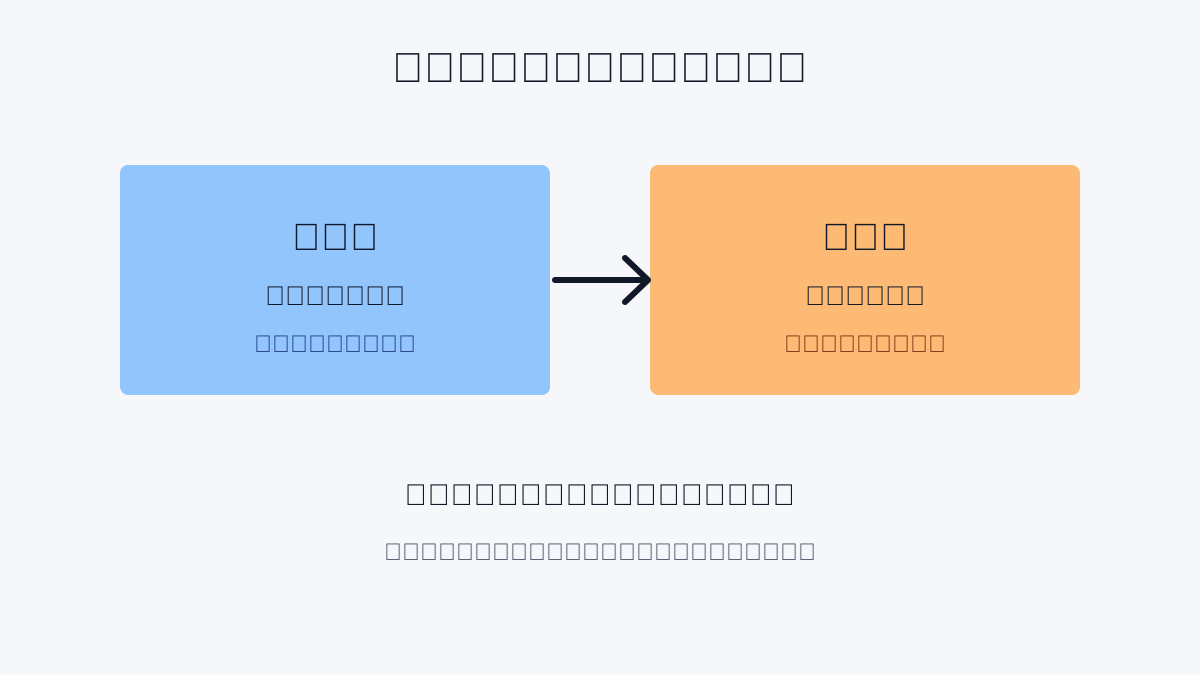
Illustration: Repayment order of subordinated loans
summary
A subordinated loan is a loan that has a lower repayment priority than regular borrowings.
The points to keep in mind are as follows.
*There is a subordination clause, so the repayment priority is lower than general debt.
- Interest rates tend to be high because the lender's collection risk is high.
- Above equity but below ordinary debt
- A subordinated equity loan is a type of subordinated loan.
- Company analysis looks at purpose of use, repayment period, interest rate, and equity evaluation
Subordinated loans are funds that fall between debt and equity.
While it is a convenient means of raising funds, it is not a low-risk loan. For companies, it is money that buys time, and for lenders, it is money that allows them to accept a lower ranking for collection in exchange for higher interest rates.
What investors should look at is not just whether there are subordinated loans. Why was that money needed? Will that money help the business recover? Will I be able to generate cash by the repayment deadline? If you look at it that far, your understanding of corporate finance will become much deeper.
source
- Financial Services Agency "Access FSA No. 4"
- Japan Finance Corporation “Challenge Support Capital Strengthening Special Loan (Capital Loan)”
- [Small and Medium Enterprise Agency "2021 White Paper on Small and Medium Enterprises, Section 2: Impact of the new coronavirus infection and trends in financing"] (https://www.chusho.meti.go.jp/pamflet/hakusyo/2021/chusho/b2_1_2.html)
- Related article: What is a subordinated equity loan? Why is it considered capital even though it is a loan
- Related article: What is a subordinated bond? Repayment order and risks behind high yield
- Related article: What is interest payment deferral? Interest payment deferral risk to be aware of with subordinated bonds