
This article is general investment educational content and does not recommend margin trading or buying or selling individual stocks. Margin trading involves risks such as price fluctuations, margin calls, interest rates, stock lending fees, reverse daily trading, and forced settlement. Before trading, please check the securities company's pre-contract documents, trading rules, fees, and risk explanations.
What is daily walking and reverse daily walking?
In margin trading, investors borrow funds and stocks from securities companies to buy and sell them.
Under such circumstances, margin selling in systematic margin trading increases and securities finance companies run out of stock certificates, which incurs costs to procure the missing stocks from outside. This cost is the item rental fee, and is generally referred to as the Gyakuhipo.
Japan Exchange Group explains that for issues with a lending fee, selling customers who engage in systematic margin trading can pay the amount, and buying customers can receive it.
Roughly speaking, reverse day walking indicates the following conditions.
| Status | View of supply and demand |
|---|---|
| High reversal rate | There is a lot of short selling, and there may be a stock shortage |
| Low negative daily trend | Weak sense of tightness due to stock shortage |
| No reverse trend | Shortage of stock in system credit has not surfaced |
What I would like to note here is that a reverse daily walk is not a ``guarantee of a rise in stock prices.'' It is an expense that simply represents the supply and demand of credit transactions, and does not directly indicate business performance or corporate value.
Meaning of “No buying for weak days”
``Don't buy on a weak day's trend'' is the idea that stocks with a low or almost no negative daily trend are considered to have little basis for buying in terms of short-term supply and demand.
The background lies in the following sense of supply and demand as seen by old market traders.
| Reverse daily trend | How to read the old market |
|---|---|
| Strong negative trend | The burden of selling is heavy and buybacks are likely to occur |
| Weak reverse trend | There are few stock shortages, and expectations for a recovery are weak |
| No reversal | Hard to see the tightness of supply and demand |
As short selling accumulates and the reverse daily price rises, sellers suffer from holding costs. As stock prices rise, losses also increase, making it easier to buy back stocks. These buybacks could push the stock price even higher, and short-term investors view this as a "trigger move."
On the other hand, such repurchase pressure is hard to see for stocks with weak inverse daily trends. That's why it's said, ``Don't buy anything from Ayumu Yakuhi.''
However, this is a matter of short-term supply and demand. Even good companies can sometimes fail to make progress. Just because a stock has a weak reverse trend doesn't mean it's not attractive as a stock.
Relationship with “No Selling on Gyokuhibu”
On the other side of the equation, there is also the saying, ``There is no selling on strong days.''
The meaning is that it is better not to sell stocks with a high reversal daily rate, as they are more expensive to sell and are more likely to be repurchased.
However, this is not a panacea either.
| How to view | Points to note |
|---|---|
| High reversal rate | There are expectations for the stock price to rise, but there is no guarantee that the stock price will rise |
| The reverse daily rate of return suddenly declines | Stock shortages may be resolved and short-term supply and demand factors may weaken |
| There is no negative trend | This does not mean that performance is poor |
Stocks with a high inversion rate often have already attracted speculative funds. Price movements are wild and sharp declines are likely to occur. It is dangerous to look at a high trend and think that it will go up if you buy.
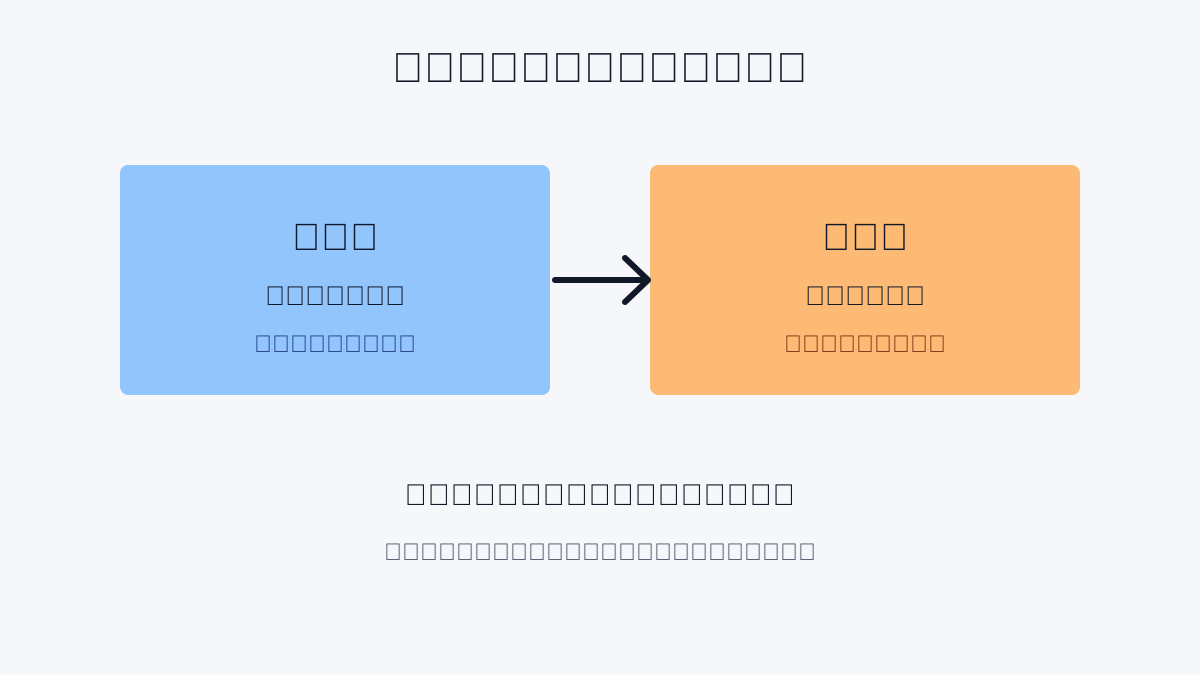
Illustration: Difference between weak and strong days
Points to note for beginners
Looking at Gyakuhi Ayumu, it seems like he can make decisions like a professional. However, if you are a beginner, it is better not to make buying and selling decisions based solely on the opposite direction.
Please note the following points.
| Points to note | Contents |
|---|---|
| Separate from corporate value | Reverse daily movement is short-term supply and demand and does not directly indicate business performance or finances |
| Change is fast | Today's backward trend does not necessarily continue tomorrow |
| Preferred stocks are prone to sudden changes | Supply and demand tends to be biased due to cross trading and short selling around the final date of entitlement |
| Low priority for long-term investments | There is almost no need to look at NISA savings every day |
| Margin trading has high risks | There are margin calls, compulsory settlements, interest rates, stock lending fees, and adverse day rate gains |
Particularly in cross-trades involving shareholder benefits, the use of systematic margin selling can sometimes result in unexpected negative gains. If the negative impact becomes greater than the value of the preferential treatment, the apparent benefit will easily disappear.
If you want to watch Gyakuhiho, what should you watch it with?
If you want to use the reverse daily rate for supply and demand analysis, it is better to combine it with other indicators rather than looking at it alone.
The following items should be checked.
| Items to check | Reasons to watch |
|---|---|
| Backlog of margin purchases | Easily subject to future selling pressure |
| Credit sales balance | View buyback room |
| Loan-to-debt ratio | Look at the bias between buying and selling |
| Trading volume | Is there liquidity to absorb changes in supply and demand |
| Stock price position | High price range or low price range |
| Materials | Financial statements, preferential treatment, capital increase, TOB, presence of regulations, etc. |
Even if the reverse trend is high, if the stock price has already skyrocketed and all stocks are exhausted, there is a high risk of buying from there. On the other hand, even if the reversal trend is weak, if business performance improves and valuation is appropriate, then there will be a different view in the medium to long term.
In other words, the reverse daily movement is a "thermometer of supply and demand," not an answer to buying and selling.
Common Misconceptions
The points that beginners often make mistakes are summarized as follows.
| Misconception | Actual |
|---|---|
| If the reverse daily step is high, it will definitely go up | There is no guarantee that it will go up |
| Stocks that don't move backwards are no good | Performance and corporate value are separate issues |
| If it's a weak move, just sell | It's not necessarily a selling point |
| Important for long-term investment | Mainly indicators for short-term supply and demand |
| Reverse daily walking is a fixed cost | It changes every day, and there are days when it does not occur |
Market sayings are useful, but the shorter they are, the easier it is to misunderstand them.
``Do not buy on a weak day's trend'' is not a rule to automatically avoid stocks with a weak day's trend. At a time when the strength of short-term supply and demand is difficult to predict, it is realistic to read this as a warning message to avoid rushing into buying.
summary
``Don't buy when the daily trend is weak'' is the idea that it is better not to buy stocks with a low negative daily trend because it is difficult to see their strength in terms of supply and demand.
The points to keep in mind are as follows.
- Gyakuhipo is a stock rental fee that occurs when there is a stock shortage in systematic margin trading.
- A strong inverse trend may indicate a burden on the seller or expectations for an upward move.
- A weak inverse trend indicates that the sense of tight stock shortage is weak.
- However, backward progress is not the company's value or performance itself.
- For long-term investment, performance, financials, valuation, and growth potential are more important
For beginners, it is sufficient to understand the reverse daily movement as reference data that shows the supply and demand of market participants, rather than using it as a basis for making buying and selling decisions.
Rather than memorizing proverbs, it is better to distinguish between what you are looking at and what you are not seeing. When looking at reverse daily progress, the most important thing is to organize it.