
Funding Update: 9th Domestic Hybrid Bond Set At 5.12% Per Year
Start with the bond market. That is where the story becomes less glamorous, and more useful.
On June 5, 2026, SoftBank Group announced the final terms of its domestic hybrid bond. This is a subordinated bond mainly targeted at individual investors, and it is an important data point for understanding both the company's ability to fund AI investments and the cost of that funding.
| Item | Details |
|---|---|
| Bond name | 9th unsecured subordinated bond with interest deferral clause and early redemption clause |
| Total issue amount | 260 billion yen |
| Coupon | 5.12% per year for the first five years |
| Term | 35 years |
| Maturity date | June 19, 2061 |
| Early redemption | Callable at the company's discretion on each interest payment date from June 19, 2031 onward |
| Rating | BBB+ by JCR |
| Use of proceeds | Part of the refinancing funds for U.S. dollar-denominated hybrid bonds with first optional redemption dates in July 2027 |
| Equity credit | Rating agencies recognize 50% equity credit for the amount raised |
A 5.12% coupon stands out for a yen-denominated bond. For individual investors, it looks like yield. For SoftBank Group, it is also the market's invoice for taking credit and duration risk.
This is not a plain corporate bond. It is a hybrid bond with interest deferral, subordination, a 35-year term, and a switch to floating rates after the first five years. For the issuer, it is easier to receive equity credit. For investors, it comes with lower repayment priority and liquidity risk compared with ordinary corporate bonds.
This is why the 5.12% number matters for the stock as well. SoftBank Group's AI investments cannot move forward on ambition alone. They need capital, refinancing capacity, ratings support, and a market willing to treat leverage as strategic rather than dangerous.
When the market likes Son's AI story, the NAV discount narrows. When it worries about funding costs, the discount widens again. The hybrid bond sits right in the middle of that debate.
SoftBank Group's AI Vertical Integration Model: Separate Facts From Uncertainty
The market is beginning to value SoftBank Group not merely as an investment company, but as a possible vertically integrated AI model.
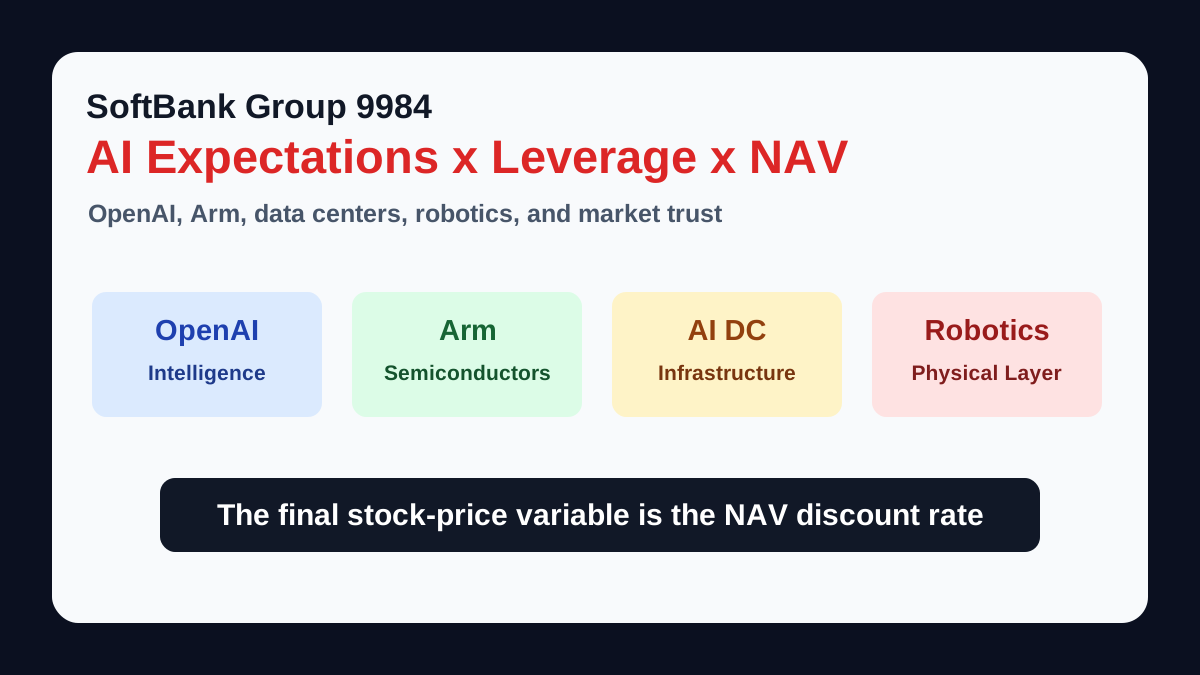
OpenAI is the intelligence layer. Arm is the semiconductor layer. AI data centers are the infrastructure layer. Robotics is the physical implementation layer.
That sentence is neat. Too neat, perhaps.
In practice, the market does not value these assets equally. OpenAI is the heat. Arm is the listed anchor. The data center plan is the capital-intensive proof point. Robotics is the long-dated option. The story is powerful, but investors still have to separate what is already in NAV from what is still expectation.
OpenAI: $64.6 Billion In Cumulative Investment And An Expected Stake Of About 13%
On February 27, 2026, SoftBank Group announced follow-on investments in OpenAI. After completion, SoftBank Group's cumulative investment is expected to reach $64.6 billion, with an expected ownership stake of about 13%.
This is one of the largest variables in SoftBank Group's NAV. It is also the part of the story where market psychology can move faster than reported earnings.
The key question is not simply "How much is OpenAI worth?" It is more uncomfortable than that: is the market valuing OpenAI's actual monetization, or is it valuing the possibility of a high-profile listing event?
An OpenAI IPO is not yet a confirmed event. The market often talks about a possible listing, but there has been no confirmed filing or set of terms. Investors should treat an "OpenAI IPO" not as a realized exit, but as a potential catalyst.
The accounting treatment is also important. SoftBank Group's OpenAI shares are treated as financial assets measured at fair value through profit or loss in the consolidated financial statements. Changes in fair value are reflected in investment gains and losses. If the valuation rises, profit expands. The reverse is also possible.
This is the part of 9984 that can feel strange to investors who usually read operating companies. A valuation change can move profit before cash is realized. That can work beautifully in a bull market. It can also turn against shareholders quickly when private-market AI valuations are questioned.
French AI Data Center: Initial EUR45 Billion, Up To EUR75 Billion
On May 31, 2026, SoftBank Group announced a plan to develop and operate a 5GW AI data center in France. The maximum investment amount is EUR75 billion. In the first phase, the company plans an initial investment of EUR45 billion to build a 3.1GW AI data center in the Hauts-de-France region.
The way these numbers are presented matters. A large AI data center plan is not a spreadsheet asset from day one.
Headlines tend to highlight "up to EUR75 billion." In practical terms, however, the core portion that is easier to evaluate today is Phase 1: EUR45 billion and 3.1GW. The EUR75 billion figure is better viewed as an upper limit that includes future expansion.
If operating successfully, an AI data center can become a powerful infrastructure asset. But before it can be counted as stable value in NAV, investors need evidence that the project is moving from press release to working capacity.
Construction progress matters. Power supply matters. Grid connection, cooling, GPU and CPU procurement, customer acquisition, utilization rates, and pricing levels all matter. The market can buy the dream in 2026. By 2027, it may start asking whether the data center can earn enough return on capital to justify the scale.
ABB Robotics: Acquisition Agreement Signed, Completion Still Subject To Approvals
On October 8, 2025, SoftBank Group signed an agreement to acquire ABB Ltd's robotics business for $5.375 billion. The acquisition has been approved by the board, but remains subject to regulatory approvals including in the EU, China, and the United States. Completion is expected in mid- to late 2026.
This acquisition is a move to expand AI from "inside the screen" to "work in the physical world." With only Arm and OpenAI, the AI vertical integration story still leans toward the digital side. Adding robotics extends the story to automated factories, logistics, industrial robots, and potentially even the build-out of AI infrastructure itself.
That said, expectations can easily run ahead of reality here as well. Robotics requires customization at each deployment site, maintenance, and integration with existing equipment. Even if AI inference performance improves, that does not immediately guarantee a highly profitable business.
For investors, ABB Robotics should probably be treated as strategic optionality first, earnings contribution second. The market likes the connection. It will still need evidence that the acquired business can be integrated without becoming another capital-heavy promise.
Arm AGI CPU: Not About Defeating NVIDIA, But About Raising AI Server CPU Economics
In March 2026, Arm announced Arm AGI CPU. This is Arm's first in-house designed data center CPU and an important step for AI infrastructure.
Expectations need to be framed carefully. The useful question is not whether Arm can "beat NVIDIA" in the broad AI race. That framing is too crude.
The center of the AI semiconductor market is still NVIDIA's GPU and CUDA ecosystem. It is not realistic to assume that Arm AGI CPU will quickly displace NVIDIA.
For SoftBank Group's valuation, the real question is whether Arm can raise the economics of AI server CPUs and surrounding IP. Royalty unit economics, server adoption, custom silicon demand from cloud operators, power efficiency, and AI inference workloads are the points to watch.
Arm does not need to replace NVIDIA for the SoftBank Group thesis to work. It needs to prove that the AI server cycle can lift Arm's revenue mix and support the valuation premium already embedded in the stock.
Conversely, if adoption is limited and Arm is pushed back by NVIDIA and the x86 ecosystem, the Arm premium can fade.
The NAV Discount Rate Determines SoftBank Group's Share Price
This is the core issue. It is also where many clean AI stock narratives break down.
SoftBank Group is often valued more on NAV than on single-year earnings. Put simply, investors estimate the value of its holdings, subtract adjusted net interest-bearing debt, and then decide how much of a discount to apply when reflecting that value in the share price.
A simplified framework looks like this.
| Factor | Meaning |
|---|---|
| Value of holdings | Arm, OpenAI, listed shares, fund interests, and other investment assets |
| Adjusted net interest-bearing debt | Holding-company net debt, hybrid bonds, foreign-currency debt, and related items |
| NAV | Value of holdings minus adjusted net interest-bearing debt |
| NAV discount rate | The percentage discount the market applies to NAV when valuing the market capitalization |
For an investment holding company like SoftBank Group, the NAV discount rate is also a measure of how much the market trusts Masayoshi Son's portfolio management.
There is a "Son premium" and a "Son discount." They can appear in the same stock, sometimes within the same year.
In the past, SoftBank Group has been heavily discounted because of China internet regulation, tech stock selloffs, Vision Fund losses, and leverage concerns. When the market becomes anxious, the share price may not follow even if the value of holdings is high.
As of June 2026, expectations for the AI vertical integration story are strong. Arm, OpenAI, data centers, and robotics appear connected by a single narrative. Foreign investors and theme-driven money can move quickly when that story is working. Short-term traders can also chase the market-cap ranking headline.
But this is still 9984. The market has a habit of trusting Son aggressively, then questioning the balance sheet just as aggressively.
This article's view is that the NAV discount rate has narrowed considerably. That narrowing is the stock's biggest tailwind. It is also the part most vulnerable to a change in mood.
From here, the share price will not be determined by OpenAI's valuation alone. Even if asset values rise, the upside can be offset if funding costs or leverage concerns cause the discount rate to widen again.
2026-2027 Stock Price Scenarios
The table below combines OpenAI, Arm, funding costs, and the NAV discount rate. These are not forecasts. They are rough ranges for thinking about how the market might price confidence, disappointment, and leverage.
| Scenario | Market mood | OpenAI and Arm confirmation | Assumed NAV discount rate | Assumed 2026-2027 share price |
|---|---|---|---|---|
| Market gets euphoric | The market treats SoftBank Group as the central Japan-listed AI platform | OpenAI listing preparation or valuation events progress, while Arm AGI CPU gains credible AI server adoption | 15-20% | 13,000-18,000 yen |
| Reality-check case | The AI story remains alive, but investors wait for data center execution and monetization evidence | OpenAI's IPO is delayed to 2027 or later, while Arm grows steadily in mobile, server, and AI-adjacent areas | 25-30% | 9,000-12,000 yen |
| AI bubble reset | Funding cost, AI monetization, and leverage concerns return at the same time | OpenAI's valuation is questioned, and Arm's AI server upside looks less certain | 35-45% | 7,000-9,000 yen |
In the euphoric scenario, an OpenAI valuation event and confirmation of real demand for Arm progress at the same time. The market starts treating the AI vertical integration model as investable, not just visionary. If the discount rate narrows to 15-20%, the share price has significant upside room.
In the reality-check case, the AI story remains intact, but confirmation takes time. OpenAI's IPO is delayed, and cash flow from data center investment is still further out. The market keeps expectations alive while applying a discount rate of around 25-30%.
In the AI bubble reset case, concerns about AI monetization, rising interest rates, slower OpenAI progress, and fading Arm expectations overlap. Even if asset value remains, the share price becomes heavy if the discount rate widens back above 35%.
Four Variables Investors Should Watch
It is dangerous to view SoftBank Group simply as an AI-related stock. That label is too easy, and 9984 has never been an easy stock.
The variables to watch should be separated into four groups.
| Variable | Points to Check |
|---|---|
| OpenAI valuation | IPO, follow-on funding, monetization, ownership dilution |
| Arm growth | AGI CPU adoption, royalty unit economics, server revenue, coexistence with NVIDIA |
| Funding cost | Hybrid bond coupon, foreign-currency debt, interest rates, ratings, LTV |
| NAV discount rate | How much the market trusts SoftBank Group's leverage and investment management |
The fourth variable is the hardest to read, because it is market psychology itself. It is also the variable that can move before the numbers do.
The numbers are good. The story is strong. But SoftBank Group is always a stock where the market asks, "How much should we trust it?"
The 5.12% coupon on the 9th hybrid bond supports the company's offensive AI investments. At the same time, it also reflects the level of risk premium demanded by the market. If this is ignored, investors can be pulled along by the AI story alone.
Final Conclusion: SoftBank Group Is An AI Revolution Bet And A Capital-Market Confidence Vote
By combining Arm, OpenAI, AI data centers, and robotics, SoftBank Group is building one of the world's rare AI vertical integration models.
If this concept succeeds, SoftBank Group may be re-rated not merely as an investment company, but as a capital allocation platform for AI infrastructure. Its market capitalization surpassing Toyota on June 1, 2026 was a symbolic event.
But it was not the finish line. It was closer to the starting line.
The AI story is powerful. OpenAI and Arm are both attractive. The French data center plan gives the story infrastructure scale. ABB Robotics gives it a physical-world angle.
Still, the market is not giving SoftBank Group a blank check.
The 5.12% domestic hybrid bond coupon says a lot. Individual investors may see income. The equity market should also see capital cost. AI investment expectations are high, but the market is asking another question at the same time: when does this turn into cash flow?
That is why OpenAI's valuation alone is not enough. Even if holding values rise, the share price can stall if investors become worried about leverage, refinancing cost, or execution risk. Conversely, if Arm growth, OpenAI valuation, data center progress, stable funding, and balance-sheet trust line up at the same time, there is still room for the NAV discount to narrow further.
The second half of 2026 may remain a market driven by expectations for OpenAI and AI infrastructure. In 2027, the market may become less patient. It will ask whether OpenAI can monetize at scale, whether Arm AGI CPU can gain real adoption, whether the French data center can move toward operation, and whether Son's AI strategy can produce returns above the cost of capital.
In other words, SoftBank Group's share price is determined not only by OpenAI's valuation, but by:
OpenAI valuation x Arm growth x financial leverage x market trust
That is why calling 9984 an AI stock is only half right.
SoftBank Group has always been a stock where investors buy a dream, then periodically test whether they still believe the person selling it. The dream is now AI. The test is capital discipline. Few Japanese stocks have a wider outcome range.
Sources
- This site: "SoftBank Group: Revenue of 7,798.650 Billion Yen (+7.7%) | FY2026/3 Full-Year Results"
- SoftBank Group: "Earnings Results for FY2025"
- SoftBank Group: "Determination of Terms of Domestic Hybrid Bonds (Interest Deferral Clause)"
- SoftBank Group: "Follow-on Investments in OpenAI"
- SoftBank Group: "SoftBank Group to Build 5GW AI Data Center in France"
- SoftBank Group: "SoftBank Group and Sesterce to Develop 1GW AI Data Center in Bosquel, France"
- SoftBank Group: "Acquisition of ABB Ltd's Robotics Business"
- Arm: "Introducing Arm AGI CPU: The Silicon Foundation for Cloud in the Agentic AI Era"
- nippon.com / Jiji Press: "SoftBank Group Becomes Japan's Largest Company By Market Capitalization, Surpassing Toyota"