
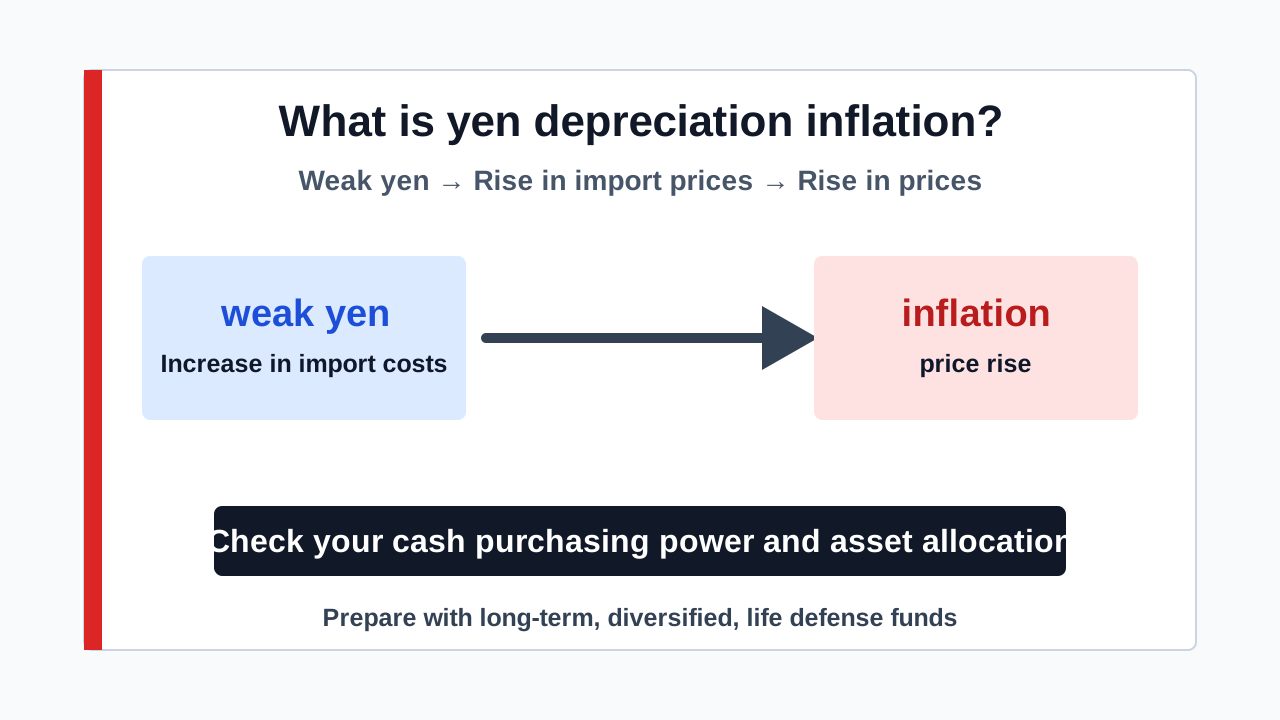
What is inflation?
Inflation refers to a situation in which the prices of goods and services continue to rise throughout the economy.
This is not simply a matter of ``the prices of certain products have increased.'' Rising prices for a wide range of items, including milk, eating out, electricity, rent, transportation costs, and service charges, will increase the overall burden on household budgets.
The image is as follows.
| Products/Services | Previous price | Current price |
|---|---|---|
| Milk | 180 yen | 230 yen |
| Hamburger | 100 yen | 190 yen |
| Gasoline | 120 yen/L | 170 yen/L |
| Electricity bill | 8,000 yen/month | 10,000 yen/month |
When the price of the same product increases, the quantity that can be purchased with the same amount of money decreases.
This is the most important point about inflation.
prices go up
  ↓
Less quantity can be bought with the same money
  ↓
the real value of money decreases
The 10,000 yen bill in my wallet is still a 10,000 yen bill. However, if we can buy fewer things than before, the ``power of money'' in our lives will weaken.
How is inflation measured?
The representative index used to measure prices in Japan is the Consumer Price Index (CPI) by the Statistics Bureau of the Ministry of Internal Affairs and Communications.
CPI is an index that shows how much the prices of goods and services purchased by households have changed. In the news, it often appears in the form of ``What percentage increase in the consumer price index compared to the previous year?''
The Bank of Japan also considers price stability an important objective of monetary policy. In January 2013, the Bank of Japan set a 2% year-on-year increase in consumer prices as its ``price stability target.''
However, when you look at the 2% number, it is a bit naive to think, ``Everything should go up 2% every year.''
If prices rise too quickly, household finances will suffer. On the other hand, if prices continue to rise and wages do not increase at all, it will be difficult for companies to raise prices or make investments. What central banks are looking at is the stability of prices, including the economy, wages, demand, and corporate profits.
why does inflation occur
There is no single cause of inflation. For beginners, it is easier to understand if you divide it into three parts.
| Cause | Content | Familiar example |
|---|---|---|
| Demand inflation | Prices rise as more people want to buy | Travel demand returns and hotel prices rise |
| Cost-push inflation | Increases in raw material and labor costs are passed on to prices | Increases in wheat, crude oil, electricity costs, and labor costs |
| Currency/financial factors | Affected by the amount of money and interest rate environment | Monetary easing, low interest rates, and currency depreciation |
demand increases
When the economy improves, consumption and business investment increase.
When a popular product or service receives more orders, it becomes easier for companies to raise prices. Wages will rise, and consumption will further increase. If this flow goes smoothly, it will lead to inflation accompanied by economic growth.
This can be seen as relatively healthy inflation.
Raw material prices rise
If prices of crude oil, natural gas, wheat, edible oil, metals, logistics costs, labor costs, etc. rise, companies' costs will increase.
If a company cannot absorb the costs, it passes them on to the selling price. From a household budget, food, electricity, gasoline, and eating out costs are likely to rise.
This type of inflation can easily put pressure on people's lives if their wages can't keep up.
Affected by amount of money and interest rate
When central banks implement monetary easing and interest rates remain low, it becomes easier for businesses and households to borrow money. If investment and consumption increase, prices may tend to rise.
However, monetary policy alone does not determine prices. Demographics, import prices, exchange rates, wages, and the competitive environment for companies also have an impact.
Impact of inflation on household finances
The first thing you'll notice about inflation is your monthly expenses.
| Expenditure items | Changes that are likely to occur |
|---|---|
| Food costs | Price increase, decrease in content |
| Utility costs | Rise in electricity and gas costs |
| Transportation costs | Increase in gasoline and fares |
| Eating out costs | Increase in menu prices |
| Education/Services | Reflection of rising labor costs |
If the salary stays the same, there will be less leeway in life.
For example, if a person with a take-home pay of 300,000 yen and living expenses of 250,000 yen becomes 270,000 yen due to a rise in prices, their monthly surplus will drop from 50,000 yen to 30,000 yen. The amount you can invest and the amount you can save will change.
What we should look at here is real wages.
Real wage = nominal wage - impact of price increaseEven if your salary goes up by 3%, if prices go up by 5%, your daily life will be difficult. On the other hand, if wages rise by 4% and prices rise by 2%, real purchasing power will likely improve.
Is cash vulnerable to inflation?
Cash and savings are very important in the short term.
You need money that can be used immediately for sudden expenses such as illness, unemployment, moving, broken home appliances, and caring for a relative. Therefore, it is dangerous to reduce cash to zero as a measure against inflation.
However, in the long term, cash carries the risk of decreasing purchasing power.
Assuming that inflation continues at 3% per year, the real value of 1 million yen will decrease as follows.
| Number of years | Estimated real value |
|---|---|
| Current | 1 million yen |
| 5 years later | Approximately 860,000 yen |
| 10 years later | Approximately 740,000 yen |
| 20 years later | Approximately 550,000 yen |
The calculations are simplified.
1 million yen ÷ (1.03 ^ number of years)Even if your account balance remains at 1 million yen, if prices rise, the amount you can buy will decrease. This is why it is said that cash is weak against inflation.
inflation and stocks
Stocks are sometimes considered to be assets that can easily respond to inflation over the long term.
The reason is that companies can sometimes increase sales by raising prices. Nominal sales are likely to increase if product prices do not rise and sales volumes do not fall significantly.
However, not all stocks are resistant to inflation.
| Company types | Views during inflation |
|---|---|
| Companies with the ability to pass on prices | Easily reflect cost increases in sales prices |
| A company with a strong brand | Customers are unlikely to leave even if prices are raised |
| Essential goods/infrastructure companies | Demand is relatively stable |
| Companies with low profit margins | Profits are likely to be squeezed due to rising labor and raw material costs |
| Companies with large amounts of debt | Interest payments are likely to increase due to rising interest rates |
When inflation occurs, central banks are more likely to raise interest rates. Rising interest rates can also create headwinds for the stock market.
In other words, inflation is not always positive for stocks.
Investors need to look at whether a company can raise prices, whether it can withstand cost increases, and whether it is susceptible to rising interest rates.
inflation and real estate
Real estate is sometimes viewed as an asset that is relatively resistant to inflation.
The reason is that land and building prices, rents, and construction costs tend to be linked to commodity prices.
However, it is also dangerous to be overconfident in real estate.
If interest rates rise, the burden of home loans and real estate loans will increase. REIT (real estate investment trust) prices can also fall when interest rates rise. Vacancies, repair costs, regional differences, and low liquidity are also risks.
If you look at real estate as a measure against inflation, you should consider rental income, borrowing interest, location, management fees, and taxes.
inflation and bonds
Fixed interest bonds can be vulnerable to inflation.
For example, let's say you own a bond that pays 1% interest per year. If prices rise by 3% a year, interest rates cannot keep up with the rise in prices.
Additionally, when interest rates rise to curb inflation, existing bond prices tend to fall.
However, bonds can also play a role in suppressing the price movements of overall assets. The characteristics differ depending on the type, such as short-term bonds, government bonds for individuals, and government bonds indexed to inflation.
Rather than just remembering that ``bonds are vulnerable to inflation,'' it is more practical to look at the term, interest rate, and sensitivity to interest rate increases separately.
Asset formation in an era of inflation
In an era of inflation, what you want to think about is not "what can I buy to win?"
The first step is to separate the roles of assets.
| Assets | Role | Notes |
|---|---|---|
| Cash/Deposits | Lifestyle defense funds, money to use soon | Purchasing power may decline in the long term |
| Stocks/Investment Trusts | Long-term growth, inflation countermeasure candidates | Loss of principal, price fluctuations, exchange rate risks |
| ETF | Diversified investment method | Contents and fees vary depending on product |
| Real estate/REIT | Candidates for diversification into rent/real assets | Interest rates, vacancies, price fluctuations, liquidity risks |
| Bonds | Suppression of price movements, interest income | Vulnerable to inflation and interest rate rises |
The Financial Services Agency introduces the concepts of long-term, savings, and diversified investments as the basics of asset formation. However, stocks and investment trusts carry the risk of loss of principal.
Therefore, countering inflation is not a binary choice between cash and investment.
Protect the money you will be using in the near future in cash. Money that will not be used for a long time can be put into stocks, investment trusts, bonds, real estate, etc. to protect against rising prices. This division is realistic.
Common misconceptions for beginners
Cash is the safest
I need cash.
However, there is a difference between not reducing the face value and protecting purchasing power. If the inflation rate exceeds the interest rate on deposits, your savings will actually decrease.
inflation is bad
Inflation has both good and bad sides.
Inflation, where demand increases, wages rise, and companies increase investment, tends to lead to economic growth. The problem is when the cost of living increases without wages being able to keep up.
Stocks and real estate can always be protected.
Stocks and real estate are candidates for inflation protection, but they are not principal guarantees.
Stock prices fall depending on the economy, interest rates, corporate performance, exchange rates, and supply and demand. Real estate is also affected by rising interest rates, vacancies, repair costs, and declining local populations.
Just look at the inflation rate
Inflation alone is not enough.
Unless we look at wages, interest rates, exchange rates, corporate profits, household expenditures, taxes, and social insurance premiums, we cannot understand the impact on people's lives.
Checklist for investment beginners
If you're thinking about building assets in the wake of inflation, you'll want to check the following in order.
- How much are your monthly living expenses increasing?
- Do you have cash for your daily life defense funds?
- Are you investing money that you plan to use within 1 to 3 years?
- Are you too biased towards deposits?
- Have you checked the contents, fees, and risks of investment trusts and ETFs?
- If you own stocks, do you look at the company's ability to pass on price?
- If you have foreign currency assets, do you anticipate valuation losses if the yen appreciates?
- Are you suddenly buying or selling large amounts just because of inflation news?
Inflation tends to create impatience.
The more you feel like you're going to lose money if you don't buy something right away, the better to reconsider your household finances and asset allocation.
summary
Inflation is a phenomenon in which the prices of goods and services continually rise and the real value of money falls.
The points to keep in mind are as follows.
- Inflation reduces the amount that can be bought with the same amount of money
- Cash is necessary as a short-term survival fund, but there is a risk of a decline in purchasing power in the long term.
- Stocks and real estate are candidates for inflation protection, but they are not always advantageous.
- Bonds are susceptible to rising interest rates and fixed interest rates
- Investing involves risks of loss of principal, price fluctuations, exchange rates, fees, and taxes.
- For beginners, it is important to divide money based on long-term, savings, and diversification based on when to use it.
Understanding inflation will change your perspective on wealth building.
The important thing is not to deny cash. Separate the money you want to protect in cash and the money you want to grow over the long term. In times when prices rise, both household budget management and asset allocation become more effective.
reference
- Statistics Bureau, Ministry of Internal Affairs and Communications, “Consumer Price Index (CPI) Nationwide (Latest Monthly Results)”, confirmed on June 18, 2026. https://www.stat.go.jp/data/cpi/sokuhou/tsuki/index-z.html
- Bank of Japan "2% 'Price Stability Target'" confirmed on June 18, 2026. https://www.boj.or.jp/mopo/outline/target.htm
- Financial Services Agency "Basics of Asset Formation", confirmed June 18, 2026. https://www.fsa.go.jp/policy/nisa2/invest/
- World Bank DataBank Glossary “Inflation, consumer prices”, confirmed June 18, 2026. https://databank.worldbank.org/metadataglossary/world-development-indicators/series/FP.CPI.TOTL.ZG